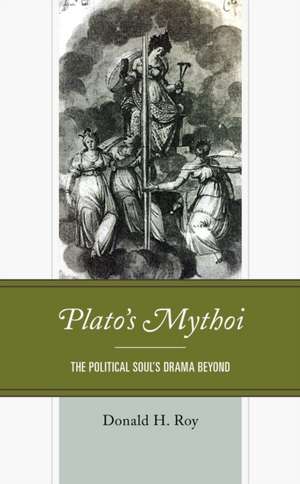
Plato's Mythoi: The Political Soul's Drama Beyond: Political Theory for Today
Autor Donald H. Royen Limba Engleză Hardback – 15 oct 2018
Din seria Political Theory for Today
- 36%
 Preț: 735.96 lei
 - 33%
 Preț: 641.30 lei
 - 30%
 Preț: 535.76 lei
 - 32%
 Preț: 551.24 lei
 - 26%
 Preț: 259.97 lei
 - 27%
 Preț: 255.81 lei
 - 32%
 Preț: 552.03 lei
 - 8%
 Preț: 255.62 lei
 - 28%
 Preț: 223.03 lei
 - 26%
 Preț: 258.39 lei
 - 28%
 Preț: 220.25 lei
 - 33%
 Preț: 582.74 lei
 - 25%
 Preț: 268.74 lei
 -
 Preț: 266.10 lei
 - 32%
 Preț: 490.66 lei
 - 26%
 Preț: 204.14 lei
 - 32%
 Preț: 533.09 lei
 - 33%
 Preț: 518.90 lei
 - 32%
 Preț: 489.39 lei
 - 36%
 Preț: 526.84 lei
 - 33%
 Preț: 610.98 lei
 - 28%
 Preț: 220.96 lei
 - 34%
 Preț: 524.45 lei
 - 24%
 Preț: 219.46 lei
 - 28%
 Preț: 219.54 lei
 - 32%
 Preț: 675.79 lei
 - 32%
 Preț: 584.08 lei
 - nou
 Preț: 552.08 lei
Preț: 701.25 lei
Preț vechi: 1057.21 lei
-34%
Puncte Express: 1052
Carte tipărită la comandă
Livrare economică 05-19 decembrie
Livrare prin curier în România Termenul estimat este afișat lângă disponibilitate.
Transport gratuit pentru acest produs Plată online sau ramburs, în funcție de opțiunile comenzii.
Retur gratuit în 14 zile Comandă securizată și suport în română.
Specificații
ISBN-13: 9781498571579
ISBN-10: 1498571573
Pagini: 346
Ilustrații: 1 Graph
Dimensiuni: 159 x 231 x 32 mm
Greutate: 0.68 kg
Editura: Bloomsbury Publishing
Colecția Lexington Books
Seria Political Theory for Today
Locul publicării:New York, United States
ISBN-10: 1498571573
Pagini: 346
Ilustrații: 1 Graph
Dimensiuni: 159 x 231 x 32 mm
Greutate: 0.68 kg
Editura: Bloomsbury Publishing
Colecția Lexington Books
Seria Political Theory for Today
Locul publicării:New York, United States
Cuprins
Chapter 1Metaphor and Analogy
Chapter 2Logos and Mythos in Plato's Dialogues
Chapter 3The Integral Relationship and Circular Sequence of Plato's Mythoi
Chapter 4The Mythoi Of Crisis, Conversion, And Descent/Ascent
Chapter 5The Mythoi Of Judgement And Return To Political/Cosmic Foundations
Chapter 6Epilogue: Mythoi In All Their Nobility/Glory: The Pathos Of Mythos
Chapter 2Logos and Mythos in Plato's Dialogues
Chapter 3The Integral Relationship and Circular Sequence of Plato's Mythoi
Chapter 4The Mythoi Of Crisis, Conversion, And Descent/Ascent
Chapter 5The Mythoi Of Judgement And Return To Political/Cosmic Foundations
Chapter 6Epilogue: Mythoi In All Their Nobility/Glory: The Pathos Of Mythos
Recenzii
Readers of Voegelin's works, and many others, will find much in Roy's text to investigate . . . Roy makes an unconventional, provocative, and valuable contribution to the study of Plato's dialogues . . . This text goes beyond previous charted paths and it opens unexplored terrain for studies of Plato's dialogues.
Don Roy's Plato's Mythoi illuminates the critical role that myth plays in Plato's dialogues. By showing how myth arouses the soul and assists reason in the pursuit of truth, this book establishes the primary importance of myth in Socratic philosophy. By delving into the components that constitute myth and then systemically showing how they appear in Plato's dialogues, Plato's Mythoi provides a comprehensive view of myth that readers will find both rewarding and enlightening. For those interested in Plato, Plato's Mythoi is a resource that readers will find immensely valuable and worth revisiting time again in the future.
Donald Roy pursues his argument with great philological sensitivity as well as analytical rigor. In light of the conventional discussion of the relationship of logos and mythos, a discursive "giving of accounts," or logos, is always superior to mere stories or myths. Roy raised the seldom-asked question: is logos a means to wisdom or an end? If the former, then myth is not necessarily subordinate to logos. In other words, Roy undertakes a recovery and restoration of the centrality of myth in Plato's work --or more specifically, of the philosophical myth. That is, myth is not just a means of communicating with the non-philosophical many who are incapable of following reasoned discussion or logos; it is also a way to communicate truths to which a reasoned discussion can only point. This is a salutary reminder of the often ignored depth and complexity of Plato's philosophy and of philosophy simply.
At the heart of Roy's timely and incisive study lies the "tale" of the recovery of the interdependent and mutually beneficial relationship of mythos to logos in Plato's oeuvre. Roy argues persuasively against the logos fettering interpretations of Plato's thought rendered by modern rationalistic and romantic readings of his work. Roy's conscientious analysis of Plato's Dialogs will delight neophytes and experts alike for he convincingly shows that for Plato, openness to participation in the fullness of Being is possible only where mythos and logos mutually form and inform one another in the philosophical search for wisdom.
Donald Roy probes deeply the full range of Plato's writings to show how he uses mythos and logos as complementary means to an end that transcends both. Resisting the modern tendency to reduce Plato's thinking from dialogue and drama to doctrine, he shows how Plato draws on imaginative tales to connect rational philosophical inquiry with the meditative depths of human experience in our "in-between" existence and to reveal how our actions and desires form who we are.
Donald Roy has written what may be the most in-depth analysis of the status and function of myth in Plato's philosophy that we currently have. Plato's Mythoi, is a comprehensive and erudite tour de force of Plato scholarship that persuasively argues for the inseparability of mythos and logos. With analytical rigor, it leaves no stone unturned in mining all the essential dialogues to illustrate the fruitful and irreducible tension between these two mediations of truth and wisdom. This work restores Plato's myths to their rightful place at the core of Platonic philosophizing. Aimed at the Plato scholar, this book will nonetheless appeal to all lovers of Plato as well as to all lovers of myth.
Don Roy's Plato's Mythoi illuminates the critical role that myth plays in Plato's dialogues. By showing how myth arouses the soul and assists reason in the pursuit of truth, this book establishes the primary importance of myth in Socratic philosophy. By delving into the components that constitute myth and then systemically showing how they appear in Plato's dialogues, Plato's Mythoi provides a comprehensive view of myth that readers will find both rewarding and enlightening. For those interested in Plato, Plato's Mythoi is a resource that readers will find immensely valuable and worth revisiting time again in the future.
Donald Roy pursues his argument with great philological sensitivity as well as analytical rigor. In light of the conventional discussion of the relationship of logos and mythos, a discursive "giving of accounts," or logos, is always superior to mere stories or myths. Roy raised the seldom-asked question: is logos a means to wisdom or an end? If the former, then myth is not necessarily subordinate to logos. In other words, Roy undertakes a recovery and restoration of the centrality of myth in Plato's work --or more specifically, of the philosophical myth. That is, myth is not just a means of communicating with the non-philosophical many who are incapable of following reasoned discussion or logos; it is also a way to communicate truths to which a reasoned discussion can only point. This is a salutary reminder of the often ignored depth and complexity of Plato's philosophy and of philosophy simply.
At the heart of Roy's timely and incisive study lies the "tale" of the recovery of the interdependent and mutually beneficial relationship of mythos to logos in Plato's oeuvre. Roy argues persuasively against the logos fettering interpretations of Plato's thought rendered by modern rationalistic and romantic readings of his work. Roy's conscientious analysis of Plato's Dialogs will delight neophytes and experts alike for he convincingly shows that for Plato, openness to participation in the fullness of Being is possible only where mythos and logos mutually form and inform one another in the philosophical search for wisdom.
Donald Roy probes deeply the full range of Plato's writings to show how he uses mythos and logos as complementary means to an end that transcends both. Resisting the modern tendency to reduce Plato's thinking from dialogue and drama to doctrine, he shows how Plato draws on imaginative tales to connect rational philosophical inquiry with the meditative depths of human experience in our "in-between" existence and to reveal how our actions and desires form who we are.
Donald Roy has written what may be the most in-depth analysis of the status and function of myth in Plato's philosophy that we currently have. Plato's Mythoi, is a comprehensive and erudite tour de force of Plato scholarship that persuasively argues for the inseparability of mythos and logos. With analytical rigor, it leaves no stone unturned in mining all the essential dialogues to illustrate the fruitful and irreducible tension between these two mediations of truth and wisdom. This work restores Plato's myths to their rightful place at the core of Platonic philosophizing. Aimed at the Plato scholar, this book will nonetheless appeal to all lovers of Plato as well as to all lovers of myth.