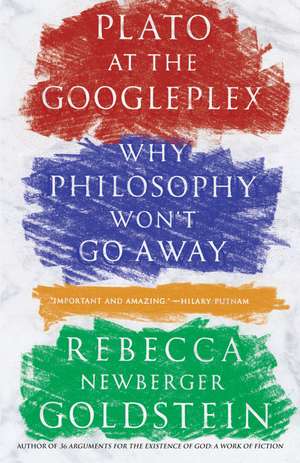
Plato at the Googleplex
Autor Rebecca Goldsteinen Limba Engleză Paperback – 6 ian 2015
În contextul actual, unde algoritmii și datele par să ofere răspunsuri la orice întrebare, Plato at the Googleplex reconfirmă necesitatea filozofiei ca disciplină fundamentală pentru etică și politică. Apreciem modul în care Rebecca Goldstein reușește să demonstreze că, deși Platon a trăit acum 2.400 de ani, întrebările sale despre natura cunoașterii și a moralității rămân vitale pentru orice student sau profesionist din domeniul științelor umaniste. Găsim în această lucrare o fuziune rară între rigoarea academică și imaginația literară, menită să testeze validitatea rațiunii în fața „înțelepciunii mulțimilor”. Cartea este o alternativă excelentă la Why Plato Matters Now de Angie Hobbs pentru cursurile de filozofie politică sau etică aplicată, având avantajul unei structuri narative inedite: Goldstein îl aduce pe Platon într-un turneu de conferințe în secolul XXI. Din punct de vedere structural, volumul alternează capitole de analiză istorică și culturală, precum „In the Shadow of the Acropolis”, cu dialoguri dramatizate în care Platon interacționează cu ingineri Google, experți în parenting sau neurobiologi. Această abordare continuă temele explorate de autoare în Betraying Spinoza sau 36 Arguments for the Existence of God, unde raționalismul filozofic este pus în dialog cu tensiunile modernității și ale credinței. Progresia textului, susținută de anexe documentare valoroase, transformă lectura dintr-o simplă expunere teoretică într-o experiență intelectuală dinamică, demonstrând că progresul științific nu elimină, ci dimpotrivă, amplifică nevoia de claritate filozofică.
Preț: 108.98 lei
Carte disponibilă
Livrare economică 07-21 noiembrie
Specificații
ISBN-10: 0307456722
Pagini: 480
Dimensiuni: 134 x 206 x 29 mm
Greutate: 0.41 kg
Editura: Knopf Doubleday Publishing Group
V-ar putea interesa
-
 InequalityLarry S. Temkin-21%Preț: 394.55 lei499.99 lei
 -
 The God of the PhilosophersAnthony Kenny-29%Preț: 361.76 lei507.88 lei
 -
 The Evidential Force of Religious ExperienceCaroline Franks Davis-29%Preț: 403.56 lei564.96 lei
 -
 Theories of EthicsPhilippa Foot-19%Preț: 334.34 lei413.50 lei
 -
 Justice, Posterity, and the EnvironmentWilfred Beckerman-29%Preț: 390.56 lei546.49 lei
 -
 Owl of Minerva: A MemoirMary MidgleyPreț: 226.02 lei
 -
 Constructions of ReasonOnora O'Neill-11%Preț: 442.80 lei497.52 lei
 -
 The Sources of NormativityChristine M. KorsgaardPreț: 196.91 lei
 -
 Necessity, Volition, and LoveHarry G. FrankfurtPreț: 166.46 lei
 -
 Properties of LightRebecca GoldsteinPreț: 94.03 lei
 -
 Environmental Ethics - An AnthologyAndrew LightPreț: 343.17 lei
 -
 The Blackwell Guide to the Philosophy of Law and Legal TheoryMartin P. GoldingPreț: 325.92 lei
 -
 -NaN%Preț: 288.82 lei288.82 lei
 -
 The Ethics of MemoryAvishai MargalitPreț: 236.84 lei
 -
 On BullshitHarry G. FrankfurtPreț: 54.92 lei
 -
 Preț: 130.05 lei
 -
 Ethics - The FundamentalsJulia DriverPreț: 190.11 lei
 -
 Preț: 315.53 lei
De ce să citești această carte
Recomandăm această carte oricărui cititor interesat de intersecția dintre tehnologie și valorile umane. Plato at the Googleplex nu este doar o lecție de istorie a filozofiei, ci un instrument critic pentru a înțelege cum dezbaterile antice despre democrație și expertiză se aplică astăzi la fenomenul fake news și social media. Câștigați o perspectivă proaspătă asupra modului în care rațiunea poate naviga complexitatea lumii digitale.
Despre autor
Rebecca Goldstein este o distinsă filosoafă și romancieră americană, deținătoare a unui doctorat de la Princeton University. Cariera sa este marcată de o capacitate unică de a umaniza ideile abstracte, fiind recompensată cu premii prestigioase precum MacArthur Fellowship și National Humanities Medal. În lucrările sale, Goldstein susține constant ideea că filozofia înregistrează progrese similare științei, o viziune care transpare și în Plato at the Googleplex. Este cunoscută pentru explorarea „teoriei relevanței” (mattering theory), integrând concepte complexe de logică și filozofia științei în texte accesibile publicului larg.
Descriere scurtă
At the origin of Western philosophy stands Plato, who got about as much wrong as one would expect from a thinker who lived 2,400 years ago. But Plato s role in shaping philosophy was pivotal. On her way to considering the place of philosophy in our ongoing intellectual life, Goldstein tells a new story of its origin, re-envisioning the extraordinary culture that produced the man who produced philosophy.
But it is primarily the fate of philosophy that concerns her. Is the discipline no more than a way of biding our time until the scientists arrive on the scene? Have they already arrived? Does philosophy itself ever make progress? And if it does, why is so ancient a figure as Plato of any continuing relevance?" Plato at the Googleplex" is Goldstein s startling investigation of these conundra. She interweaves her narrative with Plato s own choice for bringing ideas to life the dialogue.
Imagine that Plato came to life in the twenty-first century and embarked on a multicity speaking tour. How would he handle the host of a cable news program who denies there can be morality without religion? How would he mediate a debate between a Freudian psychoanalyst and a tiger mom on how to raise the perfect child? How would he answer a neuroscientist who, about to scan Plato s brain, argues that science has definitively answered the questions of free will and moral agency? What would Plato make of Google, and of the idea that knowledge can be crowd-sourced rather than reasoned out by experts? With a philosopher s depth and a novelist s imagination and wit, Goldstein probes the deepest issues confronting us by allowing us to eavesdrop on Plato as he takes on the modern world.
(With black-and-white photographs throughout.)"
Notă biografică
Cuprins
α Man Walks into a Seminar Room
β Plato at the Googleplex
γ In the Shadow of the Acropolis
δ Plato at the 92nd Street Y
ε I Don’t Know How to Love Him
ς xxxPlato
ζ Socrates Must Die
η Plato on Cable News
θ Let the Sunshine In
ι Plato in the Magnet
Appendix A: Socratic Sources
Appendix B: The Two Speeches of Pericles from Thucydides’ The History of the Peloponnesian War
Glossary
Acknowledgments
Bibliographical Note
Index