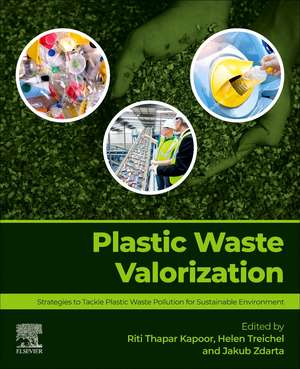
Plastic Waste Valorization: Strategies to Tackle Plastic Waste Pollution for Sustainable Environment
Editat de Riti Thapar Kapoor, Helen Treichel, Jakub Zdartaen Limba Engleză Paperback – 9 mar 2026
- Provides extensive information on the state-of-the-art application of environmentally benign approaches and various biological treatment technologies for the treatment of plastic contaminants and the restoration of contaminated sites
- Combines current knowledge with future strategies for integrated approaches, technological advancements and optimization strategies by using microbes or other bioremediation tools in enhancing process efficiency to effectively degrade plastic pollutants
- Aims to contribute significantly to achieving sustainable development goals by promoting carbon neutrality and reducing the overall cost of plastic waste management through innovative and sustainable practices
Preț: 853.99 lei
Preț vechi: 1211.68 lei
-30%
Puncte Express: 1281
Carte tipărită la comandă
Livrare economică 30 noiembrie-14 decembrie
Livrare prin curier în România Termenul estimat este afișat lângă disponibilitate.
Transport gratuit pentru acest produs Plată online sau ramburs, în funcție de opțiunile comenzii.
Retur gratuit în 14 zile Comandă securizată și suport în română.
Specificații
ISBN-13: 9780443416309
ISBN-10: 0443416303
Pagini: 544
Dimensiuni: 191 x 235 mm
Editura: ELSEVIER SCIENCE
ISBN-10: 0443416303
Pagini: 544
Dimensiuni: 191 x 235 mm
Editura: ELSEVIER SCIENCE
V-ar putea interesa
-
 PlasticsImari Walker-FranklinPreț: 87.00 lei
 -
 Preț: 322.48 lei
 -
 -31%Preț: 712.46 lei1037.32 lei
 -
 Microplastics in the EnvironmentRao Y Surampalli-23%Preț: 1698.36 lei2205.66 lei
 -
 Advances in Environmental Research: Volume 18Justin A Daniels-26%Preț: 730.58 lei992.26 lei
 -
 The Problem with PlasticJudith EnckPreț: 154.08 lei
 -
 PlasticsAlicia Chrysostomou-10%Preț: 99.31 lei109.90 lei
 -
 Handbook of Microplastics in the EnvironmentTeresa Rocha-Santos-18%Preț: 3488.96 lei4254.83 lei
 -
 Environmental Biotechnology Vol. 3K. M. Gothandam-24%Preț: 936.52 lei1232.26 lei
 -
 Microplastic in the Environment: Pattern and ProcessMichael S. BankPreț: 374.65 lei
 -
 MicroplasticsRamkumar Muthuvairavasamy-20%Preț: 593.13 lei741.41 lei
 -
 Environmental Engineering and Waste ManagementVineet Kumar-18%Preț: 1014.85 lei1237.63 lei
 -
 Springer Handbook of Circular Plastics EconomyAndrea Buettner-18%Preț: 2665.20 lei3250.25 lei
 -
 Microplastics in the EnvironmentXinxing Zhang-14%Preț: 907.78 lei1055.55 lei
 -
 -14%Preț: 858.74 lei998.53 lei
 -
 Microbial Rejuvenation of Polluted EnvironmentDeepak G. Panpatte-24%Preț: 1344.92 lei1769.63 lei
 -
 Microbial Rejuvenation of Polluted EnvironmentCharles Oluwaseun Adetunji-24%Preț: 1341.02 lei1764.51 lei
 -
 Environmental Microbiology and BiotechnologyAnoop Singh-18%Preț: 789.27 lei962.51 lei
 -
 Combating Plastic Pollution in Terrestrial EnvironmentS. Suriyanarayanan-18%Preț: 1055.90 lei1287.68 lei
 -
 -18%Preț: 1038.57 lei1266.55 lei
Cuprins
Section A: Plastic Pollution and application of sustainable technologies for degradation of plastic pollutants
1. Plastic in the environment, properties, types and applications
2. Hazardous effects of plastic wastes on the ecosystem, human-beings and animal health
3. Microplastics in marine ecosystem: ecotoxicological effects, health consequences, and food chain implications
4. Unveiling the effects of microplastics in marine ecosystem, current trends in environmental pollution and mechanisms of toxicological profile
5. Microplastics in ocean, recent trends of environmental pollution and toxicological profile mechanism : An update
6. Mechanism of plastic biodegradation : A step towards environmental sustainability
7. Microbial enzymatic remediation of synthetic plastic pollutants: a present and future perspectives
8. Relevance of microbes in plastic waste degradation
9. Microplastics: ecological and human health risks
10. Bio-chemical degradation of microplastics, its mechanisms, and methodologies
11. Microalgae-bacteria consortium for microplastic biodegradation : A strategy towards plastic mitigation
12. Biodegradable microplastics in soil ecosystem: effects on soil properties, plant and animal health
13. Role of microbial enzymes in the degradation of plastics: A sustainable tool for waste management
14. Plastic wastes in air and soil : health risks and challenges to mitigate plastic pollutant
Section B: Valorization of plastic wastes into value-added products
15. Use of waste plastic in preparation of value-added construction materials
16. Valorization of plastic wastes: current practices, challenges and future directions
17. Bioplastics production, and applications in industries : a step towards circular economy
18. Plastic waste management: a review on life cycle assessment studies
19. An integrated approach towards sustainable plastic waste management : case study from urban areas of Indonesia/other developing nation
20. Plastic wastes and its management strategies for environmental sustainability
21. Plastic recycling: applications, challenges and future prospects
1. Plastic in the environment, properties, types and applications
2. Hazardous effects of plastic wastes on the ecosystem, human-beings and animal health
3. Microplastics in marine ecosystem: ecotoxicological effects, health consequences, and food chain implications
4. Unveiling the effects of microplastics in marine ecosystem, current trends in environmental pollution and mechanisms of toxicological profile
5. Microplastics in ocean, recent trends of environmental pollution and toxicological profile mechanism : An update
6. Mechanism of plastic biodegradation : A step towards environmental sustainability
7. Microbial enzymatic remediation of synthetic plastic pollutants: a present and future perspectives
8. Relevance of microbes in plastic waste degradation
9. Microplastics: ecological and human health risks
10. Bio-chemical degradation of microplastics, its mechanisms, and methodologies
11. Microalgae-bacteria consortium for microplastic biodegradation : A strategy towards plastic mitigation
12. Biodegradable microplastics in soil ecosystem: effects on soil properties, plant and animal health
13. Role of microbial enzymes in the degradation of plastics: A sustainable tool for waste management
14. Plastic wastes in air and soil : health risks and challenges to mitigate plastic pollutant
Section B: Valorization of plastic wastes into value-added products
15. Use of waste plastic in preparation of value-added construction materials
16. Valorization of plastic wastes: current practices, challenges and future directions
17. Bioplastics production, and applications in industries : a step towards circular economy
18. Plastic waste management: a review on life cycle assessment studies
19. An integrated approach towards sustainable plastic waste management : case study from urban areas of Indonesia/other developing nation
20. Plastic wastes and its management strategies for environmental sustainability
21. Plastic recycling: applications, challenges and future prospects