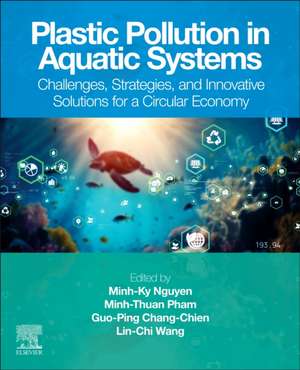
Plastic Pollution in Aquatic Systems: Challenges, Strategies, and Innovative Solutions for a Circular Economy
Editat de Minh-Ky Nguyen, Dr. Minh-Thuan Pham, Guo-Ping Chang-Chien, Lin-Chi Wangen Limba Engleză Paperback – 26 iun 2026
With contributions from leading experts, this book serves as an essential reference for researchers, environmental scientists, policymakers, and industry professionals seeking evidence-based strategies for plastic waste reduction and sustainable development. Through interdisciplinary insights, it advances the discourse on plastic pollution governance and supports the broader objectives of the Sustainable Development Goals (SDGs).
- Provides a holistic view of pollution in aquatic systems, integrating science, sustainable measures, and policies
- Offers comprehensive strategies for plastic pollution management that are aligned with Sustainable Development Goals (SDGs)
- Covers advanced AI technologies used in real case scenarios to help readers understand new applications
Preț: 840.73 lei
Preț vechi: 923.88 lei
-9%
Puncte Express: 1261
Carte tipărită la comandă
Livrare economică 26 noiembrie-10 decembrie
Livrare prin curier în România Termenul estimat este afișat lângă disponibilitate.
Transport gratuit pentru acest produs Plată online sau ramburs, în funcție de opțiunile comenzii.
Retur gratuit în 14 zile Comandă securizată și suport în română.
Specificații
ISBN-13: 9780443452482
ISBN-10: 0443452482
Pagini: 578
Dimensiuni: 216 x 276 mm
Greutate: 0.45 kg
Editura: ELSEVIER SCIENCE
ISBN-10: 0443452482
Pagini: 578
Dimensiuni: 216 x 276 mm
Greutate: 0.45 kg
Editura: ELSEVIER SCIENCE
Cuprins
I. Plastic Pollution in Aquatic Systems: Sources, Fate, and Environmental Risks
1. Plastic pollution in aquatic environments: Occurrence, pathways, and ecological consequences
2. Advances in microplastic detection: analytical techniques, methodological challenges, and perspectives
3. Fate and transport of microplastics in aquatic ecosystems
4. Microplastic interactions with heavy metals and persistent organic pollutants
5. Toxicological effects of microplastics and associated contaminants on aquatic organisms and human health
6. Plastic-associated species: Ecological risks and water treatment applications
II. Circular Economy Strategies for Plastic Pollution Management and Policy Implementation
7. Global and regional initiatives addressing marine plastic pollution
8. Circular economy approaches for plastic waste management
9. Biodegradable polymers and bio-based alternatives: advances, challenges, and outlooks
10. Regulatory frameworks and extended producer responsibility (EPR) in plastic waste management
11. Recycling and upcycling of plastic waste: Current status and future perspectives
12. Life cycle assessment (LCA) for plastic pollution management strategies: Environmental and economic considerations
III. Advanced Treatment Technologies for Plastic Waste Management and Microplastic Removal toward Sustainable Development Goals
13. Overview of advanced treatment technologies for plastic pollution mitigation and their alignment with sustainable development goals (SDGs)
14. Membrane-based filtration technologies for microplastic removal in water and wastewater treatment
15. Advanced oxidation processes (AOPs) for plastic degradation: Mechanisms, challenges, and future directions
16. Electrospun nanofiber membranes for microplastic filtration: Structure, selectivity, and permeability
17. Nanomaterial-modified adsorbents for the removal of microplastics and associated pollutants
18. Hybrid filtration and multi-stage separation technologies for microplastic removal
19. Functionalized nanofiber composites for enhanced microplastic capture in water treatment applications
20. Enzymatic and microbial degradation of plastics: Current advances and challenges
21. Nature-based solutions for plastic pollution management: Advances, challenges, and future perspectives toward sustainable development goals
IV. Future Perspectives and Sustainable Development Goals (SDGs)
22. Artificial intelligence (AI) and digital technologies for microplastic monitoring and risk assessment
23. Innovations and future directions in plastic pollution mitigation: Scientific advances, policy strategies, and SDG integration
1. Plastic pollution in aquatic environments: Occurrence, pathways, and ecological consequences
2. Advances in microplastic detection: analytical techniques, methodological challenges, and perspectives
3. Fate and transport of microplastics in aquatic ecosystems
4. Microplastic interactions with heavy metals and persistent organic pollutants
5. Toxicological effects of microplastics and associated contaminants on aquatic organisms and human health
6. Plastic-associated species: Ecological risks and water treatment applications
II. Circular Economy Strategies for Plastic Pollution Management and Policy Implementation
7. Global and regional initiatives addressing marine plastic pollution
8. Circular economy approaches for plastic waste management
9. Biodegradable polymers and bio-based alternatives: advances, challenges, and outlooks
10. Regulatory frameworks and extended producer responsibility (EPR) in plastic waste management
11. Recycling and upcycling of plastic waste: Current status and future perspectives
12. Life cycle assessment (LCA) for plastic pollution management strategies: Environmental and economic considerations
III. Advanced Treatment Technologies for Plastic Waste Management and Microplastic Removal toward Sustainable Development Goals
13. Overview of advanced treatment technologies for plastic pollution mitigation and their alignment with sustainable development goals (SDGs)
14. Membrane-based filtration technologies for microplastic removal in water and wastewater treatment
15. Advanced oxidation processes (AOPs) for plastic degradation: Mechanisms, challenges, and future directions
16. Electrospun nanofiber membranes for microplastic filtration: Structure, selectivity, and permeability
17. Nanomaterial-modified adsorbents for the removal of microplastics and associated pollutants
18. Hybrid filtration and multi-stage separation technologies for microplastic removal
19. Functionalized nanofiber composites for enhanced microplastic capture in water treatment applications
20. Enzymatic and microbial degradation of plastics: Current advances and challenges
21. Nature-based solutions for plastic pollution management: Advances, challenges, and future perspectives toward sustainable development goals
IV. Future Perspectives and Sustainable Development Goals (SDGs)
22. Artificial intelligence (AI) and digital technologies for microplastic monitoring and risk assessment
23. Innovations and future directions in plastic pollution mitigation: Scientific advances, policy strategies, and SDG integration