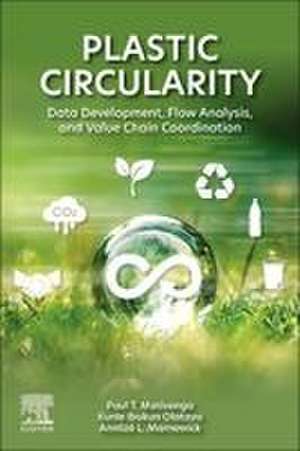
Plastic Circularity: Data Development, Flow Analysis, and Value Chain Coordination
Autor Paul T. Mativenga, Kunle Ibukun Olatayo, Annlizé L. Marnewicken Limba Engleză Paperback – noi 2026
By offering practical tools and case studies, the comprehensive resource empowers decision-makers to enhance recycling systems and promote sustainable practices, contributing to a more environmentally responsible plastic economy.
- Introduces advanced modeling techniques that allow for a thorough analysis of plastic material flows, facilitating a nuanced understanding of sustainability metrics throughout the value chain
- Highlights the importance of collaboration in driving the transition to a circular economy for plastics by outlining a structured approach for engaging diverse stakeholders
- Provides readers with concrete strategies and benchmarks to evaluate and improve recycling initiatives and circularity efforts by using case studies and practical tools
Preț: 939.90 lei
Preț vechi: 1092.92 lei
-14% Nou
Puncte Express: 1410
Carte disponibilă
Livrare economică 14-28 noiembrie
Livrare prin curier în România Termenul estimat este afișat lângă disponibilitate.
Transport gratuit pentru acest produs Plată online sau ramburs, în funcție de opțiunile comenzii.
Retur gratuit în 14 zile Comandă securizată și suport în română.
Specificații
ISBN-13: 9780443406676
ISBN-10: 0443406677
Pagini: 250
Dimensiuni: 152 x 229 mm
Greutate: 0.32 kg
Editura: ELSEVIER SCIENCE
ISBN-10: 0443406677
Pagini: 250
Dimensiuni: 152 x 229 mm
Greutate: 0.32 kg
Editura: ELSEVIER SCIENCE
V-ar putea interesa
-
 My Plastic-Free HomeKate JonesPreț: 96.06 lei
-
 Preț: 322.48 lei
-
 PlasticsAnne GunnisonPreț: 239.02 lei
-
 -18%Preț: 1257.60 lei1533.65 lei
-
 Sustainable Design from Vision to ActionJeremy FaludiPreț: 393.26 lei
-
 Preț: 235.86 lei
-
 Mastering the Circular EconomyEd WeenkPreț: 236.80 lei
-
 -29%Preț: 237.90 lei337.20 lei
-
 The Problem with PlasticJudith EnckPreț: 154.08 lei
-
 Consumed: How Big Brands Got Us Hooked on PlasticSaabira ChaudhuriPreț: 124.58 lei
-
 Recycled Materials for Construction ApplicationsLuís Eduardo Pimentel Real-24%Preț: 815.48 lei1073.00 lei
-
 -18%Preț: 1166.25 lei1422.27 lei
-
 Springer Handbook of Circular Plastics EconomyAndrea Buettner-18%Preț: 2665.20 lei3250.25 lei
-
 -14%Preț: 858.74 lei998.53 lei
-
 Preț: 381.25 lei
-
 Circular MaterialsJoe GibbsPreț: 279.66 lei
-
 -27%Preț: 175.34 lei241.35 lei
-
 Combating Plastic Pollution in Terrestrial EnvironmentS. Suriyanarayanan-18%Preț: 1055.90 lei1287.68 lei
Cuprins
1. Introduction
1.1. Book introduction
1.1.1. Circular economy: nature is circular
1.1.2. Principles of a circular economy
1.1.3. How is success measured? Metrics of a circular economy
1.1.4. Vision for a circular plastic economy
1.1.5. Structure of the book
2. Plastics economy and the value chain
2.1. Plastics in the economy
2.1.1. What makes plastic unique and widely used?
2.1.2. Plastic is helping the food industry
2.1.3. Plastic is protecting lives
2.1.4. Plastic: a double-edged sword
2.2. Plastics across the value chain
2.2.1. Plastic material production
2.2.2. Plastic product manufacturing
2.2.3. Plastic product use and waste generation
2.2.4. Plastic waste - waste collection and handling
2.2.5. Sorting
2.2.6. Plastic recycling
2.2.7. Recyclate market
2.3. Plastics in the circular economy
2.4. Potential for circularity across the plastics value chain
2.4.1. Circularity in production
2.4.2. Circularity in plastic use
2.4.3. Circularity at end-of-life
2.5. Summary
References
3. Plastic waste and the waste management hierarchy
3.1. Managing plastic waste
3.2. Waste management hierarchy systems
3.2.1. European Union waste hierarchy
3.2.2. R-framework hierarchy
3.3. Circular economy principles and the 6R framework
3.4. Consequences of mismanaged plastics
3.4.1. Plastic leakage
3.4.2. Microplastics
3.5. Summary
References
4. Impact and sustainability of plastic
4.1. The impact of plastics and the life cycle assessment
4.1.1. Plastic manufacturing and the environmental impact
4.1.2. Plastic use contributes to environmental impact
4.1.3. End-of-life impact of plastics
4.1.4. Gaps in life cycle assessment of plastics
4.2. Making plastics more sustainable
4.2.1. Economic sustainability of plastics
4.2.2. Social sustainability of plastics
4.2.3. Environmental sustainability of plastics
4.3. Plastics within planetary boundaries
4.4. Sustainability in a circular economy
4.5. Summary
References
5. Data building in the plastics value chain
5.1. Role of data in the value chain
5.2. Data sourcing and triangulation
5.3. Challenges to plastic data collection
5.3.1. Diverse data collection systems and frameworks
5.3.2. Variation in data scope
5.3.3. Data confidentiality
5.3.4. Lack of incentives
5.4. Data quality and traceability
5.5. Building data collection capacity
5.5.1. Data build-up on plastic production
5.5.2. Data build-up on plastic consumption
5.5.3. Data build-up on plastic waste generation and management
5.5.4. Plastic waste collection data
5.5.5. Data build-up on plastic waste recovery and recycling
5.6. Summary
References
6. Modelling of plastic material flows for sustainable decision-making
6.1. Goal and scope definition
6.2. Modelling flows and system boundaries
6.2.1. System analysis
6.2.2. Flow mass quantification
6.2.3. Graphic representation
6.3. Plastic footprint, trade balance and recycling rate
6.4. Policy interventions across the value chain
6.4.1. Deposit refund system
6.4.2. Tax refund
6.4.3. Mandatory utilisation
6.4.4. Extended producer responsibility
6.4.5. Plastic bag regulation
6.4.6. User pay scheme
6.4.7. Landfill tax/ban
6.4.8. Kerbside collection (door-to-door)
6.5. Summary
References
7. Participation and dynamics of stakeholders in the value chain
7.1. Value chain coordination
7.2. Stakeholders across the value chain
7.3. Participation in higher waste management hierarchy options and circularity
7.4. Global partnership towards plastic circularity
7.4.1. United Nations Environmental Programme
7.4.2. World Economic Forum
7.4.3. Ellen MacArthur Foundation
7.4.4. Waste and Resources Action Programme
7.5. Summary
References
8. Progress toward plastic circularity
8.1. The concept of pathways to circularity
8.2. Generic approach to modelling pathways to circularity
8.2.1. Modelling the plastics value chain stages
8.2.2. Analysing the material flows of plastics
8.2.3. Identifying available and appropriate circularity strategies
8.2.4. System dynamics modelling
8.2.5. Stakeholder engagement and delivery mechanisms
8.2.6. Data analytics
8.3. Pathway to zero landfill for plastics
8.4. Pathway to recycling of plastic waste
8.5. Summary
References
9. Transition towards a world-class system for plastics circularity: Performance and maturity assessment
9.1. Plastic system assessment towards world class
9.2. Performance metric framework for transition to a world-class circular economy for plastics
9.3. Maturity model for plastic system
9.3.1. Ad hoc and unstructured
9.3.2. Structured
9.3.3. Visionary
9.3.4. Integrated
9.3.5. Connected and dynamic
9.4. Summary
References
10. Case studies on country transition to a circular plastic economy
10.1. The global plastics value chains and transition towards circularity
10.2. South Africa
10.2.1. Plastics production and products manufacturing
10.2.2. Plastics use and waste generation
10.2.3. Plastics waste management and recycling
10.3. Nigeria
10.3.1. Plastics production and products manufacturing
10.3.2. Plastics use and waste generation
10.3.3. Plastics waste management and recycling
10.4. Egypt
10.4.1. Plastics production and products manufacturing
10.4.2. Plastics use and waste generation
10.4.3. Plastics waste management and recycling
10.5. India
10.5.1. Plastics production and products manufacturing
10.5.2. Plastics use and waste generation
10.5.3. Plastics waste management and recycling
10.6. China
10.6.1. Plastics production and products manufacturing
10.6.2. Plastics use and waste generation
10.6.3. Plastics waste management and recycling
10.7. Germany
10.7.1. Plastics production and products manufacturing
10.7.2. Plastics use and waste generation
10.7.3. Plastics waste management and recycling
10.8. United Kingdom
10.8.1. Plastics production and products manufacturing
10.8.2. Plastics use and waste generation
10.8.3. Plastics waste management and recycling
10.9. Summary
References
11. Conclusion
11.1. Book conclusion