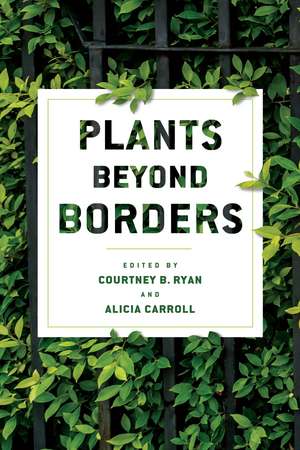
Plants Beyond Borders
Editat de Courtney B. Ryan, Alicia Carrollen Limba Engleză Hardback – 17 noi 2026
Centers vegetal life as a force that disrupts the borders of race, gender, sexuality, and colonial power.
Although plants are the most abundant life form on earth, the environmental humanities have paid them scant attention until recently, even as new challenges, such as the COVID-19 pandemic, climate change, war, and the global rise of the right have piqued interest in plants as signs of life that challenge the Anthropocene and the logic of extraction. In Plants Beyond Borders, Courtney B. Ryan and Alicia Carroll have marshalled a range of innovative contributions that focus on vegetal borderlands—or spaces in which plant and human life overlap—where vegetal life exceeds and uproots human borders. Containing perspectives from English, landscape architecture, Native American studies, performing arts, and more, Plants Beyond Borders foregrounds Indigenous sovereignty and plant knowledge; explores the shared transmutability of plants and trans, queer, and pregnant bodies; and investigates phytographia, or plant writing, as plants thinking beyond borders. No matter the objective, the essays in this interdisciplinary collection center vegetal life, considering how agentic plants not only rupture myths of settler colonialism, gender, and sexuality but also inscribe themselves and us in the world.
Contributors:
Cinthya Ammerman Muñoz, Alicia Carroll, Gwendolyn Cohen, Isaac Cohen, Xinyue Fu, Patrícia de Nóbrega Gomes, Katie Hogan, Kaley Makino, Melissa Parrish, MacKenzie Patterson, Courtney B. Ryan, John Charles Ryan, Saghar Safaeyan, Jeannette Schollaert, Kathryn Van Wert, Christina Welch
Although plants are the most abundant life form on earth, the environmental humanities have paid them scant attention until recently, even as new challenges, such as the COVID-19 pandemic, climate change, war, and the global rise of the right have piqued interest in plants as signs of life that challenge the Anthropocene and the logic of extraction. In Plants Beyond Borders, Courtney B. Ryan and Alicia Carroll have marshalled a range of innovative contributions that focus on vegetal borderlands—or spaces in which plant and human life overlap—where vegetal life exceeds and uproots human borders. Containing perspectives from English, landscape architecture, Native American studies, performing arts, and more, Plants Beyond Borders foregrounds Indigenous sovereignty and plant knowledge; explores the shared transmutability of plants and trans, queer, and pregnant bodies; and investigates phytographia, or plant writing, as plants thinking beyond borders. No matter the objective, the essays in this interdisciplinary collection center vegetal life, considering how agentic plants not only rupture myths of settler colonialism, gender, and sexuality but also inscribe themselves and us in the world.
Contributors:
Cinthya Ammerman Muñoz, Alicia Carroll, Gwendolyn Cohen, Isaac Cohen, Xinyue Fu, Patrícia de Nóbrega Gomes, Katie Hogan, Kaley Makino, Melissa Parrish, MacKenzie Patterson, Courtney B. Ryan, John Charles Ryan, Saghar Safaeyan, Jeannette Schollaert, Kathryn Van Wert, Christina Welch
Preț: 469.97 lei
Preț vechi: 580.22 lei
-19% Precomandă
Puncte Express: 705
Carte nepublicată încă
Livrare prin curier în România Precomanda se expediază când titlul devine disponibil.
Transport gratuit pentru acest produs Plată online sau ramburs, în funcție de opțiunile comenzii.
Retur gratuit în 14 zile Comandă securizată și suport în română.
Doresc să fiu notificat când acest titlu va fi disponibil:
Se trimite...
Specificații
ISBN-13: 9780814216262
ISBN-10: 0814216269
Pagini: 250
Ilustrații: 11 b&w images; 5 diagrams
Dimensiuni: 152 x 229 mm
Greutate: 0.45 kg
Editura: Ohio State University Press
Colecția Ohio State University Press
ISBN-10: 0814216269
Pagini: 250
Ilustrații: 11 b&w images; 5 diagrams
Dimensiuni: 152 x 229 mm
Greutate: 0.45 kg
Editura: Ohio State University Press
Colecția Ohio State University Press
Recenzii
“This enthralling new book focuses on vegetal borders that shield and divide, borders that establish who belongs and who does not. This focus on the tension between neocolonial lines of dominion and vegetal life is a significant innovation in the plant humanities field.” —Prudence Gibson, author of The Plant Thieves: Secrets of the Herbarium
“Defying disciplinary boundaries, geographical delimitations, and neat gender, racial, and other ontological frontiers, this book reimagines plants as agents of decolonization, world-making, and critical thought. The volume invites readers to move with plants across borders in order to cultivate more capacious, pluriversal forms of coexistence.” —Patricia Vieira, editor of The Environment in Brazilian Culture: Literature, Cinema, and the Arts
“Unique in its multidisciplinary approach and composed with a genuine sense of political urgency, Plants Beyond Borders is a generous introduction to the burgeoning field of critical plant studies. It is necessary reading.” —Vin Nardizzi, author of Marvellous Vegetables in the Renaissance
Notă biografică
Courtney B. Ryan is Assistant Professor of Theater at Lafayette College, author of Eco-Performance, Art, and Spatial Justice in the US, and a researcher of plant art and eco-theater. Alicia Carroll is Professor and Chair of English at Auburn University, where she researches and teaches critical plant studies and British literature of the long nineteenth century. Her previous work includesNew Woman Ecologies: From Arts and Crafts to the Great War and Beyond.
Extras
From ornamental flower beds edging paths, to “privacy shrubs” instrumentalized as property lines, to forests proclaimed as national boundaries, plants have historically been used to create borders. While the word “border” was originally armorial, referring to the colorful band on the edge of a shield, by 1400 it came to signify much more: “A side, edge, brink, or margin; a limit, or boundary; the part of anything lying along its boundary or outline.” By the nineteenth century, the United States’ definition of the word “border” (“The line or frontier between the occupied and unoccupied parts of the country, the frontier of civilization”) intersected with the ideology of Manifest Destiny. Today, the idea of vegetal borders is bolstered by the concept of “invasive” species, in which the very plants introduced through colonization must now be contained. Like flags, national and state flowers are wielded as both metaphors for and markers of set geographic borders; they show what belongs within that place and, conversely, what does not. A border may just as easily be defined as a boundary between countries as it may a row of rhododendrons. The fact that plants are used as both geographic dividing lines and vibrant symbols of what belongs where, however, belies—as this collection explores—their nature to spread beyond borders. Plants refuse to stay still, and, although people have done what they will to push them to the sides of our paths, they move across borders of all kinds. This collection follows that movement, tracing plants beyond ontological, geographic, and cultural borders. In examining this phenomenon, we explore the consequences and opportunities for plants and people of conceptualizing borders on the basis of such mobile beings.
The phenomenon of vegetal mobility is particularly visible at international borders, where vegetal spreadability contrasts with human efforts to stabilize boundaries and regulate crossings. For example, the 160-mile-long Korean Demilitarized Zone (DMZ) between North and South Korea is perhaps one of the most heavily fortified borders in the world, and yet, left largely unoccupied by people for over 70 years, it is also a sprawl of biodiversity where the tropisms of thousands of different plant species spread them in all directions. Similar vegetal tales have occurred along other military borders like Germany’s former Iron Curtain, now transformed as the “Green Belt.” Perhaps the best example of vegetal resistance to static human division and control of property, though, is the peepal tree checkpoint along the India–Pakistan border. Partitioned by the British in 1947, the Octroi Border Outpost in Suchetgarh, India, marks the boundary line with white pillars engraved with serial numbers. Over time, a nearby peepal tree grew so large that it engulfed a pillar, leading the Pakistan Rangers and the Indian Border Security Force to paint the tree with the pillar’s serial number, 918. While this peepal tree has been enlisted as a living border, the fact that it entirely envelops a border marker mocks imperialist boundary lines. Its enveloping of the border marker is especially significant given that the peepal tree (Ficus religiosa) is considered to be sacred within Buddhism, Hinduism, and Jainism.
Notoriously, in North America, Donald Trump’s “big, beautiful wall” project impacts border towns and cities such as Laredo, Texas, a city on the Rio Grande, ceded to the United States at the end of the Mexican American War. In Laredo the wall project remains imminent despite the project’s replacement in the national consciousness by the president’s deportation program and its resulting impact on immigration. Ironically, the “wall is coming” despite near complete cessation of immigration. When executed, it will disturb over a hundred miles of the river’s edge, including the Las Palmas Nature Trail, a community and federally funded river walkway initiated by the nearby neighborhood of Azteca. In contrast to the political rhetoric of the wall meant to keep people characterized by the Trump administration as “foreign invaders” out of the US, the planting of the Las Palmas Nature Trail means to replace European American “invaders” with “native” plants. The culprits targeted by neighborhood volunteers includes Carrizo cane—alternately called Arrundo, “Spanish cane,” or “Colorado River cane ”—a giant “aquatic invader” and “enemy” of a plant which soaks up water and obstructs riparian flow. In its place, local volunteers are planting native trees such as huisache, anaqua, retama, and mesquite, as well as pollinator-friendly plants that spread and support life on both sides of the river and benefit the international river shared by Mexico and the US. Such planting challenges the rhetoric of the wall project by flipping its terms, recasting through living plants political concepts of the domestic and the foreign, invader and aggressor, through the removal of European American “invaders” on the US side of the river. At such sites, the vital spread of plants over solid walls, through international air, water, and soil, destabilizes the political concept of borders.
The phenomenon of vegetal mobility is particularly visible at international borders, where vegetal spreadability contrasts with human efforts to stabilize boundaries and regulate crossings. For example, the 160-mile-long Korean Demilitarized Zone (DMZ) between North and South Korea is perhaps one of the most heavily fortified borders in the world, and yet, left largely unoccupied by people for over 70 years, it is also a sprawl of biodiversity where the tropisms of thousands of different plant species spread them in all directions. Similar vegetal tales have occurred along other military borders like Germany’s former Iron Curtain, now transformed as the “Green Belt.” Perhaps the best example of vegetal resistance to static human division and control of property, though, is the peepal tree checkpoint along the India–Pakistan border. Partitioned by the British in 1947, the Octroi Border Outpost in Suchetgarh, India, marks the boundary line with white pillars engraved with serial numbers. Over time, a nearby peepal tree grew so large that it engulfed a pillar, leading the Pakistan Rangers and the Indian Border Security Force to paint the tree with the pillar’s serial number, 918. While this peepal tree has been enlisted as a living border, the fact that it entirely envelops a border marker mocks imperialist boundary lines. Its enveloping of the border marker is especially significant given that the peepal tree (Ficus religiosa) is considered to be sacred within Buddhism, Hinduism, and Jainism.
Notoriously, in North America, Donald Trump’s “big, beautiful wall” project impacts border towns and cities such as Laredo, Texas, a city on the Rio Grande, ceded to the United States at the end of the Mexican American War. In Laredo the wall project remains imminent despite the project’s replacement in the national consciousness by the president’s deportation program and its resulting impact on immigration. Ironically, the “wall is coming” despite near complete cessation of immigration. When executed, it will disturb over a hundred miles of the river’s edge, including the Las Palmas Nature Trail, a community and federally funded river walkway initiated by the nearby neighborhood of Azteca. In contrast to the political rhetoric of the wall meant to keep people characterized by the Trump administration as “foreign invaders” out of the US, the planting of the Las Palmas Nature Trail means to replace European American “invaders” with “native” plants. The culprits targeted by neighborhood volunteers includes Carrizo cane—alternately called Arrundo, “Spanish cane,” or “Colorado River cane ”—a giant “aquatic invader” and “enemy” of a plant which soaks up water and obstructs riparian flow. In its place, local volunteers are planting native trees such as huisache, anaqua, retama, and mesquite, as well as pollinator-friendly plants that spread and support life on both sides of the river and benefit the international river shared by Mexico and the US. Such planting challenges the rhetoric of the wall project by flipping its terms, recasting through living plants political concepts of the domestic and the foreign, invader and aggressor, through the removal of European American “invaders” on the US side of the river. At such sites, the vital spread of plants over solid walls, through international air, water, and soil, destabilizes the political concept of borders.
Cuprins
Contents
List of Illustrations
List of Tables
Foreword Of Pando, Pilpil, and Porosity
Introduction Vegetal Borderlands
Part 1 Breaking Borders: Plants and Decolonization
Chapter 1 A Madi Salve for Settler-Colonial Ruptures
Chapter 2 Unearthing Enslaved African and Indigenous Plant Knowledge in the St. Vincent Botanical Garden, 1785-1811
Chapter 3 The Marginal Man and American Borderlands: Diasporic Botany in Minari
Chapter 4 Gardens as a Caminho: Ancestral Plants as a Strategy of Indigenous Critique in Contemporary Brazilian Art
Lateral Roots
Chapter 5 What We Ask of Plants and Why We Ask It
Part 2 Borderless Bodies: Plants, Gender, and Sexuality
Chapter 6 The New Plant Science and Trans Women of Color Fiction
Chapter 7 Mirrors of Green: Queer Fear and Ecopoetics in Little Shop of Horrors (1986)
Chapter 8 Herbal Medicine and Abortion Narratives in Ana Castillo’s Fiction
Lateral Roots
Chapter 9 Lyric Poetry and Mutual Aid at the Borders of the Human
Part 3 Becoming Vegetal: Plant Writing
Chapter 10 “There Is Nothing but Border. There Is No Border”: The (Xeno)phyto-Ontography of Jeff VanderMeer’s Southern Reach Series
Chapter 11 “Messengers of Vegetable Love”: Phytographia in Dead Astronauts
Chapter 12 Talking Trees: Arboreal Messaging and the Metaphysics of Voice
Acknowledgments
List of Contributors
Index
List of Illustrations
List of Tables
Foreword Of Pando, Pilpil, and Porosity
Introduction Vegetal Borderlands
Part 1 Breaking Borders: Plants and Decolonization
Chapter 1 A Madi Salve for Settler-Colonial Ruptures
Chapter 2 Unearthing Enslaved African and Indigenous Plant Knowledge in the St. Vincent Botanical Garden, 1785-1811
Chapter 3 The Marginal Man and American Borderlands: Diasporic Botany in Minari
Chapter 4 Gardens as a Caminho: Ancestral Plants as a Strategy of Indigenous Critique in Contemporary Brazilian Art
Lateral Roots
Chapter 5 What We Ask of Plants and Why We Ask It
Part 2 Borderless Bodies: Plants, Gender, and Sexuality
Chapter 6 The New Plant Science and Trans Women of Color Fiction
Chapter 7 Mirrors of Green: Queer Fear and Ecopoetics in Little Shop of Horrors (1986)
Chapter 8 Herbal Medicine and Abortion Narratives in Ana Castillo’s Fiction
Lateral Roots
Chapter 9 Lyric Poetry and Mutual Aid at the Borders of the Human
Part 3 Becoming Vegetal: Plant Writing
Chapter 10 “There Is Nothing but Border. There Is No Border”: The (Xeno)phyto-Ontography of Jeff VanderMeer’s Southern Reach Series
Chapter 11 “Messengers of Vegetable Love”: Phytographia in Dead Astronauts
Chapter 12 Talking Trees: Arboreal Messaging and the Metaphysics of Voice
Acknowledgments
List of Contributors
Index
Descriere
A critical plant studies anthology examining how vegetal life uproots human borders through the lenses of race, class, gender, sexuality, and decolonization.