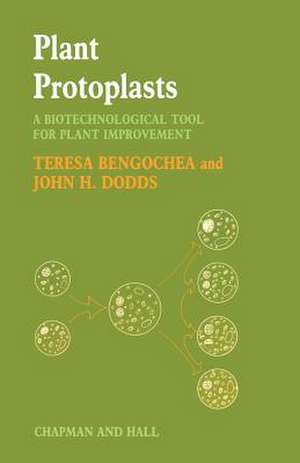
Plant Protoplasts
Autor Tessa Bengocheaen Limba Engleză Paperback – 13 oct 2011
Preț: 363.41 lei
Puncte Express: 545
Carte tipărită la comandă
Livrare economică 26 noiembrie-10 decembrie
Livrare prin curier în România Termenul estimat este afișat lângă disponibilitate.
Transport gratuit de la 400.00 lei Plată online sau ramburs, în funcție de opțiunile comenzii.
Retur gratuit în 14 zile Comandă securizată și suport în română.
Specificații
ISBN-13: 9789401083171
ISBN-10: 9401083177
Pagini: 100
Ilustrații: VI, 90 p.
Dimensiuni: 140 x 216 x 6 mm
Greutate: 0.14 kg
Ediția:Softcover reprint of the original 1st ed. 1986
Editura: Springer
Locul publicării:Dordrecht, Netherlands
ISBN-10: 9401083177
Pagini: 100
Ilustrații: VI, 90 p.
Dimensiuni: 140 x 216 x 6 mm
Greutate: 0.14 kg
Ediția:Softcover reprint of the original 1st ed. 1986
Editura: Springer
Locul publicării:Dordrecht, Netherlands
V-ar putea interesa
-
 -25%Preț: 332.02 lei444.51 lei
 -
 Kids Inventing!Susan CaseyPreț: 98.78 lei
 -
 GCSE AQA Coordinated ScienceRichard ParsonsPreț: 51.35 lei
Public țintă
ResearchCuprins
1 Introduction.- 2 Isolation and culture.- 2.1 Introduction.- 2.2 Choice of starting material.- 2.3 Enzymes and osmotica.- 2.4 Isolation methods.- 2.5 Purification of isolated protoplasts.- 2.6 Protoplast viability and plating density.- 2.7 Methods for protoplast culture.- 2.8 Cell wall regeneration.- 2.9 Division and growth.- 2.10 Isolation of subprotoplasts.- 2.11 Conclusions.- References.- 3 Regeneration of plants.- 3.1 History of plant regeneration studies.- 3.2 Organogenesis.- 3.3 Embryogenesis.- 3.4 Handling of regenerated plantlets.- 3.5 Genetic stability of regenerated plantlets.- References.- 4 Protoplast fusion.- 4.1 Introduction.- 4.2 Methods to induce fusion.- 4.3 Selection of fusion hybrids.- 4.4 Which plants to hybridize.- 4.5 Cybrid formation.- 4.6 Conclusions.- References.- 5 Protoplasts as physiological tools.- 5.1 Studies on DNA, RNA and protein synthesis.- 5.2 Protoplasts for isolation of cell components.- 5.3 Protoplasts for studies on cell wall regeneration.- References.- 6 Uptake of foreign materials.- 6.1 Introduction.- 6.2 Nuclei and subprotoplasts.- 6.3 Chloroplasts and mitochondria.- 6.4 Bacteria.- 6.5 Blue-green algae.- 6.6 Viruses.- 6.7 DNA.- 6.8 Non-biological materials.- References.- 7 Genetic engineering.- 7.1 Introduction.- 7.2 Induced tumours.- 7.3 The infective plasmid.- 7.4 Transformation of protoplasts.- 7.5 Which genes to engineer?.- References.