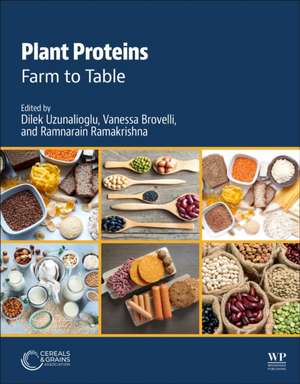
Plant Proteins: Farm to Table
Editat de Dilek Uzunalioglu, Vanessa Brovelli, Ramnarain Ramakrishnaen Limba Engleză Paperback – 12 dec 2025
It will be a welcomed addition to the libraries of food technologists, research scientists, product developers, process engineers, students and educators.
- Includes nutritional claims and calculations for individual countries supported with examples
- Presents methods and techniques for evaluations of plant-based foods
- Provides descriptions and comparisons of types of plant proteins
- Contains application case studies pertaining to ingredient insights, formulation tips, and food processing challenges and solution
- Provide insights on plant protein ingredient processing
Preț: 1213.05 lei
Preț vechi: 1781.31 lei
-32%
Puncte Express: 1820
Carte tipărită la comandă
Livrare economică 21 noiembrie-05 decembrie
Livrare prin curier în România Termenul estimat este afișat lângă disponibilitate.
Transport gratuit pentru acest produs Plată online sau ramburs, în funcție de opțiunile comenzii.
Retur gratuit în 14 zile Comandă securizată și suport în română.
Specificații
ISBN-13: 9780323917254
ISBN-10: 0323917259
Pagini: 382
Dimensiuni: 216 x 276 mm
Greutate: 1.02 kg
Editura: ELSEVIER SCIENCE
ISBN-10: 0323917259
Pagini: 382
Dimensiuni: 216 x 276 mm
Greutate: 1.02 kg
Editura: ELSEVIER SCIENCE
V-ar putea interesa
-
 Biological NMR Part AA.Joshua Wand-9%Preț: 929.82 lei1021.79 lei
 -
 Ubiquitin and Ubiquitin-like Protein ModifiersMark Hochstrasser-22%Preț: 853.01 lei1096.56 lei
 -
 -9%Preț: 1408.47 lei1547.77 lei
 -
 CRISPR-Cas EnzymesScott Bailey-9%Preț: 871.39 lei957.57 lei
 -
 Biological NMR Part BA.Joshua Wand-35%Preț: 932.49 lei1437.04 lei
 -
 Metabolons and Supramolecular Enzyme AssembliesClaudia Schmidt-Dannert-28%Preț: 872.89 lei1210.34 lei
 -
 Ubiquitin-dependent Protein DegradationMark Hochstrasser-23%Preț: 934.28 lei1208.48 lei
 -
 Exercise BiochemistryVassilis Mougios-9%Preț: 818.25 lei899.18 lei
 -
 A Primer for the Exercise and Nutrition SciencesChristopher B Scott-5%Preț: 742.68 lei781.76 lei
 -
 Molecular Chaperones in Health and DiseaseMatthias Gaestel-24%Preț: 1741.05 lei2290.85 lei
 -
 Biological AdhesivesAndrew M. Smith-24%Preț: 1661.87 lei2186.67 lei
 -
 Transposons and the Dynamic GenomeDirk-Henner Lankenau-18%Preț: 908.36 lei1107.76 lei
 -
 Drug Discovery in AfricaKelly Chibale-18%Preț: 993.52 lei1211.61 lei
 -
 The Effects of Vitamins on DNA and RNA Structures and DynamicsHeidar-Ali Tajmir-RiahiPreț: 256.79 lei
 -
 Techniques de séparation et fractionnementDjallal Eddine Houari AdliPreț: 254.62 lei
 -
 Effet du plomb sur la croissance chez Coriandrum sativum L.Chems Eddine Ahmed BelkacemPreț: 256.54 lei
 -
 Preț: 394.09 lei
 -
 Covalent conjugation of the HIV-1 ENV to functionalised liposomesBianca KohlhauserPreț: 255.10 lei
 -
 Evaluation of some antioxidants and minerals in infertility patientsAlaauldeen Subhi Mohsen Al-SallamiPreț: 260.07 lei
 -
 Bread-making quality of wheatBob Belderok-18%Preț: 1284.63 lei1566.61 lei
 -
 -20%Preț: 642.77 lei803.46 lei
 -
 -18%Preț: 1171.07 lei1428.14 lei
 -
 Cellulose: Molecular and Structural BiologyR. Malcolm Jr. Brown-24%Preț: 1171.64 lei1541.62 lei
 -
 Mechanosensitivity of the Nervous SystemAndre Kamkin-18%Preț: 1172.94 lei1430.41 lei
 -
 BIOINSPIRED CHEMISTRYBalaban Mihaela Carmen-18%Preț: 748.32 lei912.59 lei
Public țintă
Industry professionals working to develop and commercialize ingredients for plant-based foods, such as food technologists, research scientists, product developers, and process engineers as well as students and educators in food science programs and food-processing programsCuprins
Section 1: Introduction to Plant-Based Proteins as Food Ingredients
1. Plant-Based Proteins: Definitions and Types
2. Consumer Trends, Nutrition, and Sustainability
3. Advancements in Plant Sciences, Genetics, and Breeding
4. Protein Isolation and Processing Techniques
5. Functionality of Plant-Based Proteins
Section 2: Application of Plant-Based Proteins in the Food Industry
6. Rheology of Foods Containing Plant-Based Proteins
7. Sensory Aspects and Oral Processing of Plant-Based Proteins
8 Plant-Based Proteins in Bakery and Snack Applications
9. Plant-Based Proteins in Pasta and Noodle Applications
10. Plant-Based Proteins for Formulation of Dairy Alternatives (or Plant-Based Milks)
11. Texturizing Proteins for Meat Alternatives
12. Plant-Based Proteins for Formulation of Meat Alternatives
13. Using Functional Fats in Plant Protein Formulations
Section 3: Regulatory Issues Concerning Plant Proteins
14. Protein Claims
Section 4: The Future of Plant-Based Proteins
15. Emerging Technologies Pertaining to Plant-Based Proteins
16. Commercialization and Consumer Acceptance
1. Plant-Based Proteins: Definitions and Types
2. Consumer Trends, Nutrition, and Sustainability
3. Advancements in Plant Sciences, Genetics, and Breeding
4. Protein Isolation and Processing Techniques
5. Functionality of Plant-Based Proteins
Section 2: Application of Plant-Based Proteins in the Food Industry
6. Rheology of Foods Containing Plant-Based Proteins
7. Sensory Aspects and Oral Processing of Plant-Based Proteins
8 Plant-Based Proteins in Bakery and Snack Applications
9. Plant-Based Proteins in Pasta and Noodle Applications
10. Plant-Based Proteins for Formulation of Dairy Alternatives (or Plant-Based Milks)
11. Texturizing Proteins for Meat Alternatives
12. Plant-Based Proteins for Formulation of Meat Alternatives
13. Using Functional Fats in Plant Protein Formulations
Section 3: Regulatory Issues Concerning Plant Proteins
14. Protein Claims
Section 4: The Future of Plant-Based Proteins
15. Emerging Technologies Pertaining to Plant-Based Proteins
16. Commercialization and Consumer Acceptance