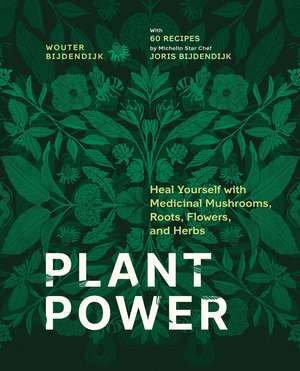
Plant Power: Heal Yourself with Medicinal Mushrooms, Roots, Flowers, and Herbs
Autor Wouter Bijdendijk Cu Joris Bijdendijken Limba Engleză Hardback – 25 sep 2025
A full-color reference guide to beneficial plants and mushrooms
“An excellent resource about the natural properties of plants.”—Kirkus Reviews
• Explores the ethnobotany and practical applications of 30 plants, fruits, nuts, bulbs, roots, flowers, and mushrooms that support the immune system, digestion, endurance, vitality, and the brain
• Examines ritual and mind-expanding plants such as fly agaric, blue lotus, cannabis, and peyote cactus
• Offers 60 delicious vegetarian recipes (two for each plant or mushroom) by Michelin star chef Joris Bijdendijk
WHILE KNOWING that spending time in nature and eating healthy is important, we often dismiss the fact that plants have been used as healing medicine for thousands of years.
In this guide, Wouter Bijdendijk highlights thirty mushrooms, herbs, flowers, fruits, nuts, bulbs, and roots that support the immune system, digestion, endurance, vitality, and the brain—from ginseng and turmeric to chaga and reishi to olive and chamomile. He also explores several plants that have played a significant role in rituals and ceremonies, such as fly agaric, blue lotus, cannabis, and peyote cactus, enabling our ancestors to connect with deeper layers of themselves, the spiritual realms, and the Divine. Michelin star chef Joris Bijdendijk provides two delicious vegetarian recipes for each major plant, offering culinary delights to help you easily incorporate the medicinal powers of these plants in your life.
A journey through the deep and ancient roots of plant knowledge, from folk uses to mystical properties to the vital role of plants in human evolution, this book shows you how to harness the natural power of plants to revitalize your body, integrate your spirit, and empower your life.
Preț: 172.90 lei
Preț vechi: 236.52 lei
-27% Recomandat
Carte disponibilă
Livrare economică 30 octombrie-11 noiembrie
Livrare express 15-21 octombrie pentru 125.16 lei
Specificații
Pagini: 288
Ilustrații: Full-color throughout
Dimensiuni: 203 x 254 x 23 mm
Greutate: 1.03 kg
Editura: Inner Traditions/Bear & Company
Colecția Findhorn Press
V-ar putea interesa
-
 Plants That HealRachel NewcombePreț: 148.46 lei
 -
 The Practical Science of HerbsAisha Hill-Hart-17%Preț: 121.10 lei146.66 lei
 -
 -22%Preț: 707.23 lei910.40 lei
 -
 Plants of the Gods: Their Sacred, Healing, and Hallucinogenic PowersRichard Evans Schultes-42%Preț: 127.27 lei218.30 lei
 -
 The Apothecary's Garden: The science and mythology of medicinal plantsKew Royal Botanic Gardens-24%Preț: 94.91 lei125.25 lei
 -
 The Psychedelic Garden: A history of mind-altering plants in folklore, superstition and popular cultureKew Royal Botanic Gardens-24%Preț: 94.51 lei125.06 lei
 -
 1001 Magical PlantsCassandra Eason-31%Preț: 149.43 lei216.61 lei
 -
 Plant Magic: The Magic Connections of Plants with the UniverseAnastasia Mostacci-17%Preț: 116.12 lei139.79 leiRecomandat
 -
 Be Your Own Shaman: A Field Guide to Utilize 101 of the World's Most Healing PlantsJane Barlow Christensen-18%Preț: 166.48 lei203.75 lei
 -
 Powerful Mushrooms: An Illustrated AnthologyFederico Di Vita-15%Preț: 82.30 lei96.99 lei
 -
 Plant Spirits Oracle: A 40-Card Deck and GuidebookLaura AversanoPreț: 79.17 lei
 -
 -17%Preț: 103.21 lei124.72 lei
 -
 -51%Preț: 90.49 lei184.43 lei
 -
 -23%Preț: 96.19 lei124.52 leiRecomandat
 -
 -15%Preț: 126.73 lei149.92 leiRecomandat
 -
 Plants for the PeopleErin Lovell Verinder-16%Preț: 122.52 lei146.13 lei
 -
 A Magical Guide to Plants: Folklore, History and SpellsSandra Lawrence-25%Preț: 92.41 lei122.94 lei
 -
 Earth Magick: A Grimoire of Nature SpellsCheralyn Darcey-17%Preț: 147.21 lei176.32 lei
 -
 Plant Energy Medicine: The Guiding Voice and Healing Vibration of 58 PlantsRhonda Pallasdowney-23%Preț: 118.87 lei154.87 leiRecomandat
 -
 -21%Preț: 101.13 lei128.02 lei
Notă biografică
Wouter Bijdendijk is an anthropologist specializing in ethnobotany and pharmacognosy with a degree from Amsterdam University. In more than 20 years of touring the world as renowned mentalist and magician Ramana, Wouter has studied herbal medicine in different traditions from around the globe. An author, lecturer, and TEDx speaker, he lives in the Netherlands.
Chef Joris Bijdendijk earned three Michelin stars within just eight years of beginning his career. As executive chef at RIJKS®, the restaurant of the Rijksmuseum, and Wils as well as Wils Bakery Café in Amsterdam, Joris is one of the leading culinary figures in the Netherlands. Beyond the kitchen, he is a columnist for Dutch newspaper Het Parool, founder of the Low Food Foundation, and author of several cookbooks.
Extras
OUR IMMUNE SYSTEM
People are living longer and longer, so we might expect them to be healthier. And yet the opposite is true.
A critical component of good health is our immune system, which is made up of an acquired and an innate part and is present throughout our body. Relatively simple measures can strengthen our immune system, such as getting enough exercise, quitting smoking, sleeping well, getting enough rest, and eating healthily.
It is preferable to consume at least 25 different types of plant-based foods a week, including organic fruits and vegetables, herbs, nuts, seeds, and mushrooms; there are even studies showing that you should aim for a minimum of 30 different plant foods per week.1 A diet lacking in variety weakens the immune system.
The environment in which you live, your genetic predisposition, how you live, and what you eat play an important role in your health. It is important to know that these different factors interact, and that you can view your health holistically.
Our immune system is one of the fundamental pillars of our health. It is not only important for keeping harmful bacteria, viruses, fungi, and other microorganisms at bay but also for our overall health. I am very taken by immunologist Jenna Macciochi’s idea that we should see the immune system as a kind of sense that you can train, fine-tune, and boost as you can with your other senses.2 If you want to stay healthy, try to support it throughout your life.
As mentioned, exercise, good sleep, plenty of fresh air, varied organic food (including 300 grams/10.5 ounces of fresh plant-based foods each day, such as vegetables and fruits) and the use of beneficial plants and mushrooms are a good first step to boosting your immune system. Taking a cold shower has also been proven to improve our resistance.3 In Europe’s earliest hospitals, often in monasteries, the (monastery) garden was considered an essential part of the healing process.
Gut Flora
Consuming plenty of omega-3 fatty acids (such as from walnuts) and specific plant substances such as polyphenols has a positive effect on our immune system. Polyphenols have an anti-inflammatory and anticarcinogenic effect and protect the body’s cells against free radicals. Well-known examples are anthocyanins from wild blueberries, blackcurrants, and raspberries; sulforaphane from broccoli; resveratrol from grapes; ECGC from green tea and matcha; vitamins A, C, and E; fiber; and probiotics.
Fiber, in particular, feeds the good bacteria in your intestines and is essential for healthy gut flora—there may be a relationship between imbalanced gut flora and obesity, depression, Alzheimer’s disease, and allergies. Most of your immune system is, in fact, located in your gut. As Swiss physician Alfred Vogel put it, “Death sits in the intestines.” 4
Indeed, diseases often enter our bodies through the intestines, so it is extremely important to maintain good gut flora. Being conscious of what you put in your body, what you eat and drink, and the effects of diet on your health and resistance is essential. Billions of bacteria and viruses live in our intestines, most of which we need and are beneficial. A well-functioning immune system recognizes the good microbes and leaves them alone, while malicious intruders are blocked or dealt with. In fact, our immune system attacks anything that looks genetically different from us and, moreover, it has a “memory.” If we experience a great deal of stress, take certain medications, and consume excess alcohol, a pathogen is more likely to be able to penetrate the intestinal mucosa. Our bodies also perceive extreme sport as stress, which means that insufficient energy goes to the core of resistance, our intestines.5
The good bacteria even pass on information to our immune system about new, still unknown microbes. Our brains and intestines are strongly connected. For example, 95 percent of the “happiness hormone” serotonin is produced in the intestines. It is also important to train your immune system and not spend all your time in a sterile environment. This works in the same way as vaccines, which are designed to trigger an immune response, thus protecting us against future exposure to certain diseases.
Inflammation
Many diseases are caused by inflammation. When your immune system is functioning well, it detects inflammation and clears it. Inflammation is an immune response that is crucial for our health but primarily intended as an acute short-term attack. If your immune system is not functioning properly, inflammation can become chronic, severe, and cause diseases.
One of the causes of inflammation is bacteria. Many people are frightened by the word bacteria, yet we live symbiotically with many bacteria that actually help us. In our intestines, especially, there are billions of bacteria that we should see as allies; our body is essentially an ecosystem with many different inhabitants. In fact, 99 percent of the bacteria that surround us at any given moment do not cause disease.6
Most people who are given antibiotics for a urinary tract infection, for example, do not realize that these will also kill the good bacteria in their gut. Although antibiotics are fantastic medicines that have saved millions of lives, you have to be careful with them. Using them too often weakens your overall immune system (especially in your intestines), making you much more susceptible to a flu virus, for example.
One of the disadvantages of a large number of chemical antibiotics is the long-term side effects. They also destroy the natural balance in our intestines by killing the good bacteria along with the bad, weakening our resistance in the process. This is something we have only lately come to realize, as the long-term dangers were not previously known. If it is medically necessary to go on a course of antibiotics, I think it is important to simultaneously supplement with high-quality probiotics and prebiotics to replace any beneficial bacteria that are lost.
Your immune system uses short-lived but powerful inflammation to eliminate pathogens. It is used for defense; however, under certain circumstances, temporary inflammation can become chronic and weaken your immune system. On the other hand, you can also overstrain your immune system, allowing an allergy or autoimmune disease to develop, essentially an overreaction. Many people experience chronic inflammation that may not be evident but causes damage. You can do a great deal to prevent and counteract chronic inflammation, starting with adjusting your diet to include more antioxidants from fruits and vegetables.
Many people are deficient in nutrients because their diet is too limited and thus, lacks trace elements, minerals, vitamins, antioxidants, and other beneficial plant compounds, as well as good fats and enough healthy protein. As you probably already know, eating junk food, such as industrially processed and refined products, is the first thing that destroys our immune defenses. The “Standard American Diet” (SAD) is considered one of the unhealthiest in the world by physician and researcher Kris Verburgh, and many agree with this.
Verburgh believes that the body’s own antioxidants, which are thousands of times better at neutralizing free radicals than antioxidant supplements, need the mineral selenium in order to function properly, as is the case with many of the immune system’s proteins.7 Most Europeans and Americans do not get enough selenium as soil in Europe and many parts of the United States of America is depleted of this mineral. Seafood, such as oysters, is high in selenium, as are some types of nuts and seeds.
One of the richest natural sources of selenium is Brazil nuts, with each nut containing 60–90 micrograms of selenium. Although it is essential, too much selenium is unhealthy, so don’t eat Brazil nuts every day; instead, aim for no more than a few a week.8 Nettles and spirulina also contain selenium.
When it comes down to it, you do not have to get too worked up about taking extra nutritional supplements if you eat a diet containing a variety of organic foods. However, since many people lack minerals, it may be a good idea to take an all-natural mineral supplement. One special mineral source is shilajit, also known as the “sweat or tears of Himalaya.” It comes from prehistoric plant material released from the rocks of the Himalayan Mountains by pressure and the heat of the sun. It’s also found in other places like the Altai mountains, and sometimes called mumijo in its purest form. Akin to ancient tar, it is a natural extract from the primeval forest that existed here millions of years ago. Shilajit is a complex natural mix of at least 85 minerals, five of which do not occur in natural form in any other substance on Earth. In Indian Ayurvedic medicine, shilajit is considered a rasayana (“path of essence” in Pali or Sanskrit), a substance that helps boost our strength, immunity, and vitality. Sanskrit scriptures that are 3,000 years old already mention shilajit as a “destroyer of weakness.”
Cuprins
Preface
Our Immune System
How to Use This Book
Working with Medicinal
and Ritual Plants
Methods
MUSHROOMS
Chaga
Button Mushroom
Ink Cap
Reishi
Shiitake
Lion’s Mane
Further Plant Journeys
Fly Agaric
Psilocybin
FRUIT & NUTS
Papaya
Grape
Bilberry Olive
Walnut
Cloudberry
Further Plant Journeys
Kola Nut
Crabwood
HERBS AND SPICES
Clove
Parsley
Sage
Verbena
Saffron
Valerian
Further Plant Journeys
Cannabis
Sweetgale
LEAVES AND FLOWERS
Nettle
Ginkgo
German Chamomile
Matcha
Meadowsweet
Dandelion
Further Plant Journeys
Coca
Blue Lotus
Huachuma Cactus
Peyote Cactus
BULBS AND ROOTS
Ginger
Ginseng
Garlic
Turmeric
Horseradish
Black Radish
Further Plant Journeys
Maca
Kava
Tepezcohuite
Tabernanthe Iboga
Afterword
Glossary
Notes
Resources
Recipe Overview
Food Glossary
Index
About the Authors
Recenzii
“This unique combination of evidence-based resource for plant and herbal medicines, how-to guide, and cookbook will ill a gap in most personal and library collections. An excellent resource about the natural properties of plants.”
“Plants are the quiet masters behind the scene, providing us with the air we breathe, food, healing, and more. We must listen and look deeply into their nature to understand them. Wouter Bijdendijk does this and shares his insights in this wonderful book.”
“It’s with great pleasure that I celebrate this book on plants and their ancestral link with humans. . . . a precious work of safeguarding living beings. Knowledge and responsible use of this marvelous natural and cultural heritage, and acting in favor of the planet, means getting back in touch with a more fulilling way of life: tasty, pleasant, and even fun! By choosing what we eat, we choose the world in which we wish to live.”
“This book brings to the table what matters, that our well-being is built on an understanding of what we consume and how we consume it. And in order to reestablish the much sought-after balance that we sometimes lose through disconnection, it is necessary to return to the natural world that we should never have left aside.”
“Dutch anthropologist Wouter Bijdendijk marries healing knowledge with culinary art, magic with science, and active molecules with plant spirit and soul. Unio mystica of plant power. This book is filled with knowledge and broadens horizons.”
“I have been a fan of Joris’s work, as he always is at the edge and pushing himself and his teams in that new direction, exploring the vast possibilities of food. This book is a testimony to his work in pushing vegetables to the forefront, not from a sustainability point of view but for their medical virtues. Plant Power is promising not only to deliver delicious recipes but like Hippocrates does, Joris and his brother, Wouter, explain how to let food be thy medicine.”
“A beautiful book packed with tasty knowledge and respect for plants. ‘Knowledge Increases Pleasure’ could be its motto.”
“Wouter and Joris Bijdendijk have put together an important and timely volume filled with easy-to-follow recipes for a variety of ailments and nutritious living. As faith in both the food and pharmaceutical industries deteriorates, books like this one will prove paramount in providing healthy alternatives to the chemical-ridden products that often pass for sustenance in the 21st century.”
“An elegant intermingling of the culinary and the curative, Plant Power entices readers to nourish both body and spirit through the medicinal magic of the natural world.”
“A visually stunning exploration that bridges rigorous science with cultural heritage and ancient wisdom. By thoughtfully integrating contemporary research with time-honored knowledge, this book invites critical engagement, compassionate stewardship, and a holistic relationship with our natural world. Plant Power offers a path back to the nourishing, transformative magic of our interconnected existence with the plant kingdom.”
“A true magician never stops learning. The deeper we dive beyond our own craft—into history, mythology, shamanism, and even the alchemy of nutrition—the more powerful our magic becomes. This book is more than a study of medicinal and ritual plants; it is a hidden initiation, revealing secrets for those with the eyes to see. A feast of wisdom awaits—Bon appétit!”
“Bijdendijk's book combines herbal medicine, culinary arts, and cultural history. Its holistic approach, which incorporates both scientific and historical information, personal narratives, and practical applications, sets it apart from other herbal books. Whether you're a practicing herbalist, a nature lover or a culinary enthusiast, this book offers a wealth of knowledge and inspiration.”
“This large format (8 x 0.9 x 10 inches, 2.25 pounds) hardcover edition of Plant Power from Findhorn Press is a collaborative project that incorporates 60 thematically relevant recipes by Chef Joris Bijdendijk with the informative commentary of anthropologist Wouter Bijdendijk. Beautifully illustrated throughout with full color photos of finished dishes, Plant Power is a deftly crafted and exceptionally informative volume that will be of special appeal to readers with an interest in Herbal Remedies, Indigenous Medicine, and Elegant Plant-Based Cuisine... A unique and unreserved recommended acquisition selection for personal, professional, community, and college/university library collections.”
Descriere
A full-color reference guide to beneficial plants and mushrooms