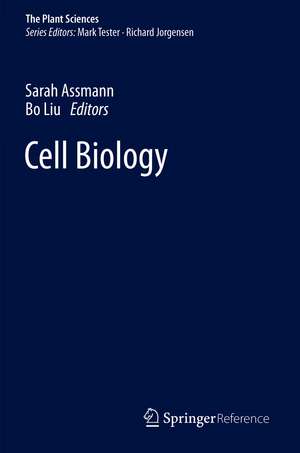
Plant Cell Biology: Plant Sciences, cartea 4
Editat de Sarah Assmann, Bo Liuen Limba Engleză Hardback – 4 iul 2018
Preț: 1133.18 lei
Preț vechi: 1664.30 lei
-32% Precomandă
Puncte Express: 1700
Carte nepublicată încă
Livrare prin curier în România Precomanda se expediază când titlul devine disponibil.
Transport gratuit pentru acest produs Plată online sau ramburs, în funcție de opțiunile comenzii.
Retur gratuit în 14 zile Comandă securizată și suport în română.
Doresc să fiu notificat când acest titlu va fi disponibil:
Se trimite...
Specificații
ISBN-13: 9781461475064
ISBN-10: 1461475066
Pagini: 400
Dimensiuni: 155 x 235 mm
Ediția:2025
Editura: SPRINGER LONDON
Colecția Plant Sciences
Seria Plant Sciences
Locul publicării:New York, NY, United States
ISBN-10: 1461475066
Pagini: 400
Dimensiuni: 155 x 235 mm
Ediția:2025
Editura: SPRINGER LONDON
Colecția Plant Sciences
Seria Plant Sciences
Locul publicării:New York, NY, United States
V-ar putea interesa
-
 Botany IllustratedJanice Glimn-LacyPreț: 518.65 lei
-
 The Remarkable BaobabThomas PakenhamPreț: 124.76 lei
-
 -23%Preț: 516.16 lei670.34 lei
-
 Flora EuropaeaD. A. WebbPreț: 538.79 lei
-
 Lichen BiologyThomas H. III Nash-11%Preț: 558.85 lei627.93 lei
-
 -25%Preț: 89.58 lei119.80 lei
-
 Plant BiologyAlison M. Smith-9%Preț: 714.55 lei785.23 lei
-
 Principles of Plant NutritionKonrad Mengel-18%Preț: 2783.54 lei3394.56 lei
-
 Nectaries and NectarSusan W. Nicolson-18%Preț: 1276.02 lei1556.13 lei
-
 Rainfed Farming SystemsPhilip Tow-18%Preț: 1290.25 lei1573.48 lei
-
 Preț: 145.40 lei
-
 -18%Preț: 983.19 lei1199.01 lei
-
 Physiological Plant EcologyWalter Larcher-18%Preț: 771.23 lei940.53 lei
-
 -20%Preț: 672.48 lei840.60 lei
-
 Forest Tree Breeding in EuropeLuc E. Pâques-18%Preț: 1283.48 lei1565.22 lei
Public țintă
ResearchCuprins
Protein targeting.- Post-translational modification of proteins.- Protein degradation.- Subcellular organelles and structure.- The plasma membrane.- Vacuoles.- Chloroplast and mitochondrial cell biology.- Cell biology of the endoplasmic reticulum and plasmodesmata.- Cell biology of the nucleus.- Cell walls, intercellular space, secretion.- Cell division.
Notă biografică
Sarah Assman, PhD
Pennsylvania State University, Department of Biology, University Park, PA, USA
Bo Liu, PhD
UC Davis, Department of Plant Biology, Davis, CA, USA
Pennsylvania State University, Department of Biology, University Park, PA, USA
Bo Liu, PhD
UC Davis, Department of Plant Biology, Davis, CA, USA
Textul de pe ultima copertă
The aim of this project is to produce a the world’s most comprehensive reference in plant sciences. The Plant Sciences will be published both in print and online; the online text will be regularly updated to enable the reference to remain a useful authoritative resource for decades to come. The aim is to provide a sustainable superstructure on which can be built further volumes as plant science evolves. The first edition will contain ten volumes, with approximately 20-30 chapters per volume. The target audience for the initial ten volumes will be upper-division undergraduates, as well as graduate students and practitioners looking for an entry into a particular topic. The Encyclopedia will provide both background and essential information in plant biology. Topics will include plant genetics, genomics, biochemistry, natural products, proteins, cell biology, development, reproduction, physiology, ecology, evolution, systematics, biodiversity, and applications, including crop improvement and non-food applications.