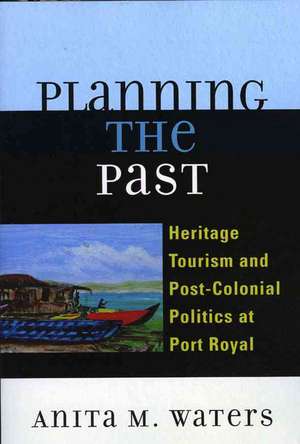
Planning the Past: Heritage Tourism and Post-Colonial Politics at Port Royal
Autor Anita M. Watersen Limba Engleză Paperback – 19 aug 2006
Preț: 304.27 lei
Preț vechi: 405.84 lei
-25%
Puncte Express: 456
Carte tipărită la comandă
Livrare economică 05-19 decembrie
Livrare prin curier în România Termenul estimat este afișat lângă disponibilitate.
Transport gratuit de la 400.00 lei Plată online sau ramburs, în funcție de opțiunile comenzii.
Retur gratuit în 14 zile Comandă securizată și suport în română.
Specificații
ISBN-13: 9780739117750
ISBN-10: 0739117750
Pagini: 125
Dimensiuni: 150 x 231 x 10 mm
Greutate: 0.22 kg
Editura: Bloomsbury Publishing
Colecția Lexington Books
Locul publicării:New York, United States
ISBN-10: 0739117750
Pagini: 125
Dimensiuni: 150 x 231 x 10 mm
Greutate: 0.22 kg
Editura: Bloomsbury Publishing
Colecția Lexington Books
Locul publicării:New York, United States
V-ar putea interesa
-
 One Hundred DaysAdmiral Sandy WoodwardPreț: 123.27 lei
 -
 -34%Preț: 914.34 lei1379.14 lei
 -
 The Antarctic: A Very Short IntroductionKlaus Dodds-20%Preț: 56.62 lei70.82 lei
 -
 Cuba and the United States: Intervention and Militarism, 1868-1933Jose M. HernándezPreț: 226.12 lei
 -
 Preț: 149.88 lei
 -
 Preț: 287.46 lei
 -
 Preț: 95.70 lei
 -
 The Big Truck That Went ByJonathan M KatzPreț: 140.80 lei
 -
 -39%Preț: 79.63 lei130.34 lei
 -
 The Fast-Changing Arctic: Rethinking Arctic Security for a Warmer WorldBarry Scott ZellenPreț: 310.43 lei
 -
 Fire Canoes: Steamboats on Great Canadian RiversAnthony Dalton-5%Preț: 73.74 lei77.60 lei
Cuprins
Chapter 1 Remembering Variable Histories
Chapter 2 Planning the Past in Port Royal
Chapter 3 Tourists Love Pirates
Chapter 4 Discovering African Port Royal
Chapter 5 A Private Community in the Public Eye
Chapter 2 Planning the Past in Port Royal
Chapter 3 Tourists Love Pirates
Chapter 4 Discovering African Port Royal
Chapter 5 A Private Community in the Public Eye
Recenzii
Waters' Planning the Past represents an important case study of the contested and changing representations of history and heritagem, one that sheds light on Jamaica's relationship with its colonial past and the region's continuing struggle with historicity and authenticity.
This is an interesting and thought-provoking study...
The research, insights, and cultural hermeneutic of Professor Waters' work are stimulating, academically engaging, and culturally restorative in vision and the justification thereof. Whereas past administrations have mapped the contours of the ruins and thereby have given up on Port Royal as a 'royal eye-sore', Professor Waters has rediscovered and reaffirmed the historic-cultural gems of the community-a people and place where the ascription of Royal is more than an honorific nomenclature, but a Port of entry into a promising vision of dignity, prosperity, and hospitality.
This is an interesting and thought-provoking study...
The research, insights, and cultural hermeneutic of Professor Waters' work are stimulating, academically engaging, and culturally restorative in vision and the justification thereof. Whereas past administrations have mapped the contours of the ruins and thereby have given up on Port Royal as a 'royal eye-sore', Professor Waters has rediscovered and reaffirmed the historic-cultural gems of the community-a people and place where the ascription of Royal is more than an honorific nomenclature, but a Port of entry into a promising vision of dignity, prosperity, and hospitality.