Cantitate/Preț
Produs

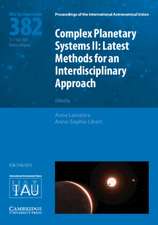
Planetary Nebulae (Iau S384)

Editat de Orsola de Marco, Albert Zijlstra, Ryszard Szczerba
en Limba Engleză Hardback – 4 dec 2025

Observăm că volumul Planetary Nebulae (IAU S384) se deschide cu o analiză riguroasă a problemelor de astrofizică ce pot fi soluționate prin studiul acestor obiecte cerești, depășind simpla admirație pentru formele lor spectaculoase. Ne-a atras atenția modul în care editorii Albert Zijlstra, Orsola de Marco și Ryszard Szczerba au structurat contribuțiile simpozionului pentru a evidenția utilitatea nebuloaselor ca laboratoare pentru procese fizice complexe. Textul explorează mecanismele prin care straturile exterioare ale stelelor de masă intermediară sunt ejectate, transformându-se în pitice albe și ionizând materia din jur. Notăm cu interes tranziția de la descrierea morfologică la aplicații concrete în evoluția chimică a galaxiilor și studiul sistemelor binare. Această ediție, publicată de Cambridge University Press în seria Proceedings of the International Astronomical Union Symposia and Colloquia, servește drept resursă tehnică pentru cercetătorii care doresc să integreze datele observaționale în modelele lor de evoluție stelară. Comparativ cu The Origin and Evolution of Planetary Nebulae de Sun Kwok, care oferă o privire de ansamblu istorică și fizică asupra subiectului, volumul de față aduce în prim-plan cele mai recente date de la simpozionul 384, fiind o alternativă actualizată pentru cursurile de astrofizică stelară, cu avantajul de a conecta studiul nebuloaselor cu astrobiologia și dinamica clusterelor galactice. Ritmul este unul academic, dens în date, facilitând o înțelegere profundă a modului în care instrumentele de diagnoză specifice pot informa și alte ramuri ale astronomiei moderne.

Citește tot Restrânge

Preț: 77177 lei

Preț vechi: 89741 lei
-14%

Puncte Express: 1158

Carte disponibilă

Livrare economică 02-16 decembrie

Livrare prin curier în România Termenul estimat este afișat lângă disponibilitate.
Transport gratuit pentru acest produs Plată online sau ramburs, în funcție de opțiunile comenzii.
Retur gratuit în 14 zile Comandă securizată și suport în română.

Specificații

ISBN-13: 9781009399326
ISBN-10: 1009399322
Pagini: 400
Dimensiuni: 182 x 249 x 22 mm
Greutate: 0.93 kg
Editura: Cambridge University Press

De ce să citești această carte

Această lucrare este esențială pentru astronomii și cercetătorii care caută o sinteză modernă a proceselor stelare și galactice. Cititorul câștigă acces la concluziile celui mai recent simpozion IAU, învățând cum să utilizeze nebuloasele planetare ca indicatori pentru evoluția chimică a universului și pentru înțelegerea sistemelor stelare binare, totul într-un format academic de înaltă ținută.


Descriere

Planetary nebulae are generated when the outer layers of intermediate-mass stars are ejected during the second giant expansion after core helium burning has ceased. The star, ultimately destined to becoming a white dwarf, ionises the ejecta revealing intricate nebular shapes. Over the years, the initial awe inspired by these beautiful displays has turned into the realisation of the vast number of astrophysical questions that can be tackled using planetary nebulae. This volume collects a series of contributions to IAU Symposium 384, which show the breadth of problems that can be addressed with these objects: from the dynamical and chemical evolutions of galaxies and clusters, to the evolution of stars, to binary interactions, and to the exploration of the chemistry of life. Researchers from many astronomical fields can discover how observational tools from planetary nebulae can be applied to inform and benefit their own work.

Cuprins

Session I. Focus on PN as populations and as tools (extragalactic PN): Planetary nebulae as probes of kinematics and abundances to trace galaxy evolution Letizia Stanghellini; Astronomical outreach and education in marginalised and indigenous communities: astronomy as a tool for social development Arianna Cortesi; Planetary nebulae as tracers of stellar population properties Ana Ennis; Survey of llanetary nebulae in the Andromeda galaxy (M31) Souradeep Bhattacharya; Analysis of distances to planetary nebulae Diego Hernández-Juárez; GTC spectroscopic surveys of planetary nebulae in the Milky Way and M31 Xuan Fang; Probing the local planetary nebula luminosity function with Gaia Nicholas Chornay; Integral field spectroscopy: a disruptive innovation for observations of Planetary Nebulae and the PNLF Martin Roth; Precision spectrophotometry for PNLF distances: the case of NGC 300 Azlizan Adhyaqsa Soemitro; PICS: Planetary nebulae in cosmological simulations Lucas Valenzuela; Towards precision cosmology with improved PNLF distances using VLT-MUSE George Jacoby; Using adaptive-optics assisted MUSE observations to measure galaxy distances with the Planetary Nebulae luminosity function Saskia Schlagenhauf; Kinematics of the diffuse intragroup/intracluster light in groups and clusters of galaxies in the Local Universe (within 100 Mpc) Magda Arnaboldi; A new population of stars between the LMC and the MW revealed by post-AGB stars Minia Manteiga Outeiro; Diverse science from VLT imagery and spectroscopy of PNe in the Galactic Bulge Quentin Parker; Planetary nebulae populations in the haloes of nearby massive early-type galaxies Johanna Hartke; Session II. Focus on PN abundances/chemistry/dust: On determining the chemical composition of planetary nebulae Grazyna Stasinska; The structure of emission lines in planetary nebulae at very high spectral resolution Michael Richer; Precise determination of extinction correction and plasma diagnostics Toshiya Ueta; Abundance determination in PNe: How to deal with large chemical inhomogeneities Christophe Morisset; A statistical view of low-ionization structures in planetary nebulae M. Mari; What do we really know about the low-ionization structures in planetary nebulae? Stavros Akras; Probing the physical and chemical properties of planetary nebulae using precision photoionization modelling Hektor Monteiro; JWST imaging observations of the Ring Nebula Roger Wesson; Remarkable chemical complexity in planetary nebulae: A molecule and dust perspective Lucy Ziurys; ALMA observations of molecular line emission from high-excitation bipolar planetary nebulae Paula Moraga Baez; Morpho-kinematical modelling in the molecular zoo beyond CO: the case of M 1-92 Miguel Santander-García; Session III. Focus on PN chemistry/dust: Dust production from low- and intermediate-mass stars: new insights from post-AGB stars and PNe Flavia Dell'Agli; Deep radio observations of (proto-) planetary nebulae Teresa Huertas-Roldán; Synthesis of complex organics in planetary nebulae Sun Kwok; NanoSpace: Networking to understand carbon molecular nanostructures in PNe Domingo García-Hernández; Dust formation in AGB stars and planetary nebulae Mikako Matsuura; The Red Rectangle: a thin disk with big grains Javier Alcolea; Dust formation during the interaction of binary stars by common envelope Luis Carlos Bermúdez Bustamante; Session IV. Focus on stellar evolution; evolutionary scenarios; including binaries: The evolutionary path from the AGB to the PN phases: certainties and open issues Paolo Ventura; Nova remnants ... the fast siblings of planetary nebulae Martin Guerrero; Evolution from Asymptotic Giant Branch to Pre-planetary Nebula: Whorled patterns and stellar companions Hyosun Kim; NGC 1514 and the post-AGB mass-luminosity relation Roberto Mendez; Monitoring of dynamical processes in outer atmospheres of cool protopla