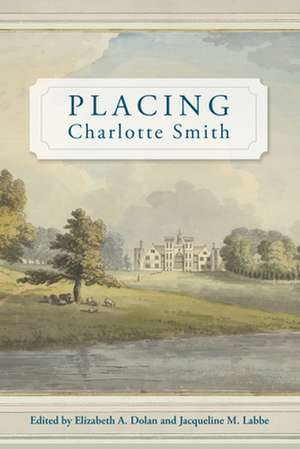
Placing Charlotte Smith
Editat de Elizabeth A. Dolan, Jacqueline M. Labbe Contribuţii de Melissa Bailes, Stephen Behrendt, Anne Chandler, Val Derbyshire, Rachael Isom, Dr Claire Knowles, Mary Anne Myers, Lisa Vargoen Limba Engleză Hardback – 30 dec 2020
Preț: 698.83 lei
Preț vechi: 1054.59 lei
-34%
Puncte Express: 1048
Carte tipărită la comandă
Livrare economică 30 noiembrie-14 decembrie
Livrare prin curier în România Termenul estimat este afișat lângă disponibilitate.
Transport gratuit pentru acest produs Plată online sau ramburs, în funcție de opțiunile comenzii.
Retur gratuit în 14 zile Comandă securizată și suport în română.
Specificații
ISBN-13: 9781611462951
ISBN-10: 1611462959
Pagini: 332
Ilustrații: 16 b/w illustrations; 1 tables;
Dimensiuni: 160 x 232 x 26 mm
Greutate: 0.62 kg
Editura: Bloomsbury Publishing
Colecția Lehigh University Press
Locul publicării:New York, United States
ISBN-10: 1611462959
Pagini: 332
Ilustrații: 16 b/w illustrations; 1 tables;
Dimensiuni: 160 x 232 x 26 mm
Greutate: 0.62 kg
Editura: Bloomsbury Publishing
Colecția Lehigh University Press
Locul publicării:New York, United States
Cuprins
Chapter 1: The Elusive Charlotte Smith, by Stephen Behrendt
Chapter 2: "Far from my native fields removed": Gentility, Displacement, and the Idea of Home in the Life and Poetry of Charlotte Smith, by Claire Knowles
Chapter 3: Creating Home: The Roots of Charlotte Smith's Cosmopolitanism in Emmeline, by Elizabeth A. Dolan
Chapter 4: Charlotte Smith: English Patriot, by Mary Anne Myers
Chapter 5: Comedic Travel and Political Satire: Smollett, Fielding, and Charlotte Smith's The Old Manor House, by Anne Chandler
Chapter 6: Locating the Common in Charlotte Smith's Ecocritical Writings for Children, by Lisa Vargo
Chapter 7: "On the green margin": Science, Gender, and Originality in Charlotte Smith's "Flora," by Melissa Bailes
Chapter 8: "With Faithful Pencil": Pastoral and Picturesque Composition in Beachy Head, by Rachael Isom
Chapter 9: "A Tale of Two Smiths": In Pursuit of the Picturesque in Emmeline, the Orphan of the Castle, by Val Derbyshire
Chapter 10: Strange Shells of Poetry in the Landscape of C
Chapter 2: "Far from my native fields removed": Gentility, Displacement, and the Idea of Home in the Life and Poetry of Charlotte Smith, by Claire Knowles
Chapter 3: Creating Home: The Roots of Charlotte Smith's Cosmopolitanism in Emmeline, by Elizabeth A. Dolan
Chapter 4: Charlotte Smith: English Patriot, by Mary Anne Myers
Chapter 5: Comedic Travel and Political Satire: Smollett, Fielding, and Charlotte Smith's The Old Manor House, by Anne Chandler
Chapter 6: Locating the Common in Charlotte Smith's Ecocritical Writings for Children, by Lisa Vargo
Chapter 7: "On the green margin": Science, Gender, and Originality in Charlotte Smith's "Flora," by Melissa Bailes
Chapter 8: "With Faithful Pencil": Pastoral and Picturesque Composition in Beachy Head, by Rachael Isom
Chapter 9: "A Tale of Two Smiths": In Pursuit of the Picturesque in Emmeline, the Orphan of the Castle, by Val Derbyshire
Chapter 10: Strange Shells of Poetry in the Landscape of C
Recenzii
The essays in Placing Charlotte Smith showcase the results of the last 25 years of scholarship on Smith to establish her place in the canon of British Romantic-era artists and to contextualize her within the political, aesthetic, and scientific concepts and practices of her time. Especially illuminating is discussion of the ways Smith employed, deconstructed, and refashioned contemporaneous literary, pictorial, and scientific conventions. Well trained in Linnaean taxonomy, she created an alternative, liminal poetic seascape. Using the "productive tensions Smith create[d] between the pastoral and picturesque traditions," including unlovely economic facts such as smuggling, Smith demonstrated the constructedness of pastoral scenes and lives normally portrayed there. One difficulty-and pleasure-in "placing" Charlotte Smith is that she creates ambiguous, multivalent personae to ensure the wide readership so essential to her survival. Highly recommended. Graduate students, researchers, faculty.
Although she aspired to be a citizen of the world, Charlotte Smith spent her entire literary career as a displaced person constantly on the move and fixated on the anomalies of her status. In Placing Charlotte Smith, a set of uniformly insightful and incisive essays concentrate on the acute sense of place Smith cultivated as a marker across her disparate productions in poetry and prose. In its large compass and its refined erudition, this important volume reminds us why Smith is such a radically original, indispensable figure in the Romantic scene.
Dolan and Labbe's rich trove of essays will delight Smith scholars. Here is a collection of lucid, often eye-opening discussions of Smith's essential interventions in late eighteenth and early nineteenth-century British literary culture. But Placing Charlotte Smith is no narrow specialist's tome. The essays in this volume engage an extensive array of cultural issues and practices including visual and literary aesthetics, constructs of national identity, and domestic ideologies. Dolan and Labbe's collection offers fresh perspectives to readers with broad interests in the period, as well as to those already familiar with Charlotte Smith's work and life.
While much has been written about Charlotte Smith (1749-1806) and sensibility, gender, the picturesque, genre, politics, and proto-feminism, amongst other topics, Placing Charlotte Smith editors Elizabeth A. Dolan and Jacqueline M. Labbe ask a series of new questions about Smith that are relevant to all other Smithian themes: Smith's placement in the world and literature. Beyond, of course, literal place, this welcome contribution to eighteenth-century studies asks where we might find Smith in history, politics, aesthetics, and the natural world. This collection is an important addition to the current body of Smithian scholarship, and, perhaps more importantly, it offers context on contemporary problems around gender and oppression and scaffolds a way of thinking through our own multiplicities. It is a valuable contribution to eighteenth-century studies, and it succeeds in articulating the vital role of place in eighteenth-century studies.
Although she aspired to be a citizen of the world, Charlotte Smith spent her entire literary career as a displaced person constantly on the move and fixated on the anomalies of her status. In Placing Charlotte Smith, a set of uniformly insightful and incisive essays concentrate on the acute sense of place Smith cultivated as a marker across her disparate productions in poetry and prose. In its large compass and its refined erudition, this important volume reminds us why Smith is such a radically original, indispensable figure in the Romantic scene.
Dolan and Labbe's rich trove of essays will delight Smith scholars. Here is a collection of lucid, often eye-opening discussions of Smith's essential interventions in late eighteenth and early nineteenth-century British literary culture. But Placing Charlotte Smith is no narrow specialist's tome. The essays in this volume engage an extensive array of cultural issues and practices including visual and literary aesthetics, constructs of national identity, and domestic ideologies. Dolan and Labbe's collection offers fresh perspectives to readers with broad interests in the period, as well as to those already familiar with Charlotte Smith's work and life.
While much has been written about Charlotte Smith (1749-1806) and sensibility, gender, the picturesque, genre, politics, and proto-feminism, amongst other topics, Placing Charlotte Smith editors Elizabeth A. Dolan and Jacqueline M. Labbe ask a series of new questions about Smith that are relevant to all other Smithian themes: Smith's placement in the world and literature. Beyond, of course, literal place, this welcome contribution to eighteenth-century studies asks where we might find Smith in history, politics, aesthetics, and the natural world. This collection is an important addition to the current body of Smithian scholarship, and, perhaps more importantly, it offers context on contemporary problems around gender and oppression and scaffolds a way of thinking through our own multiplicities. It is a valuable contribution to eighteenth-century studies, and it succeeds in articulating the vital role of place in eighteenth-century studies.