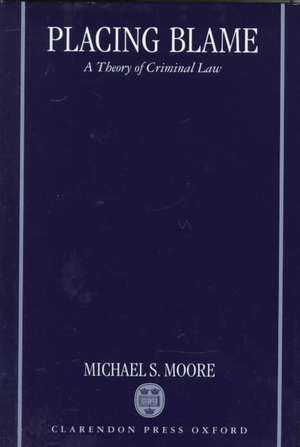
Placing Blame: A Theory of the Criminal Law
Autor Michael Mooreen Limba Engleză Hardback – 27 noi 1997
Preț: 610.66 lei
Preț vechi: 891.93 lei
-32%
Puncte Express: 916
Carte tipărită la comandă
Livrare economică 26 noiembrie-02 decembrie
Livrare prin curier în România Termenul estimat este afișat lângă disponibilitate.
Transport gratuit pentru acest produs Plată online sau ramburs, în funcție de opțiunile comenzii.
Retur gratuit în 14 zile Comandă securizată și suport în română.
Specificații
ISBN-13: 9780198254171
ISBN-10: 0198254172
Pagini: 872
Dimensiuni: 165 x 243 x 44 mm
Greutate: 1.28 kg
Editura: Clarendon Press
Colecția Clarendon Press
Locul publicării:Oxford, United Kingdom
ISBN-10: 0198254172
Pagini: 872
Dimensiuni: 165 x 243 x 44 mm
Greutate: 1.28 kg
Editura: Clarendon Press
Colecția Clarendon Press
Locul publicării:Oxford, United Kingdom
V-ar putea interesa
-
 Jurisprudence: Cambridge EssaysHyman Gross-33%Preț: 1025.22 lei1526.92 lei
 -
 Legal System Between Order and DisorderMichel Van De Kerchove-33%Preț: 754.59 lei1123.10 lei
 -
 Objectivity in LawNicos Stavropoulos-33%Preț: 993.49 lei1479.46 lei
 -
 Law and Interpretation: Essays in Legal PhilosophyAndrei Marmor-28%Preț: 543.46 lei758.33 lei
 -
 Law's Community: Legal Theory in Sociological PerspectiveRoger Cotterrell-31%Preț: 533.21 lei771.31 lei
 -
 -29%Preț: 396.50 lei555.39 lei
 -
 -33%Preț: 1091.72 lei1623.65 lei
 -
 The Autonomy of Law: Essays on Legal PositivismRobert P. George-29%Preț: 510.02 lei714.23 lei
 -
 International Law's ObjectsJessie Hohmann-31%Preț: 1140.03 lei1644.51 lei
 -
 -31%Preț: 528.54 lei765.86 lei
 -
 -18%Preț: 363.54 lei440.96 lei
 -
 Imposing Risk: A Normative FrameworkJohn Oberdiek-31%Preț: 545.37 lei789.48 lei
 -
 The Structure of PluralismVictor M. Muniz-Fraticelli-31%Preț: 710.40 lei1030.75 lei
 -
 Reflections on 'The Concept of Law'A. W. Brian Simpson-31%Preț: 570.86 lei822.07 lei
 -
 New Essays on the Nature of RightsDr Mark McBride-33%Preț: 615.07 lei911.48 lei
 -
 -36%Preț: 612.05 lei960.59 lei
 -
 Law's JudgementProfessor William Lucy-32%Preț: 615.52 lei911.74 lei
 -
 Community Literacy Journal 8.2 (Spring 2014)Michael MoorePreț: 144.72 lei
 -
 Community Literacy Journal 9.1 (Fall 2014)Michael MoorePreț: 149.14 lei
 -
 Community Literacy Journal 10.1 (Autumn 2015)Michael MoorePreț: 144.52 lei
 -
 Legal Validity: The Fabric of JusticeMaris Köpcke-30%Preț: 536.98 lei768.55 lei
 -
 The History of Chinese Legal CivilizationJinfan Zhang-18%Preț: 1017.85 lei1241.28 lei
Recenzii
The high-point of Moore's exposition ... is a fine and psychologically penetrating defense of subjective moral institutions and emotions as 'heuristic indicators' of moral truths.
In an elegant and masterly introductory essay, laying out in order all the tasks of a theory of criminal law, he pleads that any 'deep theory' of the way law operates must take a moral point of view and be founded on moral institutions.
This book belongs on the shelves of every serious criminal law theorist and every research library in the world./ M. M. Feeley, University of California, Berkeley, Choice, Feb 1999, Vol 36, no. 6
The book has four particular qualities which mark it out as a distinctive contribution to criminal law theory... its scope is remarkably broad. Furthermore, Moore brings an unusual combination of disciplinary perspectives to bear on the wide range of questions which he considers. Moore is also unusual in giving the emotions a central place in his theory of criminal law. One has to admire the originality of Moore's position. He is a trenchant anti-consequentialist in ethics who nonetheless provides a careful analysis of teh proper role of consequential arguments in shaping criminal law.
...the book works mainly as a collection of essays, written over the past twenty years, on topics in criminal theory. As such, it has real strengths./ ... these are high-quality essays by a considerable figure, and should be read by anyone interested in criminal theory who has not done so already./ A. P. Simester, The Cambridge Law Journal, 1998.
In an elegant and masterly introductory essay, laying out in order all the tasks of a theory of criminal law, he pleads that any 'deep theory' of the way law operates must take a moral point of view and be founded on moral institutions.
This book belongs on the shelves of every serious criminal law theorist and every research library in the world./ M. M. Feeley, University of California, Berkeley, Choice, Feb 1999, Vol 36, no. 6
The book has four particular qualities which mark it out as a distinctive contribution to criminal law theory... its scope is remarkably broad. Furthermore, Moore brings an unusual combination of disciplinary perspectives to bear on the wide range of questions which he considers. Moore is also unusual in giving the emotions a central place in his theory of criminal law. One has to admire the originality of Moore's position. He is a trenchant anti-consequentialist in ethics who nonetheless provides a careful analysis of teh proper role of consequential arguments in shaping criminal law.
...the book works mainly as a collection of essays, written over the past twenty years, on topics in criminal theory. As such, it has real strengths./ ... these are high-quality essays by a considerable figure, and should be read by anyone interested in criminal theory who has not done so already./ A. P. Simester, The Cambridge Law Journal, 1998.
Cuprins
- 1: A Theory of Criminal Law Theories
- Part One: THE THEORY OF PUNISHMENT
- 2: Closet Retributivism
- 3: The Moral Worth of Retribution
- Part Two: THE THEORY OF RESPONSIBILITY
- 4: The Place of Moral Theory in the Criminal Law
- Part Three: THE THEORIES OF ACTION, INTENTION, CAUSATION, JUSTIFICATION, AND EXCUSE
- A) THE NATURE OF HUMAN ACTION
- 5: The Nature of Basic and Complex Actions
- B) THE NATURE OF MENTAL STATES
- 6: Mind, Brain and the Unconscious
- 7: Intentions and Mens Rea
- C) THE NATURE OF CAUSATION
- 8: Thomson's Preliminaries about Causation and Rights
- D) THE NATURE OF JUSTIFICATION
- 9: Torture and the Balance of Evils
- E) THE NATURE OF EXCUSE
- 10: Mental Illness and Responsibility
- 11: Causation and the Excuses
- 12: Choice, Character and Excuse
- Part Four: THE THEORY OF PERSONHOOD
- 13: The Moral and Metaphysical Sources of the Criminal Law
- Part Five: PRINCIPLES OF THE SPECIAL PART
- 14: The Limits of Legislation
- 15: Sandelian Anti-Liberalism
- 16: Privacy and the Constitutional Limits on Criminal Legislation
- 17: Legality and Privacy Applied: Vagueness, Proportionality, Homosexuals in Schools, and Abortion