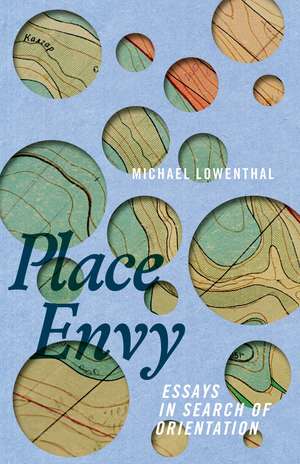
Place Envy: Essays in Search of Orientation: Machete
Autor Michael Lowenthalen Limba Engleză Paperback – 9 feb 2026
A queer, Jewish writer searches for belonging across countries, identities, and histories in a moving collection of essays about orientation and home.
Growing up in places where his family had no past, and met mostly by silence from his Holocaust-refugee grandparents, Michael Lowenthal longed to be from somewhere. Then he realized he was gay and felt displaced from his own displaced family. Place Envy—his first book of essays after five acclaimed books of fiction—chronicles his quest for orientation in the world: as an agnostic Jew, as a queer traveler and lover, and as a writer who can tell or twist the truth. Yearning for a queer lineage, he obsesses about an uncle who perished at Bergen-Belsen but then finds, in his grandmother’s German hometown, a more surprising legacy. He lives with a Pennsylvania Amish family; accompanies blind gay men on a Mexican cruise; plays jazz with Sun Ra, the Afrofuturist who claimed to hail from Saturn; and pursues a clarifying love affair in Brazil. Collectively, these essays recount Lowenthal’s many journeys of dislocation and relocation: to foreign countries and subcultures and to the riskiest shores of family and self.
Growing up in places where his family had no past, and met mostly by silence from his Holocaust-refugee grandparents, Michael Lowenthal longed to be from somewhere. Then he realized he was gay and felt displaced from his own displaced family. Place Envy—his first book of essays after five acclaimed books of fiction—chronicles his quest for orientation in the world: as an agnostic Jew, as a queer traveler and lover, and as a writer who can tell or twist the truth. Yearning for a queer lineage, he obsesses about an uncle who perished at Bergen-Belsen but then finds, in his grandmother’s German hometown, a more surprising legacy. He lives with a Pennsylvania Amish family; accompanies blind gay men on a Mexican cruise; plays jazz with Sun Ra, the Afrofuturist who claimed to hail from Saturn; and pursues a clarifying love affair in Brazil. Collectively, these essays recount Lowenthal’s many journeys of dislocation and relocation: to foreign countries and subcultures and to the riskiest shores of family and self.

Preț: 144.16 lei
Puncte Express: 216
Carte disponibilă
Livrare economică 06-20 noiembrie
Livrare prin curier în România Termenul estimat este afișat lângă disponibilitate.
Transport gratuit de la 400.00 lei Plată online sau ramburs, în funcție de opțiunile comenzii.
Retur gratuit în 14 zile Comandă securizată și suport în română.
Specificații
ISBN-13: 9780814259665
ISBN-10: 0814259669
Pagini: 292
Ilustrații: 1 b&w image
Dimensiuni: 140 x 216 x 23 mm
Greutate: 0.45 kg
Editura: Ohio State University Press
Colecția Mad Creek Books
Seria Machete
ISBN-10: 0814259669
Pagini: 292
Ilustrații: 1 b&w image
Dimensiuni: 140 x 216 x 23 mm
Greutate: 0.45 kg
Editura: Ohio State University Press
Colecția Mad Creek Books
Seria Machete
Recenzii
“Through nuanced encounters with both self and other, Place Envy takes us on a vivid and, at times, searing journey. What does it mean to love and be loved? How does one queer, Jewish writer stave off loneliness, form connections, make art, and come to understand his place in the world? Michael Lowenthal’s journey in this beautiful book is riveting and full of unexpected turns.” —Elizabeth Graver, author of Kantika
“Enlightening and heartfelt, Place Envy is laugh-out-loud funny and find-the-tissues moving. In each essay, Lowenthal explores love, family, sex, and faith, all the while asking what world, what place, can hold us all and all that we contain. His prose can elucidate the impossibly complex in an instant and yet feel as familiar as a dear friend. This book is a beautiful testament to both his skill as a writer and his heart as a seeker.” —Lyz Lenz, author of This American Ex-Wife
“Place Envy is an engrossing and provocative book. Lowenthal is a vivid narrator of his journeys as a young gay man, sharing his travels by car, bus, plane, Amish buggy, and cruise ship from Brookline to Buchau and Scotland to Salvador, Brazil. Throughout, he never hesitates to approach the third rail—and then grasp it. Beautifully written and crafted, the story reaches back generations as it explores the tortuous interplay between where you are and who you are.” —Will Schwalbe, author of The End of Your Life Book Club
“The question ‘Where am I?’ sometimes asks for a kind of orientation that no GPS can provide. So it is for Michael Lowenthal—a gay Jew from a family of Holocaust refugees—in this brilliantly written and, in the end, deeply moving account of a years-long passage from inner homelessness to home at last.” —Jack Miles, coauthor of A Friendship in Twilight: Lockdown Conversations on Death and Life
“In this quiet and elegant collection, novelist and short story writer Lowenthal uses the essay as a means of excavation, uncovering the tensions between his queer and Jewish identities and the desire to belong fully to both....A lucid, searching meditation on belonging and self-invention.” —Kirkus
“The power of Lowenthal’s essays lies in the author’s willingness to foreground his self-doubt and wrestle openly with what he wants, what he needs, and of what he feels worthy....Thanks to his willingness to put his own vulnerability on the page, Lowenthal reveals the scars...that many Jewish gay men carry.” —Wayne Hoffman, Jewish Book Council
“Elegantly recounting journeys that have taken him around the globe and to the depths of his consciousness, Lowenthal explores aspects of his identity...by placing himself in environments that are, at least superficially, unfamiliar.” —Jim Gladstone, Passport Magazine
“Lowenthal’s candor makes Place Envy a wonderful and often surprising book, one willing to play in the mud if it means getting closer to truth....Like a good David Sedaris essay, Lowenthal’s are honest, self-compromising and mischievous.” —Sam Franzini, Moment Magazine
Notă biografică
Michael Lowenthal is the author of the novels The Same Embrace,Avoidance,Charity Girl, and The Paternity Test and of the short story collection Sex with Strangers. His writing has appeared in The New York Times Magazine,The Boston Globe,The Washington Post,Out, and many other publications. His stories have been widely anthologized.
Extras
The email came from my father’s eighty-two-year-old half sister. “Please send me ‘Saying Kaddish for Peter,’” read the subject line, followed by just her address and “Thanks. Chaninah.”
By this point, in 2014, I’d had no contact with Chaninah for seven years; we had only ever met three times. What unsettled me even more than her curtness was her request for an essay I’d published two decades earlier, in my twenties. The titular Peter was her brother, who’d died in 1945 at Bergen-Belsen, but my piece had disregarded her and her real loss, focusing on my fantasies of Peter. I had long since stopped fretting that she might find the essay, but now she’d finally gotten wind of it.
Peter was, or would have been, my half uncle, but I had learned of his existence only at fourteen, when my father’s father died and I read his obituary: “Rabbi Lowenthal and his wife, Suzanne (Moos), fled to New York in July 1939, escaping the Nazi purge of the Jews. However, a son, Peter, from an earlier marriage, was a victim of the Holocaust.”
I was staggered. Who was this uncle who’d turned up out of nowhere? A forebear who, just as he appeared, also perished.
I ached to learn about him, but also—self-involved teenager that I was—to learn what he might show me about myself. I had often felt like an alien in my own family, unconvinced that I deserved our name. I latched on to Peter as a possible connection, dreaming of the links we might share. (I’d seen twins on TV shows, separated as infants and, years later, reunited.) Like me, he would be moony, into folk songs and hiking alone. Like me, he would wonder how he fit in.
I was dying to ask someone about him, but who?
I’d met Chaninah a few years earlier, when she came to Passover at my grandparents’ place, in Brookline, Massachusetts. She’d struck me as a sanded-down version of Papa Eric—that was what we called my grandfather—her old-world accent a touch less gruff, her stare as hard but with a little give. I’d thought it odd that although we both lived in Maryland (her home, in Annapolis, less than an hour from mine), we were meeting hundreds of miles away. Was she, too, a misfit, undeserving?
I didn’t see her again until Papa Eric’s funeral. I know she attended—she was his daughter, after all—but I can’t summon an image of her there. In truth, I have few memories from that day, so jarred was I by the loss compounded by an awful adolescent embarrassment. My face, as it did often then, had swollen with hives; my eyes bulged like oozing goiters. Mortified, I tried to hide behind mirrored sunglasses. Through my fog of shame, I couldn’t see that the flashy lenses only drew attention to my face, or that in the synagogue they would seem profane. (Did my dad try to talk me out of wearing them? Did anyone?)
By the time I read the obituary, days later, and learned about my grandfather’s first son, Chaninah was gone again, her place in the family largely notional—which was why, I suppose, I didn’t register that she had probably grown up with Peter. And why, even as my curiosity surged, I didn’t think to ask her about him.
By this point, in 2014, I’d had no contact with Chaninah for seven years; we had only ever met three times. What unsettled me even more than her curtness was her request for an essay I’d published two decades earlier, in my twenties. The titular Peter was her brother, who’d died in 1945 at Bergen-Belsen, but my piece had disregarded her and her real loss, focusing on my fantasies of Peter. I had long since stopped fretting that she might find the essay, but now she’d finally gotten wind of it.
Peter was, or would have been, my half uncle, but I had learned of his existence only at fourteen, when my father’s father died and I read his obituary: “Rabbi Lowenthal and his wife, Suzanne (Moos), fled to New York in July 1939, escaping the Nazi purge of the Jews. However, a son, Peter, from an earlier marriage, was a victim of the Holocaust.”
I was staggered. Who was this uncle who’d turned up out of nowhere? A forebear who, just as he appeared, also perished.
I ached to learn about him, but also—self-involved teenager that I was—to learn what he might show me about myself. I had often felt like an alien in my own family, unconvinced that I deserved our name. I latched on to Peter as a possible connection, dreaming of the links we might share. (I’d seen twins on TV shows, separated as infants and, years later, reunited.) Like me, he would be moony, into folk songs and hiking alone. Like me, he would wonder how he fit in.
I was dying to ask someone about him, but who?
I’d met Chaninah a few years earlier, when she came to Passover at my grandparents’ place, in Brookline, Massachusetts. She’d struck me as a sanded-down version of Papa Eric—that was what we called my grandfather—her old-world accent a touch less gruff, her stare as hard but with a little give. I’d thought it odd that although we both lived in Maryland (her home, in Annapolis, less than an hour from mine), we were meeting hundreds of miles away. Was she, too, a misfit, undeserving?
I didn’t see her again until Papa Eric’s funeral. I know she attended—she was his daughter, after all—but I can’t summon an image of her there. In truth, I have few memories from that day, so jarred was I by the loss compounded by an awful adolescent embarrassment. My face, as it did often then, had swollen with hives; my eyes bulged like oozing goiters. Mortified, I tried to hide behind mirrored sunglasses. Through my fog of shame, I couldn’t see that the flashy lenses only drew attention to my face, or that in the synagogue they would seem profane. (Did my dad try to talk me out of wearing them? Did anyone?)
By the time I read the obituary, days later, and learned about my grandfather’s first son, Chaninah was gone again, her place in the family largely notional—which was why, I suppose, I didn’t register that she had probably grown up with Peter. And why, even as my curiosity surged, I didn’t think to ask her about him.
Cuprins
Contents
I. A Good Place (Part 1)
Out of Nowhere
II. Dislocations and Relocations
Ligature
Face the Music
Used-Car Salesman
You Don’t See the Other Person Looking Back
Loss of Orientation
Unmolested
What I Left Out
Estrangeiro
III. A Good Place (Part 2)
Put Your House in Order
Acknowledgments
About the Author
I. A Good Place (Part 1)
Out of Nowhere
II. Dislocations and Relocations
Ligature
Face the Music
Used-Car Salesman
You Don’t See the Other Person Looking Back
Loss of Orientation
Unmolested
What I Left Out
Estrangeiro
III. A Good Place (Part 2)
Put Your House in Order
Acknowledgments
About the Author
Descriere
Chronicles the author’s quest for orientation in the world: as an agnostic Jew, as a queer traveler and lover, and as a writer who can tell or twist the truth.