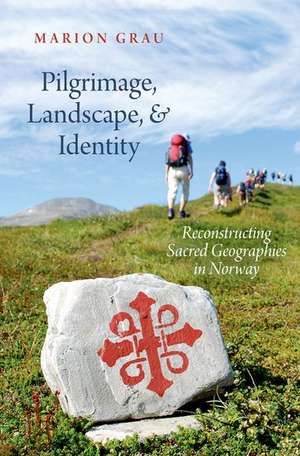
Pilgrimage, Landscape, and Identity: Reconstucting Sacred Geographies in Norway: Oxford Ritual Studies
Autor Marion Grauen Limba Engleză Hardback – 22 oct 2021


Preț: 524.60 lei
Preț vechi: 752.82 lei
-30%
Puncte Express: 787
Carte disponibilă
Livrare economică 30 octombrie-04 noiembrie
Livrare prin curier în România Termenul estimat este afișat lângă disponibilitate.
Transport gratuit pentru acest produs Plată online sau ramburs, în funcție de opțiunile comenzii.
Retur gratuit în 14 zile Comandă securizată și suport în română.
Specificații
ISBN-13: 9780197598634
ISBN-10: 0197598633
Pagini: 258
Dimensiuni: 239 x 160 x 25 mm
Greutate: 0.49 kg
Editura: Oxford University Press
Colecția OUP USA
Seria Oxford Ritual Studies
Locul publicării:New York, United States
ISBN-10: 0197598633
Pagini: 258
Dimensiuni: 239 x 160 x 25 mm
Greutate: 0.49 kg
Editura: Oxford University Press
Colecția OUP USA
Seria Oxford Ritual Studies
Locul publicării:New York, United States
Recenzii
Pilgrimage, Landscape, and Identity provides a welcome international perspective on pilgrimage in Norway, one of the few monographs on this topic published in English. Grau's circumambulation, combined with attention to international geopolitical and social issues, is commendable in its perspective on economic and ecological factors, as well as for including the voices of minorities in the discussions about the developments of pilgrimage networks.
In this impeccably researched and engagingly-written book, Marion Grau introduces readers to a Norwegian 'pilgrimage network' and its ritualizations of text, landscape, practices, and narratives. Grau brings an ecumenical perspective and a cross-disciplinary approach to bear on this rich study of reconstructed medieval pilgrimages, both at their inceptions and today as they continue to play a formative role in personal, national, and religious identity. Grau is an academic, pilgrim, and guide as she maps these paths for the reader in this important contribution to the ever-growing field of pilgrimage studies.
There has been a remarkable revival of pilgrimage shrines and routes in post-Reformation countries across Northern Europe. Marion Grau has made an impressive contribution to the growing, inter-disciplinary study of this revival. She guides us gently along the routes to the St. Olav shrine in Trondheim and sets this particular example within the wider context of a changing nation.
Interweaving 'circumambulatory field work,' theological reflection, and historical analysis, Grau has produced a richly textured tapestry of various narratives and vividly present landscapes and bodies. This is an impressive exploration of important issues concerning migration, nationalism, sacred and secular rituals, and climate change within the context of a Norwegian pilgrimage.
It is indeed a fine and novel study of pilgrimage in Norway, with interesting nuances and rich source materials. The book is written in an engaging language free of theological jargon, and it is both thought-provoking and interesting. It's well worth the read.
In this impeccably researched and engagingly-written book, Marion Grau introduces readers to a Norwegian 'pilgrimage network' and its ritualizations of text, landscape, practices, and narratives. Grau brings an ecumenical perspective and a cross-disciplinary approach to bear on this rich study of reconstructed medieval pilgrimages, both at their inceptions and today as they continue to play a formative role in personal, national, and religious identity. Grau is an academic, pilgrim, and guide as she maps these paths for the reader in this important contribution to the ever-growing field of pilgrimage studies.
There has been a remarkable revival of pilgrimage shrines and routes in post-Reformation countries across Northern Europe. Marion Grau has made an impressive contribution to the growing, inter-disciplinary study of this revival. She guides us gently along the routes to the St. Olav shrine in Trondheim and sets this particular example within the wider context of a changing nation.
Interweaving 'circumambulatory field work,' theological reflection, and historical analysis, Grau has produced a richly textured tapestry of various narratives and vividly present landscapes and bodies. This is an impressive exploration of important issues concerning migration, nationalism, sacred and secular rituals, and climate change within the context of a Norwegian pilgrimage.
It is indeed a fine and novel study of pilgrimage in Norway, with interesting nuances and rich source materials. The book is written in an engaging language free of theological jargon, and it is both thought-provoking and interesting. It's well worth the read.
Notă biografică
Marion Grau is Professor of Systematic Theology, Ecumenism and Missiology at MF Norwegian School of Theology, Religion, and Society in Oslo, Norway. Her teaching interests are in constructive theology and her current research projects include the redevelopment of pilgrimage and the reshaping of identity in Norway and a Theology of petroleum economies and climate change in the Northern hemisphere. She is the author of Refiguring Theological Hermeneutics: Hermes, Trickster, Fool, Rethinking Mission in the Postcolony: Salvation, Society, and Subversion, and Of Divine Economy: Refinancing Redemption.
Cuprins
- Introduction
- Chapter 1
- Reconstructing Sacred Geographies: Narrating Routes and Landscapes
- Chapter 2
- Vikings, Saints and Pilgrimage
- Chapter 3
- Mapping The Pilgrimage Network
- Chapter 4
- Encountering Pilgrims
- Chapter 5
- Ocean Pilgrimage and Ocean Plastics: Coastal Activism and the Reopening of the Marine Pilgrim Route
- Chapter 6
- Cathedral and Town: Movable Feasts and Adaptable Spaces
- Chapter 7
- Reconstructing Rituls: Pilgrimage and Sainthood in Contemporary Norway
- Epilogue
- Works Cited
- Notes