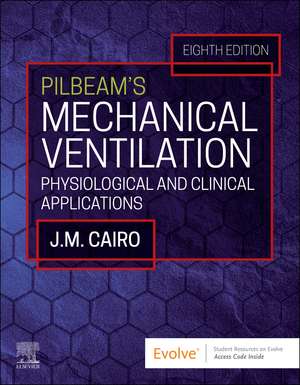
Pilbeam's Mechanical Ventilation: Physiological and Clinical Applications
Autor Jimmy M. Cairoen Limba Engleză Paperback – 19 sep 2023
Ensure you understand one of the most sophisticated areas of respiratory care with Pilbeam's Mechanical Ventilation: Physiological and Clinical Applications, 8th Edition! Known for its simple explanations and in-depth coverage of patient-ventilator management, this evidence-based text walks you through the most fundamental and advanced concepts surrounding mechanical ventilation and helps you understand how to properly apply these principles to patient care. This new edition is an excellent reference for all critical care practitioners and features coverage of the physiological effects of mechanical ventilation on different cross-sections of the population. Additionally, user-friendly features promote critical thinking and clinical application, such as key points, AARC clinical practice guidelines, critical care concepts, and updated learning objectives.
Preț: 690.70 lei
Preț vechi: 893.27 lei
-23%
Puncte Express: 1036
Carte disponibilă
Livrare economică 02-16 noiembrie
Livrare prin curier în România Termenul estimat este afișat lângă disponibilitate.
Transport gratuit pentru acest produs Plată online sau ramburs, în funcție de opțiunile comenzii.
Retur gratuit în 14 zile Comandă securizată și suport în română.
Specificații
ISBN-13: 9780323871648
ISBN-10: 032387164X
Pagini: 553
Dimensiuni: 216 x 276 mm
Greutate: 1.34 kg
Ediția:8
Editura: Elsevier
ISBN-10: 032387164X
Pagini: 553
Dimensiuni: 216 x 276 mm
Greutate: 1.34 kg
Ediția:8
Editura: Elsevier
V-ar putea interesa
-
 Year Book of Pulmonary Disease, 2016Janet R. Maurer-5%Preț: 1230.77 lei1295.55 lei
 -
 -29%Preț: 295.33 lei417.10 lei
 -
 Ventilator Management Strategies for Critical CareNicholas Hill-5%Preț: 1942.68 lei2044.92 lei
 -
 -5%Preț: 422.04 lei444.26 lei
 -
 Nocturnal Non-Invasive VentilationRobert C. Basner-5%Preț: 508.91 lei535.70 lei
 -
 Diffuse Lung DiseaseRobert P. Baughman-5%Preț: 795.86 lei837.75 lei
 -
 Chest Drains in Daily Clinical PracticeThomas Kiefer-5%Preț: 712.46 lei749.96 lei
 -
 Guide to Clinical Management of Idiopathic Pulmonary FibrosisSteven D Nathan-5%Preț: 560.13 lei589.61 lei
 -
 Pulmonary Dysfunction and DiseaseMieczyslaw Pokorski-5%Preț: 706.42 lei743.59 lei
 -
 Clinical Research and PracticeMieczyslaw Pokorski-5%Preț: 867.35 lei913.01 lei
 -
 Morphometry of the Human LungEwald R. Weibel-5%Preț: 366.18 lei385.45 lei
 -
 -5%Preț: 381.56 lei401.64 lei
 -
 Idiopathic Pulmonary FibrosisHiroyuki Nakamura-5%Preț: 629.90 lei663.06 lei
 -
 Respiratory Infections and TumoursR. White-5%Preț: 344.79 lei362.94 lei
 -
 Chronic Obstructive Pulmonary DiseaseKazutetsu Aoshiba-5%Preț: 1344.21 lei1414.96 lei
 -
 Early-stage Lung CancerXiangpeng Zheng-5%Preț: 1333.31 lei1403.48 lei
Cuprins
1. Basic Terms and Concepts of Mechanical Ventilation
2. How Ventilators Work
3. How a Breath Is Delivered
4. Establishing the Need for Mechanical Ventilation
5. Selecting the Ventilator and the Mode
6. Initial Ventilator Settings
7. Final Considerations in Ventilator Setup
8. Initial Patient Assessment
9. Ventilator Graphics
10. Assessment of Respiratory Function
11. Hemodynamic Monitoring
12. Methods to Improve Ventilation in Patient-Ventilator Management
13. Improving Oxygenation and Management of Acute Respiratory Distress Syndrome
14. Ventilator-Associated Pneumonia
15. Sedatives, Analgesics, and Paralytics
16. Extrapulmonary Effects of Mechanical Ventilation
17. Effects of Positive Pressure Ventilation on the Pulmonary System
18. Troubleshooting and Problem Solving
19. Basic Concepts of Noninvasive Positive Pressure Ventilation
20. Weaning From and Discontinuation of Mechanical Ventilation
21. Long-Term Ventilation
22. Neonatal and Pediatric Mechanical Ventilation
23. Special Techniques Used in Ventilatory Support
2. How Ventilators Work
3. How a Breath Is Delivered
4. Establishing the Need for Mechanical Ventilation
5. Selecting the Ventilator and the Mode
6. Initial Ventilator Settings
7. Final Considerations in Ventilator Setup
8. Initial Patient Assessment
9. Ventilator Graphics
10. Assessment of Respiratory Function
11. Hemodynamic Monitoring
12. Methods to Improve Ventilation in Patient-Ventilator Management
13. Improving Oxygenation and Management of Acute Respiratory Distress Syndrome
14. Ventilator-Associated Pneumonia
15. Sedatives, Analgesics, and Paralytics
16. Extrapulmonary Effects of Mechanical Ventilation
17. Effects of Positive Pressure Ventilation on the Pulmonary System
18. Troubleshooting and Problem Solving
19. Basic Concepts of Noninvasive Positive Pressure Ventilation
20. Weaning From and Discontinuation of Mechanical Ventilation
21. Long-Term Ventilation
22. Neonatal and Pediatric Mechanical Ventilation
23. Special Techniques Used in Ventilatory Support