Cantitate/Preț
Produs

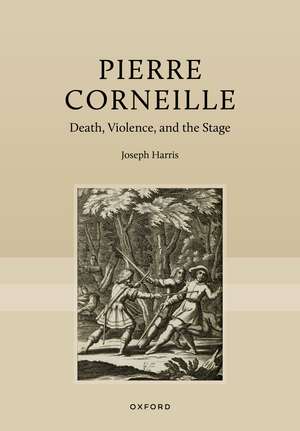
Pierre Corneille: Death, Violence, and the Stage

Autor Joseph Harris
en Limba Engleză Hardback – 25 mar 2027
Death and violence are everywhere in the writings of Pierre Corneille (1606–84). Best known nowadays for a small handful of early tragedies, Corneille in fact wrote in a range of genres, from comedies to religious poetry, from dramatic theory to quasi-operatic 'machine-plays' —and throughout all of these works, death and violence remain concerns as ambiguous and problematic as they are persistent. Yet death has no single meaning for Corneille: it proves to be a highly complex phenomenon which can produce quite contradictory responses. Indeed, while Corneille's engagement with death reveals his own idiosyncratic attitude towards dramatic convention—and towards Aristotle's Poetics in particular—it also exposes further contradictions and tensions between Corneille the practising playwright and Corneille the dramatic theorist. Rather than using death as a means to bring about aesthetic and ethical closure, for example, many of Corneille's most famous plays treat death as a dramatic problem that itself requires resolution. Elsewhere, deaths by chance or misadventure, of illness or natural causes, in combat or childbirth, flout the period's dominant ideals about tight-knit narrative causality.This study uses the twin themes of death and violence as an introduction to Corneille's poetics and dramatic practice more generally. It exposes Corneille as a restlessly experimental playwright, whose complex and evolving engagement with death reveals his readiness to defy theatrical convention and to set himself dramatic challenges. Reading Corneille alongside both his classical sources and his own contemporary rivals, collaborators, and critics, this study situates both his works and his dramatic theories within the theatrical landscape of his age. It shows death's implication in a wide range of topics: from emotion (fear and despair; grief and mourning) to politics (judicial punishment and bio-power; regicide and dynastic succession), from religion (martyrdom; the Christian and pagan afterlife) to aesthetics (dramatic spectacle; plot construction and tragic theory). While focusing on a single writer, this study raises questions that challenge and reshape the theoretical terrain of tragic theatre more generally.
Citește tot Restrânge

Preț: 63098 lei

Preț vechi: 92839 lei
-32% Precomandă

Puncte Express: 946

Carte nepublicată încă

Livrare prin curier în România Precomanda se expediază când titlul devine disponibil.
Transport gratuit pentru acest produs Plată online sau ramburs, în funcție de opțiunile comenzii.
Retur gratuit în 14 zile Comandă securizată și suport în română.
Doresc să fiu notificat când acest titlu va fi disponibil:

Specificații

ISBN-13: 9780197936443
ISBN-10: 019793644X
Pagini: 288
Dimensiuni: 156 x 234 mm
Editura: OUP OXFORD
Colecția OUP Oxford
Locul publicării:Oxford, United Kingdom

Notă biografică

Joseph Harris is Professor of Early Modern French and Comparative Literature at Royal Holloway, University of London. A specialist in early modern theatre, he has written on various topics, including cross-dressing, spectatorship, laughter, misanthropy, violence, and Shakespeare reception in France. He is the author of various books, including Inventing the Spectator: Subjectivity and the Theatrical Experience in Early Modern France and Misanthropy in the Age of Reason: Hating Humanity from Shakespeare to Schiller (both with Oxford University Press), and editor of several eighteenth-century French adaptations of seventeenth-century works, including Hamlet, Le Misanthrope, and Timon of Athens.