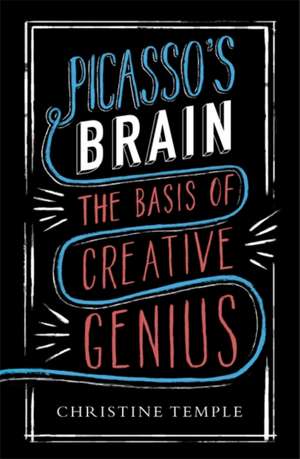
Picasso's Brain: The basis of creative genius
Autor Christine Templeen Limba Engleză Paperback – 8 dec 2016
Eminent neuropsychologist Christine Temple navigates a wide range of factors from the hard science (visual memory, spatial ability, brain functions) to the environmental (the 'mad genius' myth, and Gladwell's 10,000 hours of practice) in her study of what contributes to creativity.
Using Pablo Picasso as her model of a creative genius, she weighs up each theory as it applies to Picasso and shows how his own creativity came from a combination of many factors.
In this book, she looks at Picasso's playful mindset and passionate relationships, investigates the possibility that genius is genetic and can be inherited in families, considers whether creative genii perceive the world in a different way, and determines whether single-mindedness and focus play a part. This is the first book to look at a multitude of traits in creativity, and nail down the key factors that matter (and also which ones don't) to provide an overall picture of this fascinating area, linking the science to the personal.
Preț: 89.01 lei
Preț vechi: 120.70 lei
-26%
Puncte Express: 134
Carte disponibilă
Livrare economică 09-23 noiembrie
Livrare express 23-29 octombrie pentru 59.16 lei
Livrare prin curier în România Termenul estimat este afișat lângă disponibilitate.
Transport gratuit de la 400.00 lei Plată online sau ramburs, în funcție de opțiunile comenzii.
Retur gratuit în 14 zile Comandă securizată și suport în română.
Specificații
ISBN-13: 9781780334288
ISBN-10: 1780334281
Pagini: 288
Ilustrații: tbc
Dimensiuni: 150 x 232 x 24 mm
Greutate: 0.38 kg
Editura: Little Brown
Colecția Robinson
Locul publicării:London, United Kingdom
ISBN-10: 1780334281
Pagini: 288
Ilustrații: tbc
Dimensiuni: 150 x 232 x 24 mm
Greutate: 0.38 kg
Editura: Little Brown
Colecția Robinson
Locul publicării:London, United Kingdom
V-ar putea interesa
-
 CreativityMihaly CsikszentmihalyiPreț: 114.62 lei
 -
 How to Have Creative IdeasEdward de Bono-20%Preț: 85.93 lei106.80 lei
 -
 OutliersMalcolm Gladwell-30%Preț: 64.91 lei93.33 leiRecomandat
 -
 InnovatorsDavid W. Galenson-14%Preț: 198.57 lei231.14 lei
 -
 Think Like an ArtistWill Gompertz-19%Preț: 63.35 lei78.52 lei
 -
 The Creative BrainAnna AbrahamPreț: 271.48 lei
 -
 -27%Preț: 67.80 lei92.29 lei
 -
 Wired to CreateScott Barry KaufmanPreț: 99.27 lei
 -
 The Human MindLord Robert Winston-35%Preț: 87.49 lei134.37 lei
 -
 Creative ManErich NeumannPreț: 404.38 lei
 -
 The Creative CurveAllen Gannett-31%Preț: 98.48 lei142.56 lei
 -
 Average JoeShawn LivermorePreț: 155.03 lei
 -
 Einstein: His Life and UniverseWalter IsaacsonPreț: 75.92 lei
 -
 The Power of Different: The Link Between Disorder and GeniusDr. Gail Saltz-27%Preț: 66.13 lei91.14 lei
 -
 -12%Preț: 68.76 lei77.80 lei
 -
 Preț: 107.66 lei
 -
 The Genius MythHelen LewisPreț: 123.24 lei
 -
 Whose Truth, Whose Creativity? A 21st Century Art ManifestoGeorge J.E. SakkalPreț: 121.86 lei
 -
 Preț: 118.66 lei
 -
 The Creative Ambush: How to Unleash Your Fire into the WorldMatteo di Pascale-17%Preț: 103.15 lei124.76 leiRecomandat
Recenzii
Where does creativity come from? Are some people simply born to be a creative genius?
In Picasso's Brain, eminent neuropsychologist Christine Temple navigates a wide range of factors from the scientific (visual memory, spatial ability, brain functions) to the environmental (the 'mad genius' myth, and Gladwell's 10,000 hours of practice) in her fascinating study of what contributes to creativity.
Using Pablo Picasso as her model, she investigates the unique combination of factors that made Picasso a creative genius. Was it down to his playful mindset or his passion in relationships? Could genetic traits mean he inherited and passed on his skills? Did he perceive the world in a different way to others, or was he simply single-minded in his focus?
Ranging from hard science to art history, Picasso's Brain is an unprecedented insight into creativity as a vast web of elements that inform and affect each other. Temple highlights the key traits that matter (and identifies the ones that don't) and links the scientific with the personal to show just what makes a person extraordinarily creative.
Christine Temple was a respected neuroscientist at Essex University who was instrumental in the emergence of the field of developmental cognitive neuropsychology. This book grew from both her psychological research interests and her passion for art - she was a collector of Picasso prints. Christine died in 2014, aged 56.
In Picasso's Brain, eminent neuropsychologist Christine Temple navigates a wide range of factors from the scientific (visual memory, spatial ability, brain functions) to the environmental (the 'mad genius' myth, and Gladwell's 10,000 hours of practice) in her fascinating study of what contributes to creativity.
Using Pablo Picasso as her model, she investigates the unique combination of factors that made Picasso a creative genius. Was it down to his playful mindset or his passion in relationships? Could genetic traits mean he inherited and passed on his skills? Did he perceive the world in a different way to others, or was he simply single-minded in his focus?
Ranging from hard science to art history, Picasso's Brain is an unprecedented insight into creativity as a vast web of elements that inform and affect each other. Temple highlights the key traits that matter (and identifies the ones that don't) and links the scientific with the personal to show just what makes a person extraordinarily creative.
Christine Temple was a respected neuroscientist at Essex University who was instrumental in the emergence of the field of developmental cognitive neuropsychology. This book grew from both her psychological research interests and her passion for art - she was a collector of Picasso prints. Christine died in 2014, aged 56.