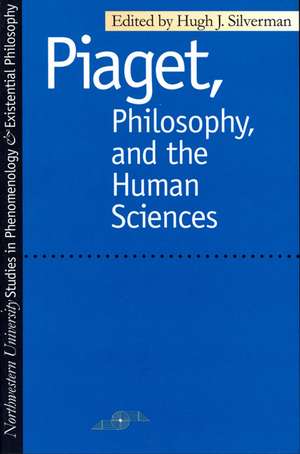
Piaget Philosophy and the Human Sciences: Studies in Phenomenology and Existential Philosophy
Autor Hugh J. Silvermanen Limba Engleză Paperback – 20 iun 1997
Leading scholars place Piaget's theory of the development and nature of knowledge in the context of twentieth-century European thought, and compare his views with those of Freud, Lacan, Heidegger, Foucault, and writers of the Frankfurt school. Piaget, Philosophy, and the Human Sciences surveys Piaget's work from a number of angles. General discussions of the main conceptual oppositions of this theory are balanced with more specific debates. Links between Piagetian and Freudian theory are explored, as are links between Piaget's theory of self-knowledge, Foucault's account of discursive knowledge practices, and Lacan's views on the symbolic power of language.
Din seria Studies in Phenomenology and Existential Philosophy
-
 Preț: 268.18 lei
 -
 Preț: 240.47 lei
 -
 Preț: 267.27 lei
 -
 Preț: 245.35 lei
 -
 Preț: 262.56 lei
 -
 Preț: 339.77 lei
 -
 Preț: 202.89 lei
 -
 Preț: 186.12 lei
 -
 Preț: 213.53 lei
 -
 Preț: 174.17 lei
 -
 Preț: 236.16 lei
 -
 Preț: 264.04 lei
 -
 Preț: 281.04 lei
 -
 Preț: 189.11 lei
 -
 Preț: 212.08 lei
 -
 Preț: 206.48 lei
 -
 Preț: 225.94 lei
 -
 Preț: 131.87 lei
 -
 Preț: 160.10 lei
 -
 Preț: 207.20 lei
 -
 Preț: 188.88 lei
 -
 Preț: 187.99 lei
 -
 Preț: 259.43 lei
 - 18%
 Preț: 753.19 lei
 -
 Preț: 174.43 lei
 -
 Preț: 214.84 lei
 -
 Preț: 233.14 lei
 -
 Preț: 257.02 lei
 - 18%
 Preț: 754.01 lei
 -
 Preț: 214.84 lei
 -
 Preț: 304.13 lei
 - 15%
 Preț: 238.52 lei
 - 11%
 Preț: 340.76 lei
 - 27%
 Preț: 546.83 lei
 - 39%
 Preț: 169.82 lei
 - 16%
 Preț: 233.23 lei
 -
 Preț: 142.95 lei
 - 16%
 Preț: 235.02 lei
 - 17%
 Preț: 210.41 lei
 - 17%
 Preț: 258.29 lei
 - 27%
 Preț: 604.98 lei
 - 18%
 Preț: 255.54 lei
 - 15%
 Preț: 236.14 lei
 -
 Preț: 175.36 lei
 - 16%
 Preț: 279.19 lei
 -
 Preț: 272.12 lei
 - 17%
 Preț: 259.61 lei
Preț: 234.45 lei
Preț vechi: 277.92 lei
-16%
Puncte Express: 352
Preț estimativ în valută:
41.46€ • 48.65$ • 35.96£
41.46€ • 48.65$ • 35.96£
Carte indisponibilă temporar
Doresc să fiu notificat când acest titlu va fi disponibil:
Se trimite...
Specificații
ISBN-13: 9780810114975
ISBN-10: 0810114976
Pagini: 174
Dimensiuni: 152 x 229 x 25 mm
Greutate: 0.29 kg
Ediția:1
Editura: Northwestern University Press
Colecția Northwestern University Press
Seria Studies in Phenomenology and Existential Philosophy
ISBN-10: 0810114976
Pagini: 174
Dimensiuni: 152 x 229 x 25 mm
Greutate: 0.29 kg
Ediția:1
Editura: Northwestern University Press
Colecția Northwestern University Press
Seria Studies in Phenomenology and Existential Philosophy
Descriere
Leading scholars place Piaget's theory of the development and nature of knowledge in the context of twentieth-century European thought, and compare his views with those of Freud, Lacan, Heidegger, Foucault, and writers of the Frankfurt school. Piaget, Philosophy, and the Human Sciences surveys Piaget's work from a number of angles. General discussions of the main conceptual oppositions of this theory are balanced with more specific debates. Links between Piagetian and Freudian theory are explored, as are links between Piaget's theory of self-knowledge, Foucault's account of discursive knowledge practices, and Lacan's views on the symbolic power of language.