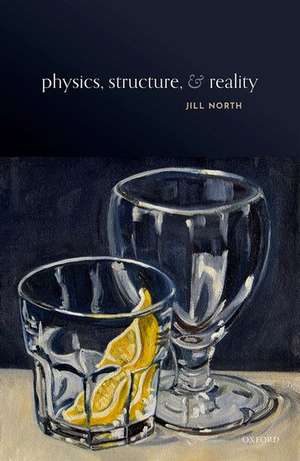
Physics, Structure, and Reality
Autor Jill Northen Limba Engleză Hardback – 25 mai 2021
Preț: 638.23 lei
Preț vechi: 936.13 lei
-32%
Puncte Express: 957
Carte disponibilă
Livrare economică 19-25 noiembrie
Livrare prin curier în România Termenul estimat este afișat lângă disponibilitate.
Transport gratuit pentru acest produs Plată online sau ramburs, în funcție de opțiunile comenzii.
Retur gratuit în 14 zile Comandă securizată și suport în română.
Specificații
ISBN-13: 9780192894106
ISBN-10: 0192894102
Pagini: 264
Dimensiuni: 161 x 242 x 21 mm
Greutate: 0.44 kg
Ediția:1
Editura: OUP OXFORD
Colecția OUP Oxford
Locul publicării:Oxford, United Kingdom
ISBN-10: 0192894102
Pagini: 264
Dimensiuni: 161 x 242 x 21 mm
Greutate: 0.44 kg
Ediția:1
Editura: OUP OXFORD
Colecția OUP Oxford
Locul publicării:Oxford, United Kingdom
V-ar putea interesa
-
 The Science of Can and Can'tChiara Marletto-19%Preț: 63.98 lei78.92 lei
 -
 The Physical World: An Inspirational Tour of Fundamental PhysicsNicholas Manton-8%Preț: 378.84 lei413.74 lei
 -
 Philosophy of Physics: A Very Short IntroductionDavid Wallace-20%Preț: 56.69 lei70.65 lei
 -
 The Philosophy and Physics of DualitySebastian De Haro-23%Preț: 898.01 lei1166.40 lei
 -
 PhysicsAristotle-17%Preț: 60.71 lei72.86 lei
 -
 -16%Preț: 91.90 lei109.79 lei
 -
 Seven Brief Lessons on Physics. Anniversary EditionCarlo RovelliPreț: 92.41 lei
 -
 Our Mathematical UniverseMax Tegmark-29%Preț: 66.91 lei94.27 lei
 -
 What is This Thing Called Science?Alan Chalmers-26%Preț: 206.78 lei278.08 lei
 -
 -20%Preț: 119.79 lei149.23 lei
 -
 Einstein's Theory of RelativityMax BornPreț: 89.74 lei
 -
 We Need to Talk About KelvinMarcus ChownPreț: 93.23 lei
 -
 The Road to RealityRoger PenrosePreț: 199.59 lei
 -
 The World According to PhysicsJim Al–khaliliPreț: 114.32 lei
 -
 The Biggest Ideas in the Universe 2Sean CarrollPreț: 79.75 lei
 -
 The Physics Book: From the Big Bang to Quantum ResurrectionClifford Pickover A-29%Preț: 154.87 lei218.63 lei
 -
 The Sapient CosmosJames B GlattfelderPreț: 306.06 lei
 -
 Relativity: The Special and the General TheoryAlbert EinsteinPreț: 39.95 lei
 -
 -23%Preț: 160.66 lei208.41 lei
Recenzii
Rewarding. Recommended. Upper-division undergraduates. Graduate students, faculty, and professionals.
This is a meticulous and deliberate and beautiful book.
It should be clear, however, that North's book opens up entirely new and promising lines of inquiry. It covers a remarkable amount of material. And it does so in an original and engaging manner. The ideas put forward in the book will have an impact in metaphysics, general philosophy of science, philosophy of mathematics, and philosophy of physics. They will be discussed, and debated for years to come.
This is a very good book. It addresses central questions about the interpretation of physical theories; it develops, in a nuanced way, some important possible answers to these questions; the writing is clear; there is diligent attention tothe literature; and the author's philosophical temperament-open-minded, resourceful-is vivid throughout. Furthermore, the writing is, by the standards of much of the current literature in philosophy of physics, nontechnical. So the book forms a natural entry point. So much by way of a tour d'horizon of this fine book: I hope to havewhetted the reader's appetite for it.
North makes a convincing case that structure really is one of the most important concepts in physics, while clearly demonstrating that the subject is far from exhausted. The writing is lucid and the lack of unnecessary formalism is refreshing, while the abundance of examples further enhances the book's clarity. Physics, Structure, and Reality^r opens up many further avenues for research and thus is a must-read for anyone interested in the physical structure of the world.
This is a meticulous and deliberate and beautiful book.
It should be clear, however, that North's book opens up entirely new and promising lines of inquiry. It covers a remarkable amount of material. And it does so in an original and engaging manner. The ideas put forward in the book will have an impact in metaphysics, general philosophy of science, philosophy of mathematics, and philosophy of physics. They will be discussed, and debated for years to come.
This is a very good book. It addresses central questions about the interpretation of physical theories; it develops, in a nuanced way, some important possible answers to these questions; the writing is clear; there is diligent attention tothe literature; and the author's philosophical temperament-open-minded, resourceful-is vivid throughout. Furthermore, the writing is, by the standards of much of the current literature in philosophy of physics, nontechnical. So the book forms a natural entry point. So much by way of a tour d'horizon of this fine book: I hope to havewhetted the reader's appetite for it.
North makes a convincing case that structure really is one of the most important concepts in physics, while clearly demonstrating that the subject is far from exhausted. The writing is lucid and the lack of unnecessary formalism is refreshing, while the abundance of examples further enhances the book's clarity. Physics, Structure, and Reality^r opens up many further avenues for research and thus is a must-read for anyone interested in the physical structure of the world.
Cuprins
- Preface
- 1: Introduction
- 2: What is Structure?
- 3: Inferences about Structure
- 4: Classical Mechanics
- 5: Spatiotemporal Structure
- 6: Realism about Structure
- 7: Equivalence of Physical Theories