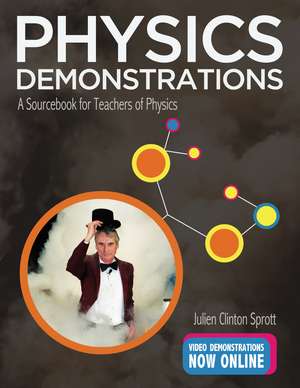
Physics Demonstrations: A Sourcebook for Teachers of Physics
Autor Julien Clinton Sprotten Limba Engleză Hardback – mar 2015
Wow! How? Few techniques are as effective at generating interest in science as dramatic demonstrations. This fully illustrated sourcebook describes eighty-five physics demonstrations suitable for performance both inside and outside classrooms. These demonstrations will fascinate and amaze while teaching the wonders and practical science of physics. Videos for the demonstrations are on our youtube.
Dr. Sprott shares demonstrations tested over many years in his popular public lectures on “The Wonders of Physics,” which appeal to general audiences and to students from grade school to graduate school. Science teachers at all levels will find a wealth of detail showing how to present these demonstrations to students with flair. Science professionals will find indispensable information for creating educational and entertaining public programs. Organized to teach the six major areas of classical physics—motion, heat, sound, electricity, magnetism, and light—Physics Demonstrations includes:
• a brief description of each demonstration
• materials lists, with sources for common materials
• preparation procedures
• discussions of the physics principles demonstrated
• potential safety hazards
• references for further information.
Dr. Sprott shares demonstrations tested over many years in his popular public lectures on “The Wonders of Physics,” which appeal to general audiences and to students from grade school to graduate school. Science teachers at all levels will find a wealth of detail showing how to present these demonstrations to students with flair. Science professionals will find indispensable information for creating educational and entertaining public programs. Organized to teach the six major areas of classical physics—motion, heat, sound, electricity, magnetism, and light—Physics Demonstrations includes:
• a brief description of each demonstration
• materials lists, with sources for common materials
• preparation procedures
• discussions of the physics principles demonstrated
• potential safety hazards
• references for further information.
Preț: 360.15 lei
Puncte Express: 540
Carte indisponibilă temporar
Doresc să fiu notificat când acest titlu va fi disponibil:
Se trimite...
Specificații
ISBN-13: 9780299304706
ISBN-10: 0299304701
Pagini: 304
Ilustrații: 230 color photos
Dimensiuni: 216 x 279 x 28 mm
Greutate: 0.99 kg
Ediția:1
Editura: University of Wisconsin Press
Colecția University of Wisconsin Press
ISBN-10: 0299304701
Pagini: 304
Ilustrații: 230 color photos
Dimensiuni: 216 x 279 x 28 mm
Greutate: 0.99 kg
Ediția:1
Editura: University of Wisconsin Press
Colecția University of Wisconsin Press
Recenzii
“Should be placed in the libraries of all college physics departments and would be useful for many high school physics programs.”—Physics Today
“Professor Sprott is a master of his trade and a true inspiration to all who perform physics demonstrations. Thorough and well-organized, this book shows how it should be done.”—David Willey, Mad Scientist for the Tonight Show
“Jaws dropped, eyes widened, and hair literally stood on end as [Sprott] produced neon liquids that defied gravity, a levitating ball, a liquid nitrogen cannon, and a human light bulb.”—Wisconsin State Journal
Notă biografică
Julien Clinton Sprott is a professor emeritus of physics at the University of Wisconsin–Madison, and his many books include Chaos and Time-Series Analysis and Images of a Complex World: The Art and Poetry of Chaos. He has received numerous awards for his work in public science education, including a lifetime achievement award from the Wisconsin Association of Physics Teachers. For more fun physics information, visit sprott.physics.wisc.edu/wop.htm.
Cuprins
Preface
Acknowledgments
1 MOTION
1.1 Guinea and Feather Tube
1.2 Reaction Time
1.3 Ballistics Car
1.4 The Monkey and the Coconut
1.5 Inertia Ball
1.6 Beaker and Tablecloth
1.7 Pail of Water
1.8 Revolving Ball and Cut String
1.9 Inclined Plane
1.10 Bowling Ball Pendulum
1.11 Come-back Can
1.12 Collision Balls
1.13 Rockets
1.14 Rolling Chain
1.15 Moving Spool
1.16 Bicycle Wheel Gyroscope
1.17 Stack of Cards
1.18 Coupled Pendulums
1.19 Wilberforce Pendulum
1.20 Chaotic Pendulums
1.21 Random Walk
2 HEAT
General Safety Considerations
2.1 Magdeburg Hemispheres
2.2 Bernoulli Effect
2.3 Bell Jar
2.4 Collapsing Can
2.5 Hero’s Engine
2.6 Model Geyser
2.7 Freezing by Evaporation
2.8 Boiling with Ice
2.9 Liquid Nitrogen
2.10 Leidenfrost Effect
2.11 Liquid Nitrogen Cannon
2.12 Liquid Nitrogen Cloud
2.13 Heat Convection
2.14 Heat Transmitter
2.15 Kinetic Theory Simulator
2.16 Carbon Dioxide Trough
2.17 Weight of Air
2.18 The Impossible Balloon
2.19 Neutral-buoyancy Balloon
2.20 Exploding Balloons
2.21 Exploding Soap Bubbles
2.22 Nonburning Handkerchief
2.23 Ethanol Vapor Explosion
2.24 Smoke Rings
2.25 Firehose Instability
2.26 Dripping Faucet
3 SOUND
Safety Considerations with Sound
3.1 Wave Speed on a Rope
3.2 Speed of Sound
3.3 Breathing Helium and Sulfur Hexafluoride
3.4 Bell in Vacuum
3.5 Doppler Effect
3.6 Flame Pipe
3.7 Oscilloscope Waveforms
3.8 Beat Frequencies
3.9 Breaking a Beaker with Sound
3.10 Ultrasound
4 ELECTRICITY
Safety Considerations with Electricity
4.1 Wimshurst Electrostatic Generator
4.2 Van de Graaff Generator
4.3 Electrophorus
4.4 Exploding Wire
4.5 Jacob’s Ladder
4.6 Tesla Coil
4.7 Faraday Cage
4.8 Gas Discharge Tube
4.9 Chaotic Circuits
5 MAGNETISM
Safety Considerations with Magnetism
5.1 Magnet and Cathode Ray Tube
5.2 Eddy Currents
5.3 Jumping Ring
5.4 Can Crusher
5.5 Levitated Ball
5.6 Superconductors
6 LIGHT
Safety Considerations with Lasers
6.1 Prism Rainbow
6.2 Laser Beam
6.3 Laser Gun
6.4 Twinkling Stars
6.5 Spiral Light Guide
6.6 Water Light Guide
6.7 Rayleigh Scattering
6.8 Fluorescence
6.9 Talking Head
6.10 Pepper’s Ghost
6.11 Tubeless Television
6.12 Optical Illusions
6.13 Fractals
Appendix A: Bibliography
Appendix B: Selected Vendors of Scientific Demonstration Equipment
Appendix C: Selected Vendors of Audiovisual and Computer Materials
Appendix D: Other Related Materials
Videotapes
The Wonders of Physics Lecture Kit
Computer Animations
Physics Demonstrations Computer Software Version 1.22
Chaos Demonstrations Computer Software Version 3.2
Index
Acknowledgments
1 MOTION
1.1 Guinea and Feather Tube
1.2 Reaction Time
1.3 Ballistics Car
1.4 The Monkey and the Coconut
1.5 Inertia Ball
1.6 Beaker and Tablecloth
1.7 Pail of Water
1.8 Revolving Ball and Cut String
1.9 Inclined Plane
1.10 Bowling Ball Pendulum
1.11 Come-back Can
1.12 Collision Balls
1.13 Rockets
1.14 Rolling Chain
1.15 Moving Spool
1.16 Bicycle Wheel Gyroscope
1.17 Stack of Cards
1.18 Coupled Pendulums
1.19 Wilberforce Pendulum
1.20 Chaotic Pendulums
1.21 Random Walk
2 HEAT
General Safety Considerations
2.1 Magdeburg Hemispheres
2.2 Bernoulli Effect
2.3 Bell Jar
2.4 Collapsing Can
2.5 Hero’s Engine
2.6 Model Geyser
2.7 Freezing by Evaporation
2.8 Boiling with Ice
2.9 Liquid Nitrogen
2.10 Leidenfrost Effect
2.11 Liquid Nitrogen Cannon
2.12 Liquid Nitrogen Cloud
2.13 Heat Convection
2.14 Heat Transmitter
2.15 Kinetic Theory Simulator
2.16 Carbon Dioxide Trough
2.17 Weight of Air
2.18 The Impossible Balloon
2.19 Neutral-buoyancy Balloon
2.20 Exploding Balloons
2.21 Exploding Soap Bubbles
2.22 Nonburning Handkerchief
2.23 Ethanol Vapor Explosion
2.24 Smoke Rings
2.25 Firehose Instability
2.26 Dripping Faucet
3 SOUND
Safety Considerations with Sound
3.1 Wave Speed on a Rope
3.2 Speed of Sound
3.3 Breathing Helium and Sulfur Hexafluoride
3.4 Bell in Vacuum
3.5 Doppler Effect
3.6 Flame Pipe
3.7 Oscilloscope Waveforms
3.8 Beat Frequencies
3.9 Breaking a Beaker with Sound
3.10 Ultrasound
4 ELECTRICITY
Safety Considerations with Electricity
4.1 Wimshurst Electrostatic Generator
4.2 Van de Graaff Generator
4.3 Electrophorus
4.4 Exploding Wire
4.5 Jacob’s Ladder
4.6 Tesla Coil
4.7 Faraday Cage
4.8 Gas Discharge Tube
4.9 Chaotic Circuits
5 MAGNETISM
Safety Considerations with Magnetism
5.1 Magnet and Cathode Ray Tube
5.2 Eddy Currents
5.3 Jumping Ring
5.4 Can Crusher
5.5 Levitated Ball
5.6 Superconductors
6 LIGHT
Safety Considerations with Lasers
6.1 Prism Rainbow
6.2 Laser Beam
6.3 Laser Gun
6.4 Twinkling Stars
6.5 Spiral Light Guide
6.6 Water Light Guide
6.7 Rayleigh Scattering
6.8 Fluorescence
6.9 Talking Head
6.10 Pepper’s Ghost
6.11 Tubeless Television
6.12 Optical Illusions
6.13 Fractals
Appendix A: Bibliography
Appendix B: Selected Vendors of Scientific Demonstration Equipment
Appendix C: Selected Vendors of Audiovisual and Computer Materials
Appendix D: Other Related Materials
Videotapes
The Wonders of Physics Lecture Kit
Computer Animations
Physics Demonstrations Computer Software Version 1.22
Chaos Demonstrations Computer Software Version 3.2
Index
Descriere
Detailed instructions for eighty-five entertaining physics demonstrations on motion, heat, sound, electricity, magnetism, and light, from an award-winning science educator.