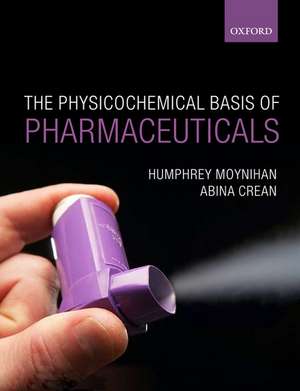
Physicochemical Basis of Pharmaceuticals
Autor Humphrey Moynihan, Abina Creanen Limba Engleză Paperback – 23 iul 2009
Preț: 398.51 lei
Preț vechi: 504.14 lei
-21%
Puncte Express: 598
Carte disponibilă
Livrare economică 29 octombrie-04 noiembrie
Livrare prin curier în România Termenul estimat este afișat lângă disponibilitate.
Transport gratuit de la 400.00 lei Plată online sau ramburs, în funcție de opțiunile comenzii.
Retur gratuit în 14 zile Comandă securizată și suport în română.
Specificații
ISBN-13: 9780199232840
ISBN-10: 0199232849
Pagini: 316
Ilustrații: 160 Colour Illustrations
Dimensiuni: 189 x 245 x 14 mm
Greutate: 0.73 kg
Editura: Oxford University Press
Colecția OUP Oxford
Locul publicării:Oxford, United Kingdom
ISBN-10: 0199232849
Pagini: 316
Ilustrații: 160 Colour Illustrations
Dimensiuni: 189 x 245 x 14 mm
Greutate: 0.73 kg
Editura: Oxford University Press
Colecția OUP Oxford
Locul publicării:Oxford, United Kingdom
V-ar putea interesa
-
 Pocket Guide: Pharmacokinetics Made EasyDonald Birkett-38%Preț: 151.96 lei246.02 lei
 -
 Therapeutics and Human Physiology: How drugs workElsie Gaskell-17%Preț: 409.32 lei490.65 lei
 -
 Rang & Dale's PharmacologyJames M. Ritter-26%Preț: 425.37 lei577.87 lei
 -
 -5%Preț: 418.37 lei440.39 lei
 -
 Dale's Pharmacology CondensedClive P. Page-29%Preț: 216.89 lei306.92 lei
 -
 Essentials of Pharmaceutical ChemistryDonald Cairns-6%Preț: 352.10 lei373.93 lei
 -
 Pharmaceutics: Remington EducationShelley Chambers Fox-14%Preț: 245.19 lei284.10 lei
 -
 Physicochemical Principles of PharmacyDavid AttwoodPreț: 423.07 lei
 -
 -23%Preț: 1070.40 lei1390.13 lei
 -
 Introduction to Pharmaceutical Analytical ChemistryBente Gammelgaard-19%Preț: 447.55 lei552.54 lei
 -
 Introduction to the Pharmaceutical Sciences: An Integrated ApproachNita K. Pandit PhD-23%Preț: 568.94 lei737.68 lei
 -
 -5%Preț: 359.06 lei377.96 lei
 -
 -27%Preț: 552.66 lei755.18 lei
 -
 Foye's Principles of Medicinal ChemistryKimberly Beck-18%Preț: 683.55 lei832.09 lei
 -
 Physical Pharmacy and Instrumental Methods of AnalysisMymoona Akhter-15%Preț: 569.70 lei670.23 lei
 -
 Pharmacological Basis of Acute CareYoo Kuen Chan-5%Preț: 788.38 lei829.87 lei
Notă biografică
Having originally received his BSc and PhD degrees from University College Cork, Humphrey Moynihan returned in 2002, where he is now involved in the teaching of Organic and Pharmaceutical/Medicinal Chemistry. His research interest is the study and control of crystallisation of organic compounds. He is also involved in collaborative research in areas such as Analytical Chemistry.Abina Crean joined the Cork School of Pharmacy in September 2004 as a Lecturer in Pharmaceutics after working in formulation and process development for Élan Pharmaceutical Technologies and Servier (Ireland) Industries. Her main research interests are in the areas of solid dose drug delivery systems and pharmaceutical solid-state properties.
Cuprins
- 1. Pharmaceuticals and medicines
- 1.1: Introduction to the essential properties of pharmaceuticals
- 1.1.1: Some key concepts
- 1.2: Classes of pharmaceutical compounds
- 1.2.1: Active pharmaceutical ingredients
- 1.2.2: Excipients
- 1.3: Drug delivery: getting the active pharmaceutical ingredient to the site of action
- 1.3.1: Routes of administration
- 1.3.2: Pharmaceutical dosage forms
- 1.3.3: Factors influencing dosage form choice
- 1.4: Summary
- 2. Pharmaceutical solutions
- 2.2: Definitions and expressions of solubility
- 2.1.1: Measurement of solubility and solubility curves
- 2.2: Solvent structure
- 2.2.1: Hydrogen bonding and the structure of water
- 2.2.2: Lipid-based media
- 2.3: Dissolution and solvation
- 2.4: Factors affecting solubility
- 2.4.1: Molecular weight
- 2.4.2: Hydrogen bonding
- 2.4.3: Hydrophobic and hydrophilic groups
- 2.5: Acidity and basicity
- 2.5.1: pKa and pKb
- 2.5.2: Acidity and environment
- 2.6: Salt selection and formation
- 2.7: Hydrolytic degradation
- 2.8: Summary
- 3. Pharmaceutical equilibria
- 3.1: Essential concepts in thermodynamics
- 3.1.1: Internal energy, enthalpy and the first law of thermodynamics
- 3.1.2: Entropy and the second and third laws of thermodynamics
- 3.1.3: Free energy, chemical potential and equilibrium
- 3.1.4: Activities of ions in solution
- 3.2: Phase equilibria
- 3.2.1: One-component systems and the phase rule
- 3.2.2: Two-component systems
- 3.2.3: Osmotic pressure
- 3.3: Drug delivery: Phase transitions
- 3.3.1: Diffusion (movement within a phase)
- 3.3.2: Dissolution (solid -liquid transition)
- 3.3.3: Partitioning (liquid- liquid transition)
- 3.3.4: Gas absorption (Gas-liquid phase transition)
- 3.3.5: Phase transitions during drug delivery
- 3.4: Summary
- 4. The pharmaceutical solid phase
- 4.1: Crystalline and amorphous solids
- 4.2: The essentials of pharmaceutical crystal structure
- 4.2.1: Unit cells, crystal systems and lattices
- 4.2.2: Space groups and space group notation
- 4.2.3: Crystal planes and faces
- 4.3: Crystal polymorphism of pharmaceuticals
- 4.3.1: Relative stabilities of polymorphs
- 4.3.2: Solvates and hydrates
- 4.4: Methods of characterising pharmaceutical solids
- 4.4.1: X-ray diffraction methods
- 4.4.2: Thermal methods
- 4.4.3: Other methods of analysis
- 4.5: Pharmaceutical crystallization
- 4.5.1: Supersaturation
- 4.5.2: Nucleation, growth and crystal morphology
- 4.5.3: Ripening and the rule of stages
- 4.6: Solid state properties of powder particles
- 4.6.1: Particle shape
- 4.6.2: Particle size
- 4.6.3: Particle surface properties
- 4.6.4: Gas adsorption
- 4.6.5: Moisture adsorption
- 4.6.6: Powder mechanical strength
- 5. Two phase solid - liquid disperse systems
- 5.1: Introduction to pharmaceutical disperse systems
- 5.2: Molecular, colloidal and coarse dispersions
- 5.3: The physical stability of disperse systems
- 5.4: Properties of disperse systems
- 5.4.1: Kinetic properties
- 5.4.2: Rheology and viscosity
- 5.4.3: Electrical properties
- 5.4.4: Interfacial properties
- 5.4.5: Optical properties
- 5.5: Suspensions
- 5.5.1: Nanosuspensions
- 5.5.2: Coarse suspensions
- 5.6: Emulsions
- 5.6.1: Macroemulsions
- 5.6.2: Multiple emulsions
- 5.6.3: Microemulsions
- 5.7: Vesicular systems
- 5.7.1: Micellar systems
- 5.7.2: Solubilised systems
- 5.7.3: Liposomes
- 5.8: Aerosols
- 5.9: Foams
- 5.10: Summary
- 6. Biological interfaces
- 6.1: Passive, active and other modes of transport
- 6.2: Cell membranes
- 6.3: Partition and partition co-efficients
- 6.4: Measurement and calculation of partition co-efficients
- 6.5: Diffusion, diffusion co-efficients and ionisation
- 6.6: The gastrointestinal barrier
- 6.7: The blood-brain barrier
- 6.8: The skin
- 6.9: Summary
- 7. Physicochemical aspects of Pharmacokinetics and Pharmacodynamics
- 7.1: Bioavailability
- 7.2: Distribution
- 7.3: Drug target interaction
- 7.4: Metabolism
- 7.5: Excretion
- 7.6: Summary