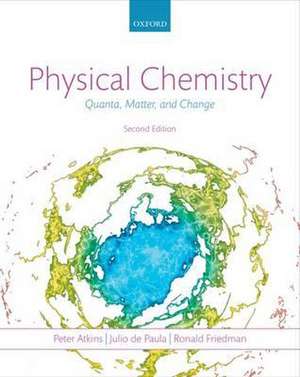
Physical Chemistry: Quanta, Matter, and Change
Autor Peter Atkins, Julio de Paula, Ronald Friedmanen Limba Engleză Paperback – 12 dec 2013
Preț: 526.16 lei
Preț vechi: 645.89 lei
-19%
Puncte Express: 789
Carte disponibilă
Livrare economică 06-17 noiembrie
Livrare prin curier în România Termenul estimat este afișat lângă disponibilitate.
Transport gratuit pentru acest produs Plată online sau ramburs, în funcție de opțiunile comenzii.
Retur gratuit în 14 zile Comandă securizată și suport în română.
Specificații
ISBN-13: 9780199609819
ISBN-10: 0199609810
Pagini: 1008
Ilustrații: 780 colour line
Dimensiuni: 218 x 276 x 37 mm
Greutate: 2.2 kg
Ediția:2nd edition.
Editura: OUP OXFORD
Colecția OUP Oxford
Locul publicării:Oxford, United Kingdom
ISBN-10: 0199609810
Pagini: 1008
Ilustrații: 780 colour line
Dimensiuni: 218 x 276 x 37 mm
Greutate: 2.2 kg
Ediția:2nd edition.
Editura: OUP OXFORD
Colecția OUP Oxford
Locul publicării:Oxford, United Kingdom
V-ar putea interesa
-
 Galileo's Finger: The Ten Great Ideas of SciencePeter Atkins-17%Preț: 77.96 lei94.25 lei
 -
 Hallelujah Moments: Tales of Drug DiscoveryEugene H. Cordes-19%Preț: 362.38 lei448.47 lei
 -
 -20%Preț: 56.33 lei70.65 lei
 -
 -21%Preț: 66.37 lei83.83 lei
 -
 Crucible of Science: The Story of the Cori LaboratoryJohn H. Exton-28%Preț: 505.11 lei705.90 lei
 -
 Phosphorus, Food, and Our FutureKarl A. Wyant-31%Preț: 756.68 lei1099.63 lei
 -
 Atkins' MoleculesPeter AtkinsPreț: 443.00 lei
 -
 Exploring Mark's GospelLeslie J. Francis-22%Preț: 203.37 lei261.09 lei
Recenzii
I like the book very much. It is clear, concise and pitched at just the right level.
By breaking the text up into 'topics' it is much easier to digest the background material required for more complex chemical subjects, which should be a useful aid for tutors and students
The use of conceptual maps to relate the different topics is a very good idea
By breaking the text up into 'topics' it is much easier to digest the background material required for more complex chemical subjects, which should be a useful aid for tutors and students
The use of conceptual maps to relate the different topics is a very good idea
Notă biografică
Peter Atkins is a fellow of Lincoln College in the University of Oxford and the author of about seventy books for students and a general audience. His texts are market leaders around the globe. A frequent lecturer in the United States and throughout the world, he has held visiting professorships in France, Israel, Japan, China, and New Zealand. He was the founding chairman of the Committee on Chemistry Education of the International Union of Pure and Applied Chemistry and was a member of IUPAC's Physical and Biophysical Chemistry Division. Peter was the 2016 recipient of the American Chemical Society's Grady-Stack Award for science journalism.Julio de Paula is Professor of Chemistry, Lewis & Clark College. A native of Brazil, Professor de Paula received a B.A. degree in chemistry from Rutgers, The State University of New Jersey, and a Ph.D. in biophysical chemistry from Yale University. His research activities encompass the areas of molecular spectroscopy, biophysical chemistry, and nanoscience. He has taught courses in general chemistry, physical chemistry, biophysical chemistry, instrumental analysis, and writing.Ronald Friedman is Professor and Chair of the Chemistry Department at Indiana University Purdue University Fort Wayne. He received a B.S. in chemistry from the University of Virginia, a Ph.D. in chemistry from Harvard University, and did postdoctoral work at the University of Minnesota. He teaches general chemistry and physical chemistry at IPFW and has also taught at the University of Michigan and at the Technion (Israel). His research interests are theories of reaction dynamics.