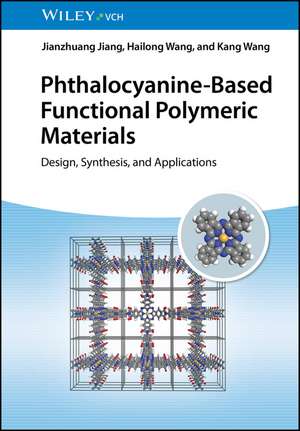
Phthalocyanine-Based Functional Polymeric Materials
Autor Jianzhuang Jiang, Hailong Wang, Kang Wangen Limba Engleză Hardback – 19 mar 2025
In Phthalocyanine-Based Functional Polymeric Materials: Design, Synthesis, and Applications, a team of distinguished researchers delivers a comprehensive discussion of phthalocyanine-involving hybrids, molecular cages, coordination polymers, covalent organic frameworks, and organic polymers. The book also explains a diverse array of the applications of these novel materials in chemical sensors, organic catalysts, electrocatalysis, photocatalysis, energy storage, and more.
The authors have included material designed to help you improve the design of monomers to synthesize polymers with desired functionalities. A valuable reference in the development of phthalocyanine chemistry, readers will also find:
* A thorough introduction to phthalocyanine-based polymers and their uses in sensors, catalysis, energy storage, and other applications
* Comprehensive explorations of the extended molecular systems of phthalocyanines, filling the gap between monomeric phthalocyanine compounds and polymers
* Practical discussions of a variety of phthalocyanine-based polymer systems, their potential applications, and major design and synthesis challenges
* Complete treatments of these novel materials appropriate for readers in academia and industry
Perfect for polymer, organic, inorganic, catalytic, complex, and structural chemists, Phthalocyanine-Based Functional Polymeric Materials will also benefit materials scientists and chemists working in industry.
Preț: 878.50 lei
Preț vechi: 1140.90 lei
-23%
Carte disponibilă
Livrare economică 10-16 noiembrie
Livrare express 31 octombrie-06 noiembrie pentru 85.29 lei
Specificații
ISBN-10: 3527351221
Pagini: 500
Ilustrații: 1 schwarz-weiße und 175 farbige Abbildungen, 4 schwarz-weiße Tabellen
Dimensiuni: 171 x 246 x 25 mm
Greutate: 0.88 kg
Editura: Wiley-VCH GmbH
Locul publicării:Weinheim, Germany
V-ar putea interesa
-
 Greene's Protective Groups in Organic Synthesis, 2 Volume SetPeter G. M. Wuts-23%Preț: 1328.77 lei1725.67 lei
 -
 Trends in Polyoxometalates ResearchLaurent Ruhlmann PhD-27%Preț: 1801.29 lei2452.00 lei
 -
 -30%Preț: 97.81 lei139.80 lei
 -
 -14%Preț: 1248.72 lei1452.00 lei
 -
 A Concise Introduction to Polymer PhysicsReinhard Hentschke-15%Preț: 489.27 lei575.61 lei
 -
 Functional PolymersMohammad Abu Jafar Mazumder-18%Preț: 3185.62 lei3884.91 lei
 -
 Next-Generation Electrochromic DevicesPierluigi Cossari-23%Preț: 845.21 lei1097.68 lei
 -
 Chemical Physics of Polymer NanocompositesVera V. Myasoedova-23%Preț: 2386.87 lei3099.83 lei
 -
 Chiral Luminescence. 2 volumesKazuo Akagi-23%Preț: 2011.58 lei2612.43 lei
 -
 Applied Polyoxometalate–Based ElectrocatalysisDM Fernandes-14%Preț: 939.64 lei1092.61 lei
 -
 -9%Preț: 1089.70 lei1197.47 lei
 -
 Functional Polymer FoamsHaoyang Mi-14%Preț: 869.31 lei1010.82 lei
 -
 Persistently Luminescent MaterialsYuanbing Mao-23%Preț: 846.77 lei1099.71 lei
 -
 -14%Preț: 1767.25 lei2054.94 lei
 -
 Functional Polyimide DielectricsJun-Wei Zha-23%Preț: 817.12 lei1061.18 lei
 -
 -9%Preț: 841.88 lei925.14 lei
Notă biografică
Jianzhuang Jiang, PhD, is Professor at the University of Science and Technology Beijing, China. His research is focused on single-molecule magnets, organic field-effect transistors, linear and nonlinear optical materials, and new energy materials.
Hailong Wang, PhD, is Professor at the University of Science and Technology Beijing, China. His research is focused on porous molecular crystals and tetrapyrrole-based crystalline materials.
Kang Wang, PhD, is Professor at the University of Science and Technology Beijing, China. His research is focused on the synthesis of conjugate extended tetrapyrrole and tetrapyrrole-fused oligomer skeletons, as well as the synthesis and application of tetrapyrrole-based conjugated mesoporous organic frameworks.
Cuprins
1 A Journey from Molecular Phthalocyanines to Polymeric Materials 1
1.1 Introduction 1
1.2 Monophthalocyanines 4
1.2.1 Tetra-Substituted Monophthalocyanines 6
1.2.2 Octa-Substituted Monophthalocyanines 7
1.3 Phthalocyanine-Based Oligomers 9
1.3.1 Sandwich-Type Phthalocyanine-Based Complexes 9
1.3.2 ¿-Oxo-Linked Phthalocyanine-Based Oligomers 12
1.3.3 Phthalocyanine-Based Supramolecular Oligomers 13
1.3.4 Phthalocyanine-Based Covalent-Bonded Oligomers 16
1.3.4.1 Phthalocyanine-Based Fused Oligomers 16
1.3.4.2 Phthalocyanine-Based Covalent-Linked Oligomers 19
1.3.5 Cofacial and Cage-Like Phthalocyanine-Based Compounds 20
1.4 Phthalocyanine-Based Polymeric Materials 23
1.4.1 Phthalocyanine-Based Porous Molecular Crystals 23
1.4.2 Phthalocyanine-Based Coordination Polymers 25
1.4.3 Phthalocyanine-Based Organic Polymers 29
1.4.3.1 Amorphous Phthalocyanine-Based Organic Polymers 29
1.4.3.2 Phthalocyanine-Based COFs 33
1.5 Porous Polymeric Materials for Functional Applications 36
1.5.1 Phthalocyanine-Based Polymeric Materials for Chemical Sensors 36
1.5.2 Phthalocyanine-Based Polymeric Materials for Electrocatalysis 37
1.5.3 Phthalocyanine-Based Polymeric Materials for Photocatalysts 40
1.5.4 Phthalocyanine-Based Polymeric Materials for Energy Storage 42
1.6 Conclusion 43
Abbreviations 43
References 44
2 Phthalocyanine-Based Cages 55
2.1 Introduction 55
2.1.1 Metal-Organic Cages 55
2.1.2 Porous Organic Cages 56
2.2 Phthalocyanine-Based Cages 57
2.2.1 Pc-Based MOCs 57
2.2.2 Pc-Based POCs 58
2.2.3 Subphthalocyanine-Based Cages 64
2.2.4 Other Phthalocyanine-Based Molecule Cages 65
2.3 Electrochemical Properties of Pc-Based Cages 73
2.4 Photophysical Properties of Pc-Based Cage 77
2.5 Gas-Sensing Properties of Pc-Based Cage 80
2.6 Host-Guest Properties of Pc-Based Molecular Cages 80
2.7 Conclusion 82
Abbreviations 84
References 84
3 Phthalocyanine-Based Coordination Polymers 89
3.1 Introduction 89
3.2 Synthesis of Pc-Based MOFs 90
3.2.1 The First Pc-Based Porous Coordination Polymers 91
3.2.2 MOFs Based on Octahydroxy-Pcs 92
3.2.3 MOFs Based on Amino-Pcs 98
3.2.4 MOFs Based on Carboxyl-Substituted Pcs 103
3.3 Electrochemical Properties of Pc-Based MOFs 106
3.4 The Nanocomposite of Pcs with Different MOFs Systems 113
3.5 The Axial Polymer of Pcs 125
3.6 The Polymers Based on the Co-Assembly of Pcs with Cyclodextrin 128
3.7 The Nanocomposite of Pcs with MOFs and COFs 130
3.8 Conclusion 132
Abbreviations 132
References 133
4 Porous Phthalocyanine-Based Organic Polymers 137
4.1 Introduction 137
4.2 Pc-Based CMPs 139
4.2.1 Imine-Linked Pc-Based CMPs 140
4.2.2 Ethynyl-Linked Pc-Based CMPs 144
4.2.3 Other Mode-Linked Pc-Based CMPs 146
4.3 Pc-Based COFs 148
4.3.1 Octahydroxyphthalocyanine-Derived COFs 150
4.3.2 Octaaminophthalocyanine-Derived COFs 157
4.3.3 Octacarboxyphthalocyanine-Derived COFs 164
4.3.4 Hexadecafluorophthalocyanine-Derived COFs 169
4.4 Polyphthalocyanines 172
4.4.1 Amorphous Polyphthalocyanines 173
4.4.2 Crystalline Polyphthalocyanines 180
4.5 Conclusion 184
Abbreviations 185
References 188
5 Sensors Based on Phthalocyanine Polymers and Covalent Organic Frameworks 193
5.1 Introduction 193
5.2 Basic Parameters for Sensors 194
5.3 Pc-Based NO2 /NH3 /NO2¿ Sensors195
5.4 Pc-Based 3O2 / 1O2 /H2O2 Sensors 199
5.5 Pc-Based Neurotransmitters and Stimulants Sensors 204
5.6 Pc-Based Cancer Biomarker (L-Cysteine) Sensors 206
5.7 Pc-Based Glucose Sensors 208
5.8 Pc-Based Ion Sensors 210
5.9 Pc-Based Organic Compounds Sensors 212
5.10 Pc-Based Temperature/Pressure Sensors 219
5.11 Conclusion 220
Abbreviations 221
References 223
6 Application of Phthalocyanine in Electrocatalysis 227
6.1 Introduction 227
6.2 Phthalocyanine for CO2 Electroreduction 227
6.3 Phthalocyanine for ORR 255
6.4 Phthalocyanine for OER 259
6.5 Phthalocyanine for HER 260
6.6 Phthalocyanine for Nitrogen Reduction Reaction (NRR) 260
6.7 Phthalocyanine for Electrochemical H2O2 Generation 264
6.8 Conclusion and Outlook 265
Abbreviations 265
References 266
7 Application of Phthalocyanine in Photocatalysis 269
7.1 Introduction 269
7.2 Phthalocyanine for CO2 Photoreduction 270
7.3 Phthalocyanine for H2O2 Photosynthesis 285
7.4 Phthalocyanine for Photocatalytic Degradation 287
7.5 Phthalocyanine for Photocatalytic Water Splitting 305
7.6 Conclusion and Outlook 308
Abbreviations 309
References 309
8 Applications of Phthalocyanine-Based Polymeric Materials for Energy Storage 313
8.1 Introduction 313
8.2 Metal-Ion Battery 313
8.3 Lithium-Ion Battery 314
8.3.1 Cathode Material 314
8.3.2 Anode Material 316
8.3.3 Bipolar Electrode Material 321
8.3.4 Interface-Modified Film 325
8.3.5 Lithium-Sulfur Battery Catalyst 326
8.4 Sodium-Ion Battery 328
8.4.1 Anode Material 328
8.4.2 Bipolar Electrode Material 329
8.4.3 Sodium-Iodide Battery Catalyst 332
8.5 Potassium-Ion Battery 332
8.6 Metal-Air Battery 335
8.7 Li-O2 Battery 336
8.8 Li-CO2 Battery 338
8.9 Zinc-Air Battery 339
8.10 Supercapacitor 351
8.11 Aqueous Electrolyte System 354
8.12 Nonaqueous Electrolyte System 355
8.13 Gel Electrolyte System 358
8.14 Conclusions and Outlook 360
Abbreviations 361
References 362
Index 365