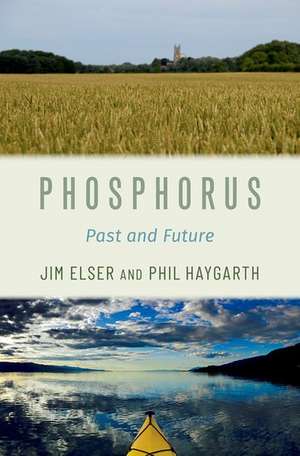
Phosphorus: Past and Future
Autor Jim Elser, Phil Haygarthen Limba Engleză Hardback – 4 mar 2021
Preț: 215.57 lei
Preț vechi: 257.54 lei
-16%
Puncte Express: 323
Carte tipărită la comandă
Livrare economică 26 noiembrie-02 decembrie
Livrare express 17-23 octombrie pentru 70.45 lei
Livrare prin curier în România Termenul estimat este afișat lângă disponibilitate.
Transport gratuit de la 400.00 lei Plată online sau ramburs, în funcție de opțiunile comenzii.
Retur gratuit în 14 zile Comandă securizată și suport în română.
Specificații
ISBN-13: 9780199916917
ISBN-10: 0199916918
Pagini: 242
Dimensiuni: 145 x 211 x 23 mm
Greutate: 0.43 kg
Editura: Oxford University Press
Colecția OUP USA
Locul publicării:New York, United States
ISBN-10: 0199916918
Pagini: 242
Dimensiuni: 145 x 211 x 23 mm
Greutate: 0.43 kg
Editura: Oxford University Press
Colecția OUP USA
Locul publicării:New York, United States
Recenzii
Jim Elser and Phil Haygarth's book is an optimistic 'Call to Arms' sequel to Emsley's gripping book written two decades ago: The Shocking History of Phosphorus. Elser and Haygarth's book is not just about phosphorus atoms and its cycle: It is about the people and events that led to the discovery, use (as well as abuse) of phosphorus, and the champions of change in the current sustainable phosphorus movement. This element underpins the world we live in — from the food on our table to the atoms in our DNA, so the risks facing the world's fragile phosphorus cycle are relevant to all of us, not just to scientists. Elser and Haygarth are not only brilliant scientists, they are excellent storytellers. Phosphorus needed Jim and Phil to tell the inside story. This really is a book for everyone.
At a time when environmental concerns are dominated by carbon (above all by its role in the global warming), this book is a welcome reminder that the human interference in other biospheric cycles deserves no less attention. Elser and Haygarth's treatment and approach stands out. They offer a systematic and thorough examination of the element in the modern world, of its fundamental importance, its irreplaceable uses, their desired and unwelcome consequences, and the ways to manage them better.
Who thinks about phosphorus when they dig into a juicy sirloin steak? Elser and Haygarth bring the two together from the beginning of the universe (actually after the Big Bang) to the chunk of red meat on the plate. They skillfully guide the reader through the history of discovery, use, over-use, and need for reduced consumption of phosphorus because there is only so much left on our planet. Doomsday is set aside when they provide alternative human behaviors that reduce our over-consumptive threats to our resources and provide ways for us to make a smaller carbon footprint, a smaller nitrogen footprint, and a smaller phosphorus footprint.
Past and Future presents phosphorus, a complex and abstract topic, in a digestible manner. The authors Jim Elser, a biologist at the University of Montana, and Phil Haygarth, a biogeochemist at Lancaster University, serve as self-described "publicists for phosphorus" providing a comprehensive overview of this crucial element. Overall, Phosphorus: Past and Future does a good job of integrating many areas including chemistry, biology, economics, and sociology into one, brief book. Well researched and approachable, Phosphorus: Past and Future serves as a template for how scientists can cover big challenges without leaving readers stuck in a pit of despair.
Phosphorus: Past and Future does a good job of integrating many areas including chemistry, biology, economics, and sociology into one, brief book. While reading, I appreciated the author's informative and hopeful tone. The discussion about wizards, prophets, and systems innovators toward the end, provides readers with an optimistic outlook on our future.Well researched and approachable, Phosphorus: Pastand Future serves as a template for how scientists can cover big challenges without leaving readers stuck in a pit of despair.
At a time when environmental concerns are dominated by carbon (above all by its role in the global warming), this book is a welcome reminder that the human interference in other biospheric cycles deserves no less attention. Elser and Haygarth's treatment and approach stands out. They offer a systematic and thorough examination of the element in the modern world, of its fundamental importance, its irreplaceable uses, their desired and unwelcome consequences, and the ways to manage them better.
Who thinks about phosphorus when they dig into a juicy sirloin steak? Elser and Haygarth bring the two together from the beginning of the universe (actually after the Big Bang) to the chunk of red meat on the plate. They skillfully guide the reader through the history of discovery, use, over-use, and need for reduced consumption of phosphorus because there is only so much left on our planet. Doomsday is set aside when they provide alternative human behaviors that reduce our over-consumptive threats to our resources and provide ways for us to make a smaller carbon footprint, a smaller nitrogen footprint, and a smaller phosphorus footprint.
Past and Future presents phosphorus, a complex and abstract topic, in a digestible manner. The authors Jim Elser, a biologist at the University of Montana, and Phil Haygarth, a biogeochemist at Lancaster University, serve as self-described "publicists for phosphorus" providing a comprehensive overview of this crucial element. Overall, Phosphorus: Past and Future does a good job of integrating many areas including chemistry, biology, economics, and sociology into one, brief book. Well researched and approachable, Phosphorus: Past and Future serves as a template for how scientists can cover big challenges without leaving readers stuck in a pit of despair.
Phosphorus: Past and Future does a good job of integrating many areas including chemistry, biology, economics, and sociology into one, brief book. While reading, I appreciated the author's informative and hopeful tone. The discussion about wizards, prophets, and systems innovators toward the end, provides readers with an optimistic outlook on our future.Well researched and approachable, Phosphorus: Pastand Future serves as a template for how scientists can cover big challenges without leaving readers stuck in a pit of despair.
Notă biografică
Jim Elser is Bierman Professor of Ecology of the University of Montana in the United States and Director of UM's Flathead Lake Biological Station. He also holds a part-time research faculty position in the School of Sustainability at Arizona State University. Trained as a limnologist, Elser is best known for his role in the study of coupling of chemical elements such as carbon, nitrogen, and phosphorus in living systems. Phil Haygarth is Professor of Soil and Water Science at the Lancaster Environment Centre at Lancaster University in the United Kingdom. Trained in geography and soil chemistry, he spent 16 years as a soil scientist at an agricultural research institute (North Wyke, now Rothamsted Research) before he took his professorship at Lancaster. He is known for his studies on phosphorus at the interface of soil and water and how this may be impacted by climate change.