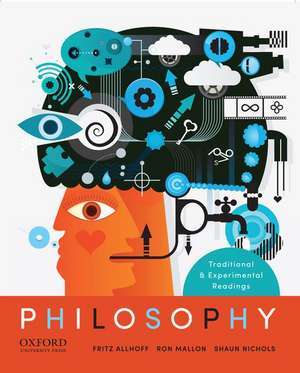
Philosophy: Traditional and Experimental Readings
Editat de Fritz Allhoff Autor Ron Mallon, Shaun Nicholsen Limba Engleză Paperback – 13 sep 2012
Preț: 836.40 lei
Preț vechi: 1105.86 lei
-24%
Puncte Express: 1255
Carte tipărită la comandă
Livrare economică 20-25 noiembrie
Livrare prin curier în România Termenul estimat este afișat lângă disponibilitate.
Transport gratuit pentru acest produs Plată online sau ramburs, în funcție de opțiunile comenzii.
Retur gratuit în 14 zile Comandă securizată și suport în română.
Specificații
ISBN-13: 9780199775255
ISBN-10: 0199775257
Pagini: 608
Dimensiuni: 188 x 231 x 25 mm
Greutate: 0.88 kg
Editura: Oxford University Press
Colecția OUP USA
Locul publicării:New York, United States
ISBN-10: 0199775257
Pagini: 608
Dimensiuni: 188 x 231 x 25 mm
Greutate: 0.88 kg
Editura: Oxford University Press
Colecția OUP USA
Locul publicării:New York, United States
V-ar putea interesa
-
 -27%Preț: 886.86 lei1214.87 lei
 -
 -22%Preț: 436.91 lei556.93 lei
 -
 Experimental PhilosophyJoshua Knobe-13%Preț: 295.62 lei338.64 lei
 -
 Leibniz's 'New System' and Associated Contemporary TextsR. S. Woolhouse-33%Preț: 866.33 lei1289.52 lei
 -
 Frege's TheoremRichard G. HeckPreț: 274.43 lei
 -
 The Oxford Handbook of WittgensteinOskari Kuusela-18%Preț: 325.13 lei398.49 lei
 -
 Wittgenstein and Natural ReligionGordon Graham-29%Preț: 503.52 lei704.98 lei
 -
 Construction of Human KindsRon Mallon-19%Preț: 571.12 lei705.08 lei
 -
 -20%Preț: 312.42 lei388.42 lei
 -
 British Ethical Theorists from Sidgwick to EwingThomas Hurka-28%Preț: 429.88 lei598.67 lei
 -
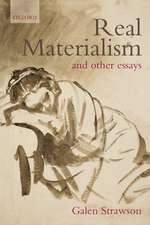 Real Materialism: and Other EssaysGalen Strawson-12%Preț: 278.40 lei317.76 lei
 -
 -28%Preț: 347.41 lei483.18 lei
 -
 Bound: Essays on free will and responsibilityShaun Nichols-19%Preț: 530.09 lei654.43 lei
 -
 New Essays on Tarski and PhilosophyDouglas Patterson-33%Preț: 936.25 lei1388.34 lei
 -
 Oxford Studies in Early Modern Philosophy Volume IVDaniel Garber-31%Preț: 661.44 lei960.42 lei
 -
 Oxford Studies in Early Modern Philosophy Volume IVDaniel Garber-21%Preț: 301.96 lei380.21 lei
 -
 -14%Preț: 276.31 lei319.97 lei
 -
 Carl SchmittReinhard Mehring-19%Preț: 475.05 lei586.48 lei
 -
 Before TomorrowCatherine MalabouPreț: 157.39 lei
 -
 Freedom to FailPeter TrawnyPreț: 145.42 lei
 -
 Moral PsychologyNadelhofferPreț: 448.82 lei
 -
 Die Geburt der Philosophie im Garten der LüsteWilhelm SchmidPreț: 101.91 lei
Notă biografică
Fritz Allhoff is Associate Professor of Philosophy and Director of Graduate Studies at Western Michigan University. Ron Mallon is Associate Professor of Philosophy and Director of Philosophy-Neuroscience-Psychology at Washington University in St. Louis. Shaun Nichols is Professor of Philosophy at The University of Arizona.
Cuprins
- PART I: KNOWLEDGE AND REALITY
- Chapter 1: Belief in God
- Kevin Timpe: Introduction
- 1.1a. Anselm: Proslogion
- 1.1b. Gaunilo: A Reply on Behalf of the Fool
- 1.2. Thomas Aquinas: Summa Theologiae
- 1.3. William Paley: Natural Theology
- 1.4. Blaise Pascal: Pensées
- 1.5. Peter van Inwagen: The Argument from Evil
- 1.6. Sigmund Freud: The Future of an Illusion
- 1.7. Alvin Plantinga: Warranted Christian Belief
- 1.8. Deborah Kelemen: Are Children "Intuitive Theists"?
- 1.9. Daniel Dennett: Breaking the Spell
- Chapter 2: Skepticism and the Analysis of Knowledge
- James Beebe and Anand J. Vaidya: Introduction
- 2.1. Sextus Empiricus: Outlines of Pyrrhonism
- 2.2. René Descartes: Meditation I: Concerning Those Things That Can Be Called into Doubt
- 2.3. George Berkeley: Principles of Human Knowledge
- 2.4. G. E. Moore: Proof of an External World
- 2.5. Edmund Gettier: Is Justified True Belief Knowledge?
- 2.6. Alvin Goldman: What Is Justified Belief?
- 2.7. Shaun Nichols, Stephen Stich, and Jonathan Weinberg: Meta-Skepticism: Meditations in Ethno-Epistemology
- Chapter 3: Explanation and Causation
- Alexandra Bradner: Introduction
- 3.1. Aristotle: Physics, Posterior Analytics, Physics
- 3.2. David Hume: Enquiry Concerning Human Understanding
- 3.3. Albert Michotte: The Perception of Causality
- 3.4. David Lewis: Causation
- 3.5. Laura Scultz, Tamar Kushnir, and Alison Gopnik: Learning from Doing
- PART II: MIND AND SELF
- Chapter 4: Mental States
- Mark Phelan and Eric Mandelbaum: Introduction
- 4.1. René Descartes and Princess Elisabeth: How Can Souls Move Bodies?
- 4.2. Paul Bloom: The Duel between Body and Soul
- 4.3. Mark Phelan, Eric Mandelbaum, and Shaun Nichols: Brain Damage, Mind Damage, and Dualism
- 4.4. Paul Churchland: Eliminative Materialism and the Propositional Attitudes
- 4.5. Ron Mallon, Edouard Machery, Shaun Nichols, and Stephen Stich: Against Arguments from Reference
- 4.6. Jerry Fodor: The Persistence of the Attitudes
- 4.7. Daniel Dennett: Real Patterns
- 4.8. Alison Gopnik and Henry M. Wellman: Why the Child's Theory of Mind Really Is a Theory
- 4.9. Joshua Knobe: Person as Scientist, Person as Moralist
- Chapter 5: Consciousness
- Emily Esch and Joshua Weisberg: Introduction
- 5.1. René Descartes: Meditations on First Philosophy
- 5.2. Gottfried Leibniz: The Monadology
- 5.3. T. H. Huxley: On the Hypothesis That Animals Are Automata, and Its History
- 5.4. Frank Jackson: Epiphenomenal Qualia
- 5.5. David Chalmers: The Puzzle of Conscious Experience
- 5.6. Patricia Churchland: The Hornswoggle Problem
- 5.7a. Martha J. Farah: Visual Perception and Visual Awareness after Brain Damage: A Tutorial
- 5.7b. Michael Tye: Ten Problems of Consciousness
- 5.8. Justin Sytsma: Folk Psychology and Phenomenal Consciousness
- Chapter 6: Free Will and Moral Responsibility
- Stephen Morris and Chris Weigel: Introduction
- 6.1. Kai Nielson: The Compatibility of Freedom and Determinism
- 6.2. Roderick Chisholm: Human Freedom and the Self
- 6.3. Galen Strawson: The Impossibility of Moral Responsibility
- 6.4. Harry G. Frankfurt: Freedom of the Will and the Concept of a Person
- 6.5. Eddy Nahmias, Stephen Morris, Thomas Nadelhoffer, and Jason Turner: Surveying Freedom: Folk Intuitions about Free Will and Moral Responsibility
- 6.6. Daniel Wegner: The Illusion of Conscious Will
- 6.7. Alfred R. Mele: Free Will and Luck
- Chapter 7: Persons and the Self
- Emily Esch: Introduction
- 7.1. John Locke: An Essay Concerning Human Understanding
- 7.2. Thomas Reid: Essays on the Intellectual Powers of Man
- 7.3. David Hume: Treatise of Human Nature
- 7.4. Derek Parfit: Divided Minds and the Nature of Persons
- 7.5. Paul Bloom: First Person Plural
- PART III: VALUE THEORY
- Chapter 8: Meta-Ethics
- Tamler Sommers and Jennifer Cole Wright: Introduction
- 8.1. Herodotus: Culture Is King
- 8.2. Plato: Why Be Moral?
- 8.3. A. J. Ayer: Emotivism
- 8.4. J. L. Mackie: Error Theory
- 8.5. Michael Smith: The Moral Problem
- 8.6. James Rachels: The Challenge of Cultural Relativism
- 8.7. John Doris and Stephen Stich: Empirical Approaches to Metaethics
- 8.8. Jennifer Cole Wright and Hagop Sarkissian: Folk Meta-Ethical Commitments
- Chapter 9: Normative Ethics
- Kevin Timpe: Introduction
- 9.1. Aristotle: Nicomachean Ethics
- 9.2. Immanuel Kant: Groundwork for the Metaphysics of Morals
- 9.3. John Stuart Mill: Utilitarianism
- 9.4. John Doris: Persons, Situations, and Virtue Ethics
- 9.5. Joshua Greene: The Secret Joke of Kant's Soul
- Chapter 10: Philosophical Method
- Anand J. Vaidya and Michael Shaffer: Introduction
- 10.1. Plato: Meno
- 10.2. Ludwig Wittgenstein: Philosophical Investigations
- 10.3. Stephen P. Stich: Plato's Method Meets Cognitive Science
- 10.4. Ernest Sosa: Experimental Philosophy and Philosophical Intuition