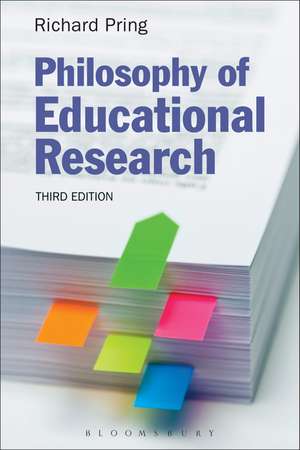
Philosophy of Educational Research
Autor Professor Richard Pringen Limba Engleză Paperback – 29 ian 2015
Preț: 255.87 lei
Preț vechi: 334.45 lei
-23%
Puncte Express: 384
Carte tipărită la comandă
Livrare economică 09-23 octombrie
Livrare prin curier în România Termenul estimat este afișat lângă disponibilitate.
Transport gratuit de la 400.00 lei Plată online sau ramburs, în funcție de opțiunile comenzii.
Retur gratuit în 14 zile Comandă securizată și suport în română.
Specificații
ISBN-13: 9781472575340
ISBN-10: 1472575342
Pagini: 232
Dimensiuni: 138 x 214 x 14 mm
Greutate: 0.32 kg
Ediția:Revizuită
Editura: Bloomsbury Publishing
Colecția Bloomsbury Academic
Locul publicării:London, United Kingdom
ISBN-10: 1472575342
Pagini: 232
Dimensiuni: 138 x 214 x 14 mm
Greutate: 0.32 kg
Ediția:Revizuită
Editura: Bloomsbury Publishing
Colecția Bloomsbury Academic
Locul publicării:London, United Kingdom
V-ar putea interesa
-
 Vygotsky and ResearchHarry DanielsPreț: 482.42 lei
 -
 Preț: 374.59 lei
 -
 Education and the Social OrderBertrand RussellPreț: 154.91 lei
 -
 On EducationBertrand RussellPreț: 170.56 lei
 -
 Preț: 422.07 lei
 -
 Does Religious Education Work?: A Multi-dimensional InvestigationProfessor James C. Conroy-33%Preț: 962.48 lei1432.46 lei
 -
 John DeweyProfessor Richard Pring-16%Preț: 276.77 lei328.89 lei
 -
 Michel FoucaultDr Lynn Fendler-16%Preț: 271.57 lei322.16 lei
 -
 Authority and the TeacherWilliam H. Kitchen-26%Preț: 197.07 lei265.87 lei
 -
 Teaching as the Practice of WisdomDavid Smith-17%Preț: 205.63 lei247.43 lei
 -
 The salmon of knowledgeNick OwenPreț: 151.36 lei
 -
 Making Schools DifferentKitty Te RielePreț: 446.20 lei
Cuprins
Foreword to Third Edition
1. Setting the scene: criticisms of educational research
2. Doing philosophy: defining what you mean
3. The focus of educational research: practice and policy
4. Research methods: philosophical issues they raise
5. Quantitative and qualitative research: a false dualism
6. Key concepts and recurring conflicts
7. Competing philosophical positions
8. Research into practice: action and practitioner research
9. Quality of educational research
10. Ethical dimensions to educational research
11. Political context of educational research
12. Conclusion: the nature and future of educational research
Bibliography
Index
1. Setting the scene: criticisms of educational research
2. Doing philosophy: defining what you mean
3. The focus of educational research: practice and policy
4. Research methods: philosophical issues they raise
5. Quantitative and qualitative research: a false dualism
6. Key concepts and recurring conflicts
7. Competing philosophical positions
8. Research into practice: action and practitioner research
9. Quality of educational research
10. Ethical dimensions to educational research
11. Political context of educational research
12. Conclusion: the nature and future of educational research
Bibliography
Index
Recenzii
Clear, comprehensive and highly readable, the third edition of this core text revisits certain education issues in the light of recent policy debate and development. For readers looking to understand philosophy of educational research the book is up-to-date and accessible: it remains in a class of its own.
A stimulating and readable book...Pring gives a succinct account of the different philosophical positions and makes a balanced evaluation of their strong and weak points...should be compulsory reading for all trainee teachers let alone educational researchers.
This volume is a textbook and a manifesto, and research students will welcome the clarity with which the various concepts, tools and approaches are outlined ...[T]eachers will be stimulated by it.
Professor Pring's work is far more than the title modestly claims it to be. As much a primer in philosophy of education as a specialist work on the philosophy of educational research it is lucid and concise on topics ranging from the aim[s] of education to the nature of knowledge.
This is a highly accessible but thorough revelation of the underlying philosophical basis and issues embedded in the ever-burgeoning area of educational research. An articulate and lucid work that reflects the author's depth of experience and devoted commitment to improving our understanding of the field of education.
Richard Pring makes a persuasive case that acquiring tools and insights from philosophy should be a central component of preparation for conducting educational research. His book shows that informative research on educational practice must go beyond the methods of trustworthy empirical inquiry to consider issues of purpose and meaning.
In this updated edition of his masterly Philosophy and Educational Research, Richard Pring displays an unrivalled depth of scholarship in demonstrating why and how many of the problems confronting the weaknesses of educational research stem from ignorance of the extensive philosophical literature, particular in epistemology. This outstanding work, cogent and readable, should be a required text for every doctoral student in education and, more generally in the social sciences. The underlying, and sometimes explicit, political themes should also put it on the reading list of educational politicians and all who oversee research funding.
A stimulating and readable book...Pring gives a succinct account of the different philosophical positions and makes a balanced evaluation of their strong and weak points...should be compulsory reading for all trainee teachers let alone educational researchers.
This volume is a textbook and a manifesto, and research students will welcome the clarity with which the various concepts, tools and approaches are outlined ...[T]eachers will be stimulated by it.
Professor Pring's work is far more than the title modestly claims it to be. As much a primer in philosophy of education as a specialist work on the philosophy of educational research it is lucid and concise on topics ranging from the aim[s] of education to the nature of knowledge.
This is a highly accessible but thorough revelation of the underlying philosophical basis and issues embedded in the ever-burgeoning area of educational research. An articulate and lucid work that reflects the author's depth of experience and devoted commitment to improving our understanding of the field of education.
Richard Pring makes a persuasive case that acquiring tools and insights from philosophy should be a central component of preparation for conducting educational research. His book shows that informative research on educational practice must go beyond the methods of trustworthy empirical inquiry to consider issues of purpose and meaning.
In this updated edition of his masterly Philosophy and Educational Research, Richard Pring displays an unrivalled depth of scholarship in demonstrating why and how many of the problems confronting the weaknesses of educational research stem from ignorance of the extensive philosophical literature, particular in epistemology. This outstanding work, cogent and readable, should be a required text for every doctoral student in education and, more generally in the social sciences. The underlying, and sometimes explicit, political themes should also put it on the reading list of educational politicians and all who oversee research funding.
Notă biografică
Richard Pring was Emeritus Professor at the Department of Education, and Emeritus Fellow of Green Templeton College, University of Oxford, UK. He was Lead Director of the six year Nuffield Review of 14-19 Education and Training for England and Wales, and until 2003, Professor of Educational Studies, University of Oxford, UK, where he was Director of the Department.