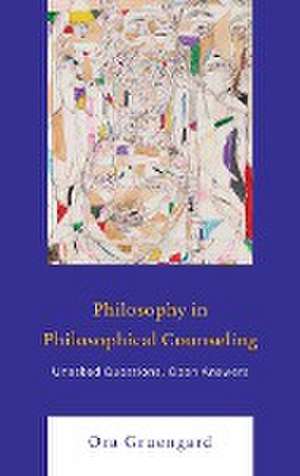
Philosophy in Philosophical Counseling: Unasked Questions, Open Answers: Philosophical Practice: Transformative Reflection on Life
Autor Ora Gruengarden Limba Engleză Hardback – 25 iul 2023



Preț: 530.90 lei
Preț vechi: 782.87 lei
-32%
Puncte Express: 796
Carte tipărită la comandă
Livrare economică 02-16 decembrie
Livrare prin curier în România Termenul estimat este afișat lângă disponibilitate.
Transport gratuit pentru acest produs Plată online sau ramburs, în funcție de opțiunile comenzii.
Retur gratuit în 14 zile Comandă securizată și suport în română.
Specificații
ISBN-13: 9781793649096
ISBN-10: 179364909X
Pagini: 252
Dimensiuni: 152 x 232 x 22 mm
Greutate: 0.52 kg
Editura: Bloomsbury Publishing
Colecția Lexington Books
Seria Philosophical Practice: Transformative Reflection on Life
Locul publicării:New York, United States
ISBN-10: 179364909X
Pagini: 252
Dimensiuni: 152 x 232 x 22 mm
Greutate: 0.52 kg
Editura: Bloomsbury Publishing
Colecția Lexington Books
Seria Philosophical Practice: Transformative Reflection on Life
Locul publicării:New York, United States
Cuprins
Introduction: The Relevance of Philosophy
Chapter One: Philosophical Questions
Chapter Two: Coping with the Questions of the Counselees
Chapter Three: The Philosophical Counselor
Chapter Four: Some Concrete Examples
Chapter Five: Who Does Not Need Academic Philosophy?
Chapter Six: The Irrelevance of Philosophy: The Scientific Perspective
Conclusion: The Relevance of Philosophy
Appendix A: Wisdom: Knowing When to Decide Rationally to Be Non-Rational
Appendix B: Philosophical Controversies
Appendix C: Philosophical Influences and Presuppositions in Psychotherapy
Chapter One: Philosophical Questions
Chapter Two: Coping with the Questions of the Counselees
Chapter Three: The Philosophical Counselor
Chapter Four: Some Concrete Examples
Chapter Five: Who Does Not Need Academic Philosophy?
Chapter Six: The Irrelevance of Philosophy: The Scientific Perspective
Conclusion: The Relevance of Philosophy
Appendix A: Wisdom: Knowing When to Decide Rationally to Be Non-Rational
Appendix B: Philosophical Controversies
Appendix C: Philosophical Influences and Presuppositions in Psychotherapy
Recenzii
Ora Gruengard's eloquent book is a noteworthy addition to the expanding descriptive and explanatory literature on philosophical counseling or practice. In its carefully researched and expertly presented chapters, Dr. Gruengard responds to the allegation that theoretical or academic philosophy is largely irrelevant to philosophical practice or counseling. She discusses what philosophy in counseling is, is not, and ought to be in no uncertain terms by contrasting it with practices such as religious indoctrination, political propagandizing, clinical psychology, and so on. She offers a carefully detailed discussion of the minimal philosophical education required of anyone planning to enter the counseling or therapeutic professions. Dr. Gruengard combines a historical perspective on philosophy with its current application in counseling and therapy in a clear style accessible to professionals, students, and interested lay readers alike. She warns potential patients to beware of counselors and therapists trained exclusively in psychotherapy. Many attempt to appropriate the historical legacy of philosophy by dishonestly claiming that their psychiatric methods are in fact philosophical. This book is an easy-to-read, deeply satisfying, and convincing argument that philosophy is indeed relevant, not only to various practitioners and counselors but to everyone. It's an important addition to any student's or practitioner's library.
Ora Gruengard presents an erudite and insightful treatment of core issues not only in contemporary philosophical counseling, but also in the history of ideas that led to the prominence of this growing global movement. Her sharp distinctions between psychological versus philosophical approaches to the human condition are compellingly drawn from her richly-informed perspective as a pioneering practitioner.
By reflecting a rich variety of examples from philosophical practice and from literature Ora Gruengard shows in a convincing way how fruitful it can be to take everyday experiences as the point of departure for philosophizing. Particularly important is her emphasis of the relevance of philosophical practice also for academic philosophy; taking philosophical practice seriously may lead to a renewal of the understanding of philosophy in our time.
Ora Gruengard presents an erudite and insightful treatment of core issues not only in contemporary philosophical counseling, but also in the history of ideas that led to the prominence of this growing global movement. Her sharp distinctions between psychological versus philosophical approaches to the human condition are compellingly drawn from her richly-informed perspective as a pioneering practitioner.
By reflecting a rich variety of examples from philosophical practice and from literature Ora Gruengard shows in a convincing way how fruitful it can be to take everyday experiences as the point of departure for philosophizing. Particularly important is her emphasis of the relevance of philosophical practice also for academic philosophy; taking philosophical practice seriously may lead to a renewal of the understanding of philosophy in our time.