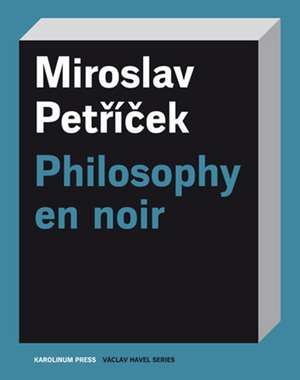
Philosophy En Noir
Autor Miroslav Petrícek Traducere de Phil Jonesen Limba Engleză Paperback – 23 ian 2020
Thought necessarily reflects the times. Following the tragedy of the Holocaust, this fact became ever more clear. And it may be the reason postwar philosophical texts are so difficult to understand, since they confront incomprehensibly traumatic experiences. In this first English-language translation of any of his books, Miroslav Petříček—one of the most influential and erudite Czech philosophers, and a student of Jan Patočka—argues that to exist in the second half of the twentieth century and beyond, Western philosophy has had to rewrite its tradition and its discourse, radically transforming itself. Should philosophy be capable of bearing witness to the time, Petříček contends, this metamorphosis in philosophy is necessary. Offering an original Central European perspective on postwar philosophical discourse that reflects upon the historical underpinnings of pop culture phenomena and complex philosophical schools—including Adorno, Agamben, Benjamin, Derrida, Husserl, Kracauer, and many others—Philosophy en noir is a record of this transformation.
Preț: 113.29 lei
Preț vechi: 133.13 lei
-15%
Puncte Express: 170
Carte indisponibilă temporar
Doresc să fiu notificat când acest titlu va fi disponibil:
Se trimite...
Specificații
ISBN-13: 9788024638539
ISBN-10: 8024638533
Pagini: 330
Dimensiuni: 150 x 188 x 28 mm
Greutate: 0.5 kg
Editura: Karolinum Press, Charles University
ISBN-10: 8024638533
Pagini: 330
Dimensiuni: 150 x 188 x 28 mm
Greutate: 0.5 kg
Editura: Karolinum Press, Charles University
Notă biografică
Miroslav Petříčekis a Czech philosopher who teaches philosophy in the Department of Philosophy and Religion at Charles University, Prague, and film studies at the Film and TV School of the Academy of Performing Arts in Prague. He specializes in the relationship between philosophy and art. Phil Jones is a translator of Czech into English.
Recenzii
“The author’s masterful erudition across the broadest of spectrums is clear from the book’s initial juxtaposition, and the unified interpretation that follows, of Doctor Fu Manchu and Edmund Husserl’s Crisis of European Sciences and Transcendental Phenomenology. . . . I cannot question the success of his investigation.”
“Petříček is one of our most beloved intellectuals. He is, in a sense, a popular philosopher, someone who is not afraid to translate himself and his ideas for the public arena. This, however, does not mean that he trivializes philosophical issues; instead, he realizes that it is important to shift his perspective, so he can speak about them a bit differently.”
“Like many philosophers since 1945, Petricek wants reflectively to 'rethink' philosophy, so turn its very conceptual apparatus on to itself. This reflexivity means his book is hard-going and, like some challenging experimental music, perhaps really only for initiates.”