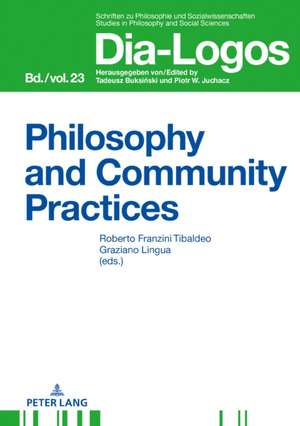
Philosophy and Community Practices: DIA-LOGOS, cartea 23
Editat de Graziano Lingua, Roberto Franzini Tibaldeoen Limba Engleză Hardback – 14 iun 2018
Din seria DIA-LOGOS
- 8%
 Preț: 583.29 lei
 - 8%
 Preț: 603.17 lei
 - 8%
 Preț: 603.38 lei
 - 23%
 Preț: 500.80 lei
 - 23%
 Preț: 533.13 lei
 - 23%
 Preț: 589.09 lei
 - 23%
 Preț: 482.11 lei
 - 23%
 Preț: 573.60 lei
 - 23%
 Preț: 480.24 lei
 -
 Preț: 379.07 lei
 - 23%
 Preț: 489.90 lei
 - 23%
 Preț: 466.93 lei
 - 23%
 Preț: 472.11 lei
 -
 Preț: 434.88 lei
 -
 Preț: 479.21 lei
 -
 Preț: 478.11 lei
Preț: 533.44 lei
Puncte Express: 800
Carte tipărită la comandă
Livrare economică 01-15 decembrie
Livrare prin curier în România Termenul estimat este afișat lângă disponibilitate.
Transport gratuit pentru acest produs Plată online sau ramburs, în funcție de opțiunile comenzii.
Retur gratuit în 14 zile Comandă securizată și suport în română.
Specificații
ISBN-13: 9783631733851
ISBN-10: 3631733852
Pagini: 204
Dimensiuni: 153 x 216 x 16 mm
Greutate: 0.34 kg
Ediția:1. Auflage
Editura: PETER LANG
Colecția DIA-LOGOS
Seria DIA-LOGOS
ISBN-10: 3631733852
Pagini: 204
Dimensiuni: 153 x 216 x 16 mm
Greutate: 0.34 kg
Ediția:1. Auflage
Editura: PETER LANG
Colecția DIA-LOGOS
Seria DIA-LOGOS
Notă biografică
Roberto Franzini Tibaldeo is F.R.S.-FNRS Chargé de recherche (Postdoctoral researcher) at the Université catholique de Louvain (Belgium). Graziano Lingua is Associate Professor of Theoretical Philosophy at the University of Turin and Associate Member of GSRL (EPHE-CNRS) in Paris.
Descriere
The book deals with the relevance of community-based philosophical practices to individual and social empowerment. The methodological focus is on "Philosophy for Communities", an application of Lipman and Sharp's "Philosophy for Children" to non-formal and informal education contexts with adults. The book shows how to assess community practices.