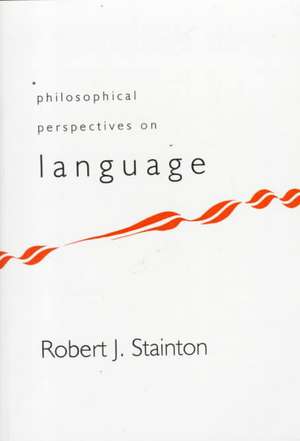
Philosophical Perspectives on Language
Autor Robert J. Staintonen Limba Engleză Paperback – 18 mar 1996
Recomandăm Philosophical Perspectives on Language ca o resursă fundamentală pentru studenții din învățământul terțiar care doresc să stăpânească fundamentele lingvisticii și ale filosofiei analitice. Relevanța acestui manual pentru examenele de specialitate derivă din capacitatea sa de a unifica teme care, în alte texte, par disparate — precum actele de vorbire, referința directă și adevărul — sub o singură umbrelă teoretică: limbajul privit ca un sistem coerent de simboluri.
Observăm o organizare riguroasă în trei părți distincte. Prima parte, „Perspectiva Sistemului”, analizează sintaxa și teoriile referinței (Russell, Frege), oferind o bază solidă în semantica teoretică. A doua parte, „Perspectiva Cunoașterii”, face tranziția către filosofia minții, explorând conceptul de „Mentalese” și teoriile lui Grice. În final, „Perspectiva Utilizării” ancorează conceptele în realitatea comunicării umane. Această progresie reflectă evoluția recentă a domeniului către o convergență cu datele empirice.
În contextul operei sale, această carte reprezintă pilonul teoretic ce susține antologia Perspectives in the Philosophy of Language. În timp ce antologia oferă sursele primare, acest volum furnizează cadrul explicativ necesar interpretării lor. De asemenea, lucrarea extinde preocupările autorului din The Semantics-Pragmatics Boundary in Philosophy, oferind o privire de ansamblu mai accesibilă asupra intersecției dintre înțelesul literal și intenția vorbitorului. Comparativ cu Introduction to Linguistic Philosophy de Ian E. Mackenzie, care se concentrează pe evoluția istorică a analiștilor lingvistici, textul lui Robert J. Stainton este mai tehnic și mai orientat către modelele structurale contemporane, adăugând o dimensiune cognitivă pe care manualele pur istorice o omit adesea.
Preț: 330.78 lei
Preț vechi: 425.39 lei
-22%
Carte disponibilă
Livrare economică 29 mai-12 iunie
Livrare express 15-21 mai pentru 130.60 lei
Specificații
ISBN-10: 1551110865
Pagini: 254
Dimensiuni: 165 x 229 x 11 mm
Greutate: 0.43 kg
Ediția:New.
Editura: BROADVIEW PR
Colecția Broadview Press
Locul publicării:Peterborough, Canada
V-ar putea interesa
-
 -25%Preț: 142.42 lei189.62 lei
 -
 -33%Preț: 842.19 lei1255.58 lei
 -
 Meaning: A Very Short IntroductionEmma Borg-21%Preț: 53.25 lei67.64 lei
 -
 Reference and Beyond: Essays in Philosophy of LanguageMichael Devitt-33%Preț: 885.44 lei1327.64 lei
 -
 Philosophy of LanguageA. P. Martinich-27%Preț: 805.69 lei1103.68 lei
 -
 Metaphors We Live ByProfessor George LakoffPreț: 104.42 lei
 -
 Women, Fire, and Dangerous Things: What Categories Reveal about the MindProfessor George LakoffPreț: 179.00 lei
 -
 Wittgenstein: The Senses of UseSandra LaugierPreț: 313.48 lei
 -
 When Everyone Knows That Everyone Knows...Steven PinkerPreț: 131.42 lei
 -
 Schott's SignificaBen SchottPreț: 162.83 lei
 -
 Mathematical Structure of Syntactic MergeMatilde Marcolli-14%Preț: 399.16 lei464.14 lei
 -
 -27%Preț: 1662.80 lei2277.81 leiNou
 -
 Language and Symbolic PowerPierre BourdieuPreț: 156.58 lei
 -
 Perspectives in the Philosophy of Language: A Concise AnthologyRobert J. Stainton-22%Preț: 388.30 lei500.75 lei
 -
 Logic, Language and PhilosophyFenrong LiuPreț: 307.95 lei
 -
 Prose & ConsGyles BrandrethPreț: 76.10 lei
 -
 Preț: 234.68 lei
 -
 Language and Reality from a Naturalistic PerspectiveAndrea Bianchi-18%Preț: 1072.47 lei1307.89 lei
De ce să citești această carte
Această carte este esențială pentru studenții la filosofie și lingvistică deoarece oferă o structură clară într-un domeniu adesea fragmentat. Cititorul câștigă o înțelegere profundă a modului în care limbajul interacționează cu mintea și logica. Este un instrument de studiu excelent datorită stilului academic precis și a modului în care explică teorii complexe precum referința directă sau innatismul fără a sacrifica rigoarea științifică.
Despre autor
Robert J. Stainton este profesor de filosofie și decan asociat la Universitatea Western Ontario. Cu un doctorat obținut la M.I.T., Stainton este o figură centrală în filosofia limbajului contemporană, fiind autor sau editor a numeroase volume de referință. Expertiza sa duală, în lingvistică și filosofie, îi permite să abordeze studiul limbajului nu doar ca pe o structură abstractă, ci ca pe un proces cognitiv complex, temă recurentă în întreaga sa activitate academică și în publicațiile realizate la edituri prestigioase precum Broadview Press.
Recenzii
Philosophical Perspectives on Language is distinguished in several important respects from other introductions to the topic. Rather than looking at philosophy of language as a collection of (at best) loosely related topics—speech acts, demonstratives, sense and reference, truth and meaning, etc.—this book is organized around a unifying theme: language as a system of symbols that is known and used.
“Stainton has written an excellent textbook on the philosophy of language. It provides a clear and careful introduction to all the main issues in the area. It can be easily [used in conjunction with] some very good anthologies on the topic. … It’s extremely well-written and very polished; Stainton’s prose just flows smoothly from beginning to end. … It’s a joy to read a textbook that walks the reader through some rather tough terrain, never faltering along the way.” — Reinaldo Elugardo, University of Oklahoma
“This is a very good text indeed. It covers the important issues in contemporary philosophy of language, and is extremely clear. It is written in a chatty, lively style … an excellent resource for those new to the philosophy of language.” — Patricia Blanchette, Notre Dame University
Descriere
Philosophical Perspectives on Language is distinguished in several important respects from other introductions to the topic. Rather than looking at philosophy of language as a collection of (at best) loosely related topics—speech acts, demonstratives, sense and reference, truth and meaning, etc.—this book is organized around a unifying theme: language as a system of symbols that is known and used.
Cuprins
Preface
Chapter One: Introduction
- Three Perspectives on Language
- Who Cares?
- Some Terminology
Chapter Two: Syntax
- Introduction
- Option One — Rule Systems
- Option Two — Principles and Parameters
- Epilogue: Prescriptive and Descriptive Syntax
- Three Approaches to Meaning
- Direct Reference Theories
- Bertrand Russell on Descriptions
- Introduction
- Frege
- Possible Worlds
- Truth and Meaning
- Non-Declaratives and Truth
Chapter Six: The Idea Theory of Meaning
- Introduction
- Mental Images
- H. Paul Grice
- Mentalese and the Idea Theory of Meaning
- An Alternative to LOT: Connectionism
- Another Alternative to LOT: Dennett’s International Stance
- Innateness
- Rules and Regularities
- Radical Translation
Chapter Nine: The Use Theory of Meaning
- Meaning and Use
- Indexicals
- Strawson on Referring
- Speech Act Theory
- Quine and Meaning Nihilism
- Conversational Implication
- Metaphor
- Referential-Attributive
- Non-Literal Use and the Need for Conventions
- The Private Language Argument
- Davidson on the Limits of Convention
Notes
References
Index