Cantitate/Preț
Produs

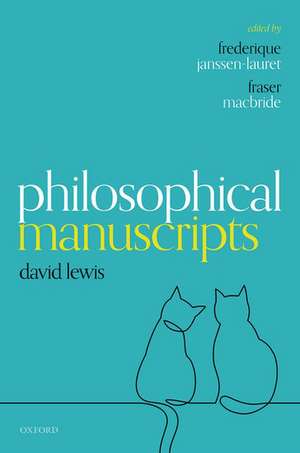
Philosophical Manuscripts

Autor David Lewis Editat de Frederique Janssen-Lauret, Fraser Macbride
en Limba Engleză Hardback – 28 sep 2023

Această culegere de studii postumă, publicată de OUP OXFORD, reprezintă un eveniment editorial major pentru filozofia analitică contemporană. Ne-a atras atenția modul în care acest volum reușește să recupereze și să sistematizeze moștenirea lăsată de David Lewis, unul dintre cei mai influenți gânditori ai secolului XX. Structura cărții este construită în jurul a două manuscrise ample pe care autorul intenționa inițial să le transforme în cărți de sine stătătoare. Primul, 'The Paradoxes of Time Travel', derivă din prelegerile susținute la Universitatea din Adelaide și servește drept poartă de acces către metafizică, în timp ce al doilea, 'Confirmation Theory', oferă o sinteză tehnică a teoriilor confirmării, menținând totodată un nivel matematic riguros, dar accesibil. Subliniem faptul că volumul este întregit de treizeci și unu de texte scurte care explorează teme recurente în opera sa, de la contraparți și referință până la problema răului divin. Această lucrare acoperă aceeași arie tematică precum Perspectives on the Philosophy of David K. Lewis, dar cu o abordare mult mai directă, oferind vocea nefiltrată a autorului prin manuscrise inedite, spre deosebire de comentariile critice ale altor savanți. Față de volumele anterioare, precum Papers in Philosophical Logic: Volume 1 sau Papers in Metaphysics and Epistemology: Volume 2 din seria Cambridge Studies in Philosophy, care reuneau articole deja publicate, 'Philosophical Manuscripts' aduce la lumină material de arhivă care clarifică geneza multora dintre doctrinele sale favorite.

Citește tot Restrânge

Preț: 23029 lei

Preț vechi: 25951 lei
-11%

Puncte Express: 345

Carte disponibilă

Livrare economică 08-19 mai
Livrare express 25 aprilie-01 mai pentru 6312 lei


Specificații

ISBN-13: 9780192847393
ISBN-10: 0192847392
Pagini: 282
Dimensiuni: 160 x 240 x 20 mm
Greutate: 0.57 kg
Editura: OUP OXFORD
Colecția OUP Oxford
Locul publicării:Oxford, United Kingdom

De ce să citești această carte

Recomandăm acest volum oricărui student sau cercetător interesat de filozofia analitică și metafizică. Cititorul câștigă acces la laboratorul de creație al lui David Lewis, descoperind argumente inedite despre călătoria în timp și logica probabilității. Este o piesă esențială pentru a înțelege evoluția ideilor care au dominat agenda filozofică a ultimelor decenii, completată de o biografie intelectuală valoroasă a anilor de formare ai autorului.


Despre autor

David Lewis (1941-2001) a fost o figură centrală a filozofiei analitice, cunoscut pentru contribuțiile sale fundamentale în metafizică, filozofia limbajului și epistemologie. Profesor la Universitatea Princeton, Lewis a redefinit dezbaterile despre modalitate prin realismul său modal și a influențat profund logica contemporană. Deși datele biografice externe pot genera confuzii cu alți autori omonimi din domenii tehnice sau beletristice, David Kellogg Lewis rămâne reperul academic incontestabil pentru teoriile cauzalității și ale lumilor posibile, opera sa fiind subiectul a numeroase volume de exegeză și cursuri universitare la nivel mondial.


Descriere

David Lewis (1941-2001) was a celebrated and influential figure in analytic philosophy. When Lewis died, he left behind a large body of unpublished notes, manuscripts, and letters. This volume contains two longer manuscripts which Lewis had originally intended to turn into books, and thirty-one shorter items. The longer manuscripts are 'The Paradoxes of Time Travel', his David Gavin Young Lectures at the University of Adelaide, and 'Confirmation Theory', which is based on a graduate course on probability and logic that he gave at UCLA. Lewis's described his purposes in 'The Paradoxes of Time Travel' as being, `(1) to solve a philosophical problem hitherto largely ignored or casually mis-solved by philosophers […]; (2) to introduce the layman to various topics in metaphysics, since our problem turns out to connect with many more familiar ones; and (3) to show of several of my favorite doctrines and methods in metaphysics'. By contrast, 'Confirmation Theory' is a technical work in which Lewis aimed to present in a unified fashion what he considered to be the best from competing theories of confirmation. Lewis described the work as 'Mathematically self-contained, with proofs for the major theorems; but the mathematics is kept down to hairy high-school algebra'. The thirty-one shorter items cover such topics as causation, freedom of the will, probability, counterparts, reference, logic, value, and divine evil. They are included here both for their intrinsic philosophical interest and their historical value. This volume also contains an intellectual biography of the young David Lewis by the editors.

Notă biografică

Frederique Janssen-Lauret is a Lecturer in Philosophy at the University of Manchester, specialising in philosophical logic and history of analytic philosophy. She was previously a research fellow on the AHRC-funded project 'The Age of Metaphysical Revolution: David Lewis and His Place in the History of Analytic Philosophy'. She is co-translator of Quine's The Significance of the New Logic (Cambridge University Press 2018) and has published papers on philosophical logic, Lewis, Quine, and Stebbing in Synthese, The Monist, Australasian Journal of Philosophy, Journal for the History of Analytical Philosophy, and in volumes published by Oxford, Cambridge, and Palgrave.Fraser MacBride is currently Chair of Logic & Metaphysics at the University of Manchester. He was previously the Chair of Logic and Rhetoric at Glasgow University and held a Readership at the University of Cambridge. He is the author of On the Genealogy of Universal: The Metaphysical Origins of Analytic Philosophy (OUP) and was awarded a Leverhulme Prize for his work on metaphysics and the philosophy of mathematics. He was Co-Investigator on the AHRC funded project 'The Age of Metaphysical Revolution: David Lewis and His Place in the History of Analytic Philosophy' and has published papers on Lewis's relationship to Armstrong, Quine, and Carnap.