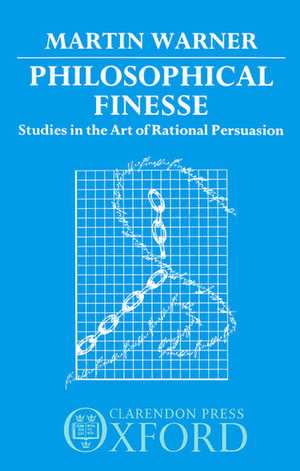
Philosophical Finesse: Studies in the Art of Rational Persuasion
Autor Martin Warneren Limba Engleză Hardback – iun 1989
Preț: 390.95 lei
Preț vechi: 553.28 lei
-29%
Puncte Express: 586
Carte tipărită la comandă
Livrare economică 19-25 noiembrie
Livrare prin curier în România Termenul estimat este afișat lângă disponibilitate.
Transport gratuit de la 400.00 lei Plată online sau ramburs, în funcție de opțiunile comenzii.
Retur gratuit în 14 zile Comandă securizată și suport în română.
Specificații
ISBN-13: 9780198244554
ISBN-10: 019824455X
Pagini: 412
Dimensiuni: 145 x 224 x 29 mm
Greutate: 0.67 kg
Editura: Clarendon Press
Colecția Clarendon Press
Locul publicării:Oxford, United Kingdom
ISBN-10: 019824455X
Pagini: 412
Dimensiuni: 145 x 224 x 29 mm
Greutate: 0.67 kg
Editura: Clarendon Press
Colecția Clarendon Press
Locul publicării:Oxford, United Kingdom
V-ar putea interesa
-
 Why is There Something Rather Than Nothing?Leszek Kolakowski-32%Preț: 62.40 lei91.77 lei
 -
 In Search of the MiraculousP. D. OuspenskyPreț: 113.68 lei
 -
 Locke's Philosophy: Content and ContextG. A. J. Rogers-21%Preț: 301.93 lei380.16 lei
 -
 The Philosophy of SchopenhauerBryan Magee-21%Preț: 371.88 lei468.36 lei
 -
 -28%Preț: 405.52 lei560.67 lei
 -
 Natural Law and the Theory of Property: Grotius to HumeStephen Buckle-28%Preț: 419.35 lei585.07 lei
 -
 Philosophical Grounds of Rationality: Intentions, Categories, EndsRichard E. Grandy-28%Preț: 396.89 lei550.18 lei
 -
 John Locke: Selected CorrespondenceMark Goldie-22%Preț: 365.81 lei468.39 lei
 -
 -19%Preț: 355.18 lei437.64 lei
 -
 Plotinus on IntellectEyjólfur Kjalar Emilsson-33%Preț: 709.30 lei1053.28 lei
 -
 History of Western PhilosophyBertrand RussellPreț: 242.24 lei
 -
 Revise Philosophy for AS LevelMichael LacewingPreț: 295.84 lei
 -
 The Form of Things: Essays on Life, Ideas and LibertyProf A.C. Grayling-6%Preț: 66.57 lei70.93 lei
 -
 Leibniz: A Guide for the PerplexedDr Franklin Perkins-17%Preț: 177.02 lei213.16 lei
 -
 Preț: 101.42 lei
 -
 Perspectives on Philosophy of CommunicationPat ArnesonPreț: 190.38 lei
 -
 The Essential Rene GuenonJohn HerlihyPreț: 147.29 lei
Cuprins
Philosophical reasoning: The disposition to Geometrize; Classical models of rationality: Plato, Aristotle and Cicero; On taking the Phaedo seriously; Job versus his comforters: Rival paradigms of "Wisdom"; Pascal's reasons of the heart; Hume and the education of Pamphilus; Nietzsche's philosophical hammer; Philosophical finesse; notes
Recenzii
'a useful addition to the group of works which recently have called attention of philosophers to the character of their own discourse on the grounds of the philosophical, not merely the ornamental significance of that analysis'Berel Lang, State University of New York at Albany, The Review of Metaphysics, March 1992
'Philosophical Finesse has much to offer to many readers. It is informed and informative. It is argued tightly and lives up to the expectations it creates in the reader ... it is researched carefully and extensively.'John Poulakos, University of Pittsburgh, Philosophy and Rhetoric, Vol. 27, No. 1, 1994
'Philosophical Finesse has much to offer to many readers. It is informed and informative. It is argued tightly and lives up to the expectations it creates in the reader ... it is researched carefully and extensively.'John Poulakos, University of Pittsburgh, Philosophy and Rhetoric, Vol. 27, No. 1, 1994