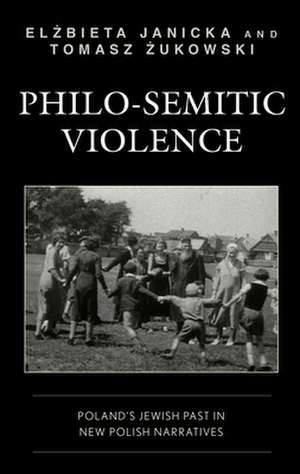
Philo-Semitic Violence: Poland's Jewish Past in New Polish Narratives: Reading Trauma and Memory
Autor Elzbieta Janicka, Tomasz Zukowskien Limba Engleză Hardback – 7 iul 2021
Elzbieta Janicka and Tomasz Zukowski examine phenomena termed a "new opening in Polish-Jewish relations," thought to stem from sociocultural change and the posthumous inclusion of those subjected to anti-Semitic violence. The authors investigate the terms and conditions of this inclusion whose object is an imagined collective Jewish figure.
Different creators and media, same friendly intentions, same warm reception beyond class and political cleavages, regardless of gender and age. The made-to-measure Jewish figure confirms and legitimizes the majority narrative-especially about Polish stances and behaviors during the Holocaust. Enabled by this, philo-Semitic feelings indulge the dominant group in Baudrillard's retrospective hallucinations. The consequence: aggression toward anyone who dares to interrupt the narcissistic self-staging.
This book exposes the Polish ethnoreligious identity regime that privileges the concern for the collective image over reality. The authors' inquiry shows how patterns of exclusion and violence are reproduced when anti-Semitism-with its Christian sources and community-building function-is not openly problematized, reassessed, and rejected in light of its consequences and the basic principle of equal rights.




Preț: 578.44 lei
Preț vechi: 873.74 lei
-34%
Puncte Express: 868
Preț estimativ în valută:
102.37€ • 119.64$ • 88.88£
102.37€ • 119.64$ • 88.88£
Carte tipărită la comandă
Livrare economică 20 februarie-06 martie
Preluare comenzi: 021 569.72.76
Specificații
ISBN-13: 9781793636690
ISBN-10: 1793636699
Pagini: 294
Ilustrații: 5 b/w photos;
Dimensiuni: 160 x 232 x 22 mm
Greutate: 0.54 kg
Editura: Bloomsbury Publishing
Colecția Lexington Books
Seria Reading Trauma and Memory
Locul publicării:New York, United States
ISBN-10: 1793636699
Pagini: 294
Ilustrații: 5 b/w photos;
Dimensiuni: 160 x 232 x 22 mm
Greutate: 0.54 kg
Editura: Bloomsbury Publishing
Colecția Lexington Books
Seria Reading Trauma and Memory
Locul publicării:New York, United States
Cuprins
Introduction: Philo-Semitic Violence
Elzbieta Janicka, Tomasz Zukowski
Chapter I: Interception of a Document: Po-lin by Jolanta Dylewska (2008)
Elzbieta Janicka, Tomasz Zukowski
Chapter II: Correction of the Reality: Reenacting the Destruction of the Bedzin Ghetto (2010)
Tomasz Zukowski
Chapter III: The Object and Subject of Nostalgia: I Miss You, Jew and The Burning Barn by Rafal Betlejewski (2010)
Tomasz Zukowski
Chapter IV: Purification through Separation: The Commemoration of the Warsaw Ghetto Bridge
(1996, 2007-2011)
Elzbieta Janicka
Chapter V: A Freudian Slip: The Keret House at Zelazna Street in Warsaw (2012)
Elzbieta Janicka
Elzbieta Janicka, Tomasz Zukowski
Chapter I: Interception of a Document: Po-lin by Jolanta Dylewska (2008)
Elzbieta Janicka, Tomasz Zukowski
Chapter II: Correction of the Reality: Reenacting the Destruction of the Bedzin Ghetto (2010)
Tomasz Zukowski
Chapter III: The Object and Subject of Nostalgia: I Miss You, Jew and The Burning Barn by Rafal Betlejewski (2010)
Tomasz Zukowski
Chapter IV: Purification through Separation: The Commemoration of the Warsaw Ghetto Bridge
(1996, 2007-2011)
Elzbieta Janicka
Chapter V: A Freudian Slip: The Keret House at Zelazna Street in Warsaw (2012)
Elzbieta Janicka
Recenzii
A wonderful and original book by two of the most gifted Poland's cultural critics.
In a time when a truthful Holocaust history and memory is under assault in Poland, Philo-Semitic Violence: Poland's Jewish Past in New Polish Narratives is a fundamental contribution to scholarship as well as to public discussions of these topics. Most importantly, it reminds us of the essential ethical element in historical writing and memory.
Philosemitic Violence presents an entirely original and brilliant examination of contemporary Polish antisemitism through the multiple lenses of literature, film, architecture, public space and public discourse-through the "mentality" or consciousness of Poland's endless recital of its historic victimhood, its virtue, goodness and truth. It reveals and analyzes the self-justifying consciousness that propels the good intentions of the Polish majority toward its Jewish minority, on the one hand, while violating the dignity and humanity of this minority, on the other, whereby praising Jews, helping Jews, working for the benefit of Jews is a central element in the violence done to the humanity of Jews, to their concrete, historical memory and authentic historical experience. Much like racist attitudes in the American South that enabled Whites to treat Blacks fairly, look after their families and their needs as long as they remained "good" Blacks, as long as they did not stray out of the safe and demeaning stereotypes that denied them essential personhood, contemporary philosemitic violence in Poland, among Poles, offers Jews a friendly face and a friendly hand as long as Jews know their place and make no demands that threaten the master narrative of Polish society. Philosemitic Violence is a major and original contribution to current debates over Polish antisemitism and the future of Jewish life in Poland.
The strength and importance of Philo-Semitic Violence lie in its thought-provoking criticism and piercing analysis of educational and commemorative initiatives related to the Jewish past in Poland.
In a time when a truthful Holocaust history and memory is under assault in Poland, Philo-Semitic Violence: Poland's Jewish Past in New Polish Narratives is a fundamental contribution to scholarship as well as to public discussions of these topics. Most importantly, it reminds us of the essential ethical element in historical writing and memory.
Philosemitic Violence presents an entirely original and brilliant examination of contemporary Polish antisemitism through the multiple lenses of literature, film, architecture, public space and public discourse-through the "mentality" or consciousness of Poland's endless recital of its historic victimhood, its virtue, goodness and truth. It reveals and analyzes the self-justifying consciousness that propels the good intentions of the Polish majority toward its Jewish minority, on the one hand, while violating the dignity and humanity of this minority, on the other, whereby praising Jews, helping Jews, working for the benefit of Jews is a central element in the violence done to the humanity of Jews, to their concrete, historical memory and authentic historical experience. Much like racist attitudes in the American South that enabled Whites to treat Blacks fairly, look after their families and their needs as long as they remained "good" Blacks, as long as they did not stray out of the safe and demeaning stereotypes that denied them essential personhood, contemporary philosemitic violence in Poland, among Poles, offers Jews a friendly face and a friendly hand as long as Jews know their place and make no demands that threaten the master narrative of Polish society. Philosemitic Violence is a major and original contribution to current debates over Polish antisemitism and the future of Jewish life in Poland.
The strength and importance of Philo-Semitic Violence lie in its thought-provoking criticism and piercing analysis of educational and commemorative initiatives related to the Jewish past in Poland.