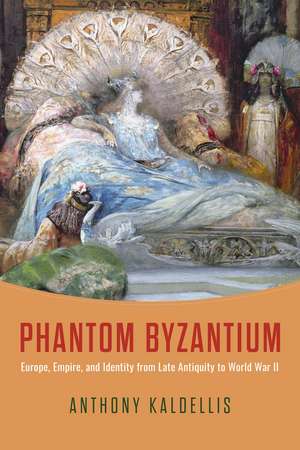
Phantom Byzantium: Europe, Empire, and Identity from Late Antiquity to World War II
Autor Anthony Kaldellisen Limba Engleză Hardback – 3 apr 2026
Unveiling the ideological foundations of Byzantine studies, Phantom Byzantium is a pioneering survey of western European perceptions of the eastern Roman empire (also known as Byzantium) spanning late antiquity to World War II. Through ten chronological chapters, Anthony Kaldellis makes the case that western Europe gradually formed its identity by adopting prestigious cultural elements from the eastern empire but simultaneously portraying the east as inferior. The West modeled its Roman imperial style on Constantinople while minimizing the latter as Greek rather than Roman; appropriated a host of Christian traditions from the east while casting the east as schismatic, heretical, or treacherous; and, during the Renaissance, used classical Hellenic philology from Greek scholars before marginalizing them as unworthy bearers of that tradition. This orientalizing impulse worked to buttress western exceptionalism and resulted in the fictitious construction of “Byzantium” as Europe’s evil doppelgänger, embodying the worst versions of traditions fundamental to European identity and casting the region as despotic, superstitious, and degenerate.
Explaining the creation, history, and functions of the ideological construct of Byzantium in the western imagination and European self-fashioning, this book has critical implications for contemporary views of European history.
Preț: 269.21 lei
Puncte Express: 404
Carte disponibilă
Livrare economică 29 octombrie-12 noiembrie
Livrare express 15-21 octombrie pentru 40.26 lei
Livrare prin curier în România Termenul estimat este afișat lângă disponibilitate.
Transport gratuit de la 400.00 lei Plată online sau ramburs, în funcție de opțiunile comenzii.
Retur gratuit în 14 zile Comandă securizată și suport în română.
Specificații
ISBN-13: 9780226847139
ISBN-10: 0226847136
Pagini: 240
Dimensiuni: 152 x 229 x 23 mm
Greutate: 0.52 kg
Ediția:First Edition
Editura: University of Chicago Press
Colecția University of Chicago Press
ISBN-10: 0226847136
Pagini: 240
Dimensiuni: 152 x 229 x 23 mm
Greutate: 0.52 kg
Ediția:First Edition
Editura: University of Chicago Press
Colecția University of Chicago Press
Notă biografică
Anthony Kaldellis is professor of classics at the University of Chicago. He is the author of many books, including, most recently, The New Roman Empire: A History of Byzantium, and he is the host of the podcast Byzantium & Friends.
Cuprins
Introduction
1. The Dual Empire
2. The Barbarian Kingdoms
3. Pope and Kaiser
4. The Era of the Crusades
5. The Dead Ends of Colonization
6. Humanism and Hellenic Studies
7. Early Scholarship and Political Theory
8. Afoul of the Enlightenment
9. Great Power Politics
10. The Metaphysical Turn
Conclusion
Acknowledgments
Notes
Selected Bibliography
Index
1. The Dual Empire
2. The Barbarian Kingdoms
3. Pope and Kaiser
4. The Era of the Crusades
5. The Dead Ends of Colonization
6. Humanism and Hellenic Studies
7. Early Scholarship and Political Theory
8. Afoul of the Enlightenment
9. Great Power Politics
10. The Metaphysical Turn
Conclusion
Acknowledgments
Notes
Selected Bibliography
Index
Recenzii
“Once again, Kaldellis has forced us to rethink much of what we thought we knew—in this case, the millennium-long role of Western Europe in the concept of ‘Byzantium.’ Kaldellis demonstrates that ‘Byzantium’ was a project of European self-fashioning, a way for Western elites to claim for themselves the Hellenistic, Roman, and Christian past while denying those same legacies to the peoples we call the Byzantines. This is an innovative but accessible study that showcases a scholar with an extraordinary command of the sources.”
“With his important and extremely exciting Phantom Byzantium, Kaldellis continues to redefine the field of Byzantine Studies. Kaldellis builds admirably on his project to provide a comprehensive critique of the centuries-long denial of the Roman identity belonging to the people modern scholars call Byzantines. He explores how western European superiority, notions of imperialism, and racism came together in the early twentieth century to create peculiarly dismissive attitudes among Byzantinists toward the texts, artworks, and people they study.”
“With his important and extremely exciting Phantom Byzantium, Kaldellis continues to redefine the field of Byzantine Studies. Kaldellis builds admirably on his project to provide a comprehensive critique of the centuries-long denial of the Roman identity belonging to the people modern scholars call Byzantines. He explores how western European superiority, notions of imperialism, and racism came together in the early twentieth century to create peculiarly dismissive attitudes among Byzantinists toward the texts, artworks, and people they study.”