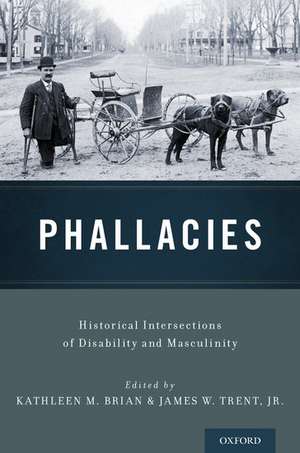
Phallacies: Historical Intersections of Disability and Masculinity
Editat de Kathleen M. Brian, James W. Trent, Jr.en Limba Engleză Hardback – 26 oct 2017
Preț: 507.87 lei
Preț vechi: 638.93 lei
-21%
Puncte Express: 762
Carte tipărită la comandă
Livrare economică 18-23 decembrie
Livrare prin curier în România Termenul estimat este afișat lângă disponibilitate.
Transport gratuit pentru acest produs Plată online sau ramburs, în funcție de opțiunile comenzii.
Retur gratuit în 14 zile Comandă securizată și suport în română.
Specificații
ISBN-13: 9780190458997
ISBN-10: 0190458992
Pagini: 368
Dimensiuni: 152 x 236 x 25 mm
Greutate: 0.66 kg
Editura: Oxford University Press
Colecția OUP USA
Locul publicării:New York, United States
ISBN-10: 0190458992
Pagini: 368
Dimensiuni: 152 x 236 x 25 mm
Greutate: 0.66 kg
Editura: Oxford University Press
Colecția OUP USA
Locul publicării:New York, United States
Recenzii
That masculinity is an embodied practice has become epigrammatic to researchers. But what about when that body is damaged, incomplete, disfigured, partial, or somehow other? In this breakthrough interdisciplinary collection, 17 scholars and writers
Phallacies provides an essential map to multiple locations where disabilities and masculinities have materialized, from clinics, to courtrooms, to theatres, to public streets, to private domestic spaces. The importance of studying disability at the intersections of gender, sexuality, race, and class has been firmly established in the vibrant, interdisciplinary field of disability studies. However, more than any other, this anthology makes it possible to pursue that study historically, in thick, nuanced, comparative, and expansive ways. - Robert McRuer, PhD, Professor, Department of English, The George Washington University; author, Crip Theory: Cultural Signs of Queerness and Disability
Phallacies provides an essential map to multiple locations where disabilities and masculinities have materialized, from clinics, to courtrooms, to theatres, to public streets, to private domestic spaces. The importance of studying disability at the intersections of gender, sexuality, race, and class has been firmly established in the vibrant, interdisciplinary field of disability studies. However, more than any other, this anthology makes it possible to pursue that study historically, in thick, nuanced, comparative, and expansive ways. - Robert McRuer, PhD, Professor, Department of English, The George Washington University; author, Crip Theory: Cultural Signs of Queerness and Disability
Notă biografică
Kathleen M. Brian, PhD, is a Lecturer in the Liberal Studies Department at Western Washington University. Brian's recent work has appeared in the Journal of Literary and Disability Studies, the History of Psychiatry, and the Bulletin of the History of Medicine.James W. Trent, Jr., PhD, is a Visiting Scholar in the Heller School at Brandeis University. He is author of The Manliest Man: Samuel G. Howe and the Contours of Nineteenth-Century American Reform (2012) and Inventing the Feeble Mind: A History of Intellectual Disability in the United States (2016).
Cuprins
- Acknowledgements
- List of Illustrations
- Contributor Biographies
- Introduction
- David Serlin
- Part I: Is He Normal?
- Chapter 1. "Disability's Other: The Production of 'Normal Men' in Midcentury America"
- Anna Creadick
- Chapter 2. "Henry Darger and the Unruly Paper Dollhouse Scrapbook"
- Mary S. Trent
- Chapter 3. "Black and Crazy: The Antinomian Black Male in North American Consciousness"
- Lawrence E. Holcomb
- Chapter 4. "Masculinity or Bust: Gender and Impairment in Russ Meyer's Faster Pussycat! Kill! Kill!"
- Murray K. Simpson
- Part II: War, Manhood, and Disability
- Chapter 5. "Marketing Disabled Manhood: Veterans and Advertising since the Civil War"
- John Kinder
- Chapter 6. "'Half a Man': The Symbolism and Science of Paraplegic Impotence in World War II America"
- Beth Linker and Whitney E. Laemmli
- Chapter 7. "'A Blind Man's Home-Coming': Masculinity, Disability and Male Care-giving in First World War Britain"
- Jessica Meyer
- Part III: Disabled Man as "Less than a Man"
- Chapter 8. "Hysteria in the Male: Images of Masculinity in Late Nineteenth-Century France"
- Daniela S. Barberis
- Chapter 9. "Down and Out: American Male Beggars' Presentations, 1860s-1930s"
- Robert Bogdan
- Chapter 10. "Death on a Silver Platter: Masculinity, Disabilities, and the Noxon Murder Trials of 1944"
- Ivy George and James W. Trent Jr.
- Part IV: Men and Boys as "Supercrips"
- Chapter 11. "Mythological Pedagogies; or, Suicide Clubs as Eugenic Alibi"
- Kathleen M. Brian
- Chapter 12. "Making Useful Men: The Roman Rosell Institute and Asylum for the Blind, 1933-1950"
- Rebecca Ellis
- Chapter 13. "Weeping and Bad Hair: The Bodily Suffering of Early Christian Hell as a Threat to Masculinity"
- Megan Henning
- Chapter 14. "Porgy and Dubose"
- Susan Schweik
- Chapter 15. "Ernest Hemingway: Ernest Hemingway, the Man, the Girl, and the Genius"
- Carolyn Slaughter
- Contributor Biographies
- Index