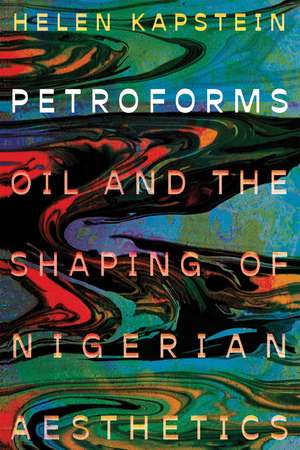
Petroforms: Oil and the Shaping of Nigerian Aesthetics: Energy and Society
Autor Helen Kapsteinen Limba Engleză Paperback – noi 2025
Petroforms contributes a much-needed theory of form and genre to the cutting-edge field of petrocriticism, itself an offshoot of developments in postcolonial ecocriticism. Studies of resource fiction and inquiries in the energy humanities have recently taken their rightful place as necessary reflections on the role of the literary imagination in intervening in the Anthropocene as we find ourselves precariously placed in the face of a fossil fuel crisis, climate change, and mass extinctions.
With Petroforms, Helen Kapstein undertakes close readings of a range of Nigerian aesthetic forms: short stories, romance novels, documentary film, the “Nollywood” film industry, fine art sculpture, and poetry. She uses these forms to argue that the demands of paying attention to petroleum extraction, production, consumption, and distribution in the creation of resource fictions must necessarily alter and affect conventional forms and structures. What results is a new set of genre-bending forms, like documentary film that we can read as horror, in response to the forceful and fluid demands of the petroleum industry and its master narrative.
Nigeria is one of the world’s largest oil-producing nations, in which that production is concentrated in the Niger Delta, resulting in a local environment that has been steadily degraded by oil spills, flares, pollution, and contamination, and a local culture shaped by false scarcity in a space of abundance, murderous politics, and escalating violence. At the same time as the Niger Delta grounds Kapstein’s argument in its own political realities and cultural responses, Nigeria’s participation in a global economy of petrodependency allows her theory of petroforms to be extended and applied more generally.
What Peter Hitchcock calls “oil’s generative law” is that it is “everywhere and obvious, it must be opaque or otherwise fantastic.” He means the coexistence of oil’s taken-for-granted qualities is something constitutive of every level of everyday life and its spectacular displays—gushers, spills, explosions. Oil’s nature, the fact that it is everywhere, unctuously oozing into every corner of everyday life, means that it constantly spills over out of our existing forms, genres, and systems, demanding accommodation. To try to contain it, we create new forms. Thus, a petroform is simultaneously reactionary (a necessary response to oil’s pressures, a by-product of the commodity itself) and resistant (an attempt at containment, at generating a retort to the very thing that shapes it). Each form figures oil and then configures and reconfigures itself in reaction to it.
Din seria Energy and Society
-
 Preț: 177.21 lei
 -
 Preț: 205.38 lei
 -
 Preț: 193.98 lei
 -
 Preț: 246.84 lei
 -
 Preț: 192.84 lei
 -
 Preț: 141.68 lei
 - 23%
 Preț: 570.85 lei
 -
 Preț: 252.38 lei
 -
 Preț: 283.02 lei
 -
 Preț: 196.95 lei
Preț: 155.33 lei
Puncte Express: 233
Carte tipărită la comandă
Livrare economică 30 noiembrie-14 decembrie
Livrare express 23-29 octombrie pentru 31.65 lei
Livrare prin curier în România Termenul estimat este afișat lângă disponibilitate.
Transport gratuit de la 400.00 lei Plată online sau ramburs, în funcție de opțiunile comenzii.
Retur gratuit în 14 zile Comandă securizată și suport în română.
Specificații
ISBN-13: 9781959000563
ISBN-10: 195900056X
Pagini: 182
Ilustrații: 15
Dimensiuni: 152 x 229 x 15 mm
Greutate: 0.34 kg
Ediția:First Edition
Editura: West Virginia University Press
Colecția West Virginia University Press
Seria Energy and Society
ISBN-10: 195900056X
Pagini: 182
Ilustrații: 15
Dimensiuni: 152 x 229 x 15 mm
Greutate: 0.34 kg
Ediția:First Edition
Editura: West Virginia University Press
Colecția West Virginia University Press
Seria Energy and Society
Notă biografică
Helen Kapstein is professor of English at John Jay College, The City University of New York. She is the author of Postcolonial Nations, Islands, and Tourism: Reading Real and Imagined Space.
Textul de pe ultima copertă
2026 PROSE Award Finalist, Humanities: Literature
Petroforms contributes a much-needed theory of form and genre to the cutting-edge field of petrocriticism, itself an offshoot of developments in postcolonial ecocriticism. Studies of resource fiction and inquiries in the energy humanities have recently taken their rightful place as necessary reflections on the role of the literary imagination in intervening in the Anthropocene as we find ourselves precariously placed in the face of a fossil fuel crisis, climate change, and mass extinctions.
With Petroforms, Helen Kapstein undertakes close readings of a range of Nigerian aesthetic forms: short stories, romance novels, documentary film, the “Nollywood” film industry, fine art sculpture, and poetry. She uses these forms to argue that the demands of paying attention to petroleum extraction, production, consumption, and distribution in the creation of resource fictions must necessarily alter and affect conventional forms and structures. What results is a new set of genre-bending forms, like documentary film that we can read as horror, in response to the forceful and fluid demands of the petroleum industry and its master narrative.
Petroforms contributes a much-needed theory of form and genre to the cutting-edge field of petrocriticism, itself an offshoot of developments in postcolonial ecocriticism. Studies of resource fiction and inquiries in the energy humanities have recently taken their rightful place as necessary reflections on the role of the literary imagination in intervening in the Anthropocene as we find ourselves precariously placed in the face of a fossil fuel crisis, climate change, and mass extinctions.
With Petroforms, Helen Kapstein undertakes close readings of a range of Nigerian aesthetic forms: short stories, romance novels, documentary film, the “Nollywood” film industry, fine art sculpture, and poetry. She uses these forms to argue that the demands of paying attention to petroleum extraction, production, consumption, and distribution in the creation of resource fictions must necessarily alter and affect conventional forms and structures. What results is a new set of genre-bending forms, like documentary film that we can read as horror, in response to the forceful and fluid demands of the petroleum industry and its master narrative.
Cuprins
CONTENTS
List of Illustrations
Acknowledgments
Introduction
1 Crude Fictions
2 Petrofeminism
3 Petroart
4 Petrohorror
5 Petrocinema
6 Petrodrama
Conclusion
Works Cited
List of Illustrations
Acknowledgments
Introduction
1 Crude Fictions
2 Petrofeminism
3 Petroart
4 Petrohorror
5 Petrocinema
6 Petrodrama
Conclusion
Works Cited
Recenzii
2026PROSE Award Finalist, Humanities: Literature
“…Kapstein asks us to consider the possibility that ‘different forms get at different aspects of living with and around petroleum’ in contemporary Nigeria. Her illuminating analyses of this thoughtfully curated collection of texts makes that argument in a compelling way.” —Délice Williams, ISLE: Interdisciplinary Studies in Literature and Environment, 2026
“Petroforms is a remarkable study of the manifold genres produced not merely by what we in the energy humanities term petromodernity; it attends to those ‘crude’ genres that arise organically from the extraction, refinement and distribution of petroleum within global markets. The central argument—that oil engenders its own forms, because it exceeds the ontological containers available through conventional literary-critical protocols—is one that has often been made in the context of reader reception but not necessarily in terms of artistic production.” —Stacey Balkan, associate professor of environmental humanities at Florida Atlantic University and author of Rogues in the Postcolony: Narrating Extraction and Itinerancyin India and co-author of Solarities: Seeking Energy Justice and Oil Fictions: World Literature and Our Contemporary Petrosphere.
“Responding to the sense that oil encounters are difficult to capture in literature, Petroforms demonstrates how literary, filmic, sculptural, and pop-cultural forms from Nigeria stretch and change to represent oil. Helen Kapstein locates this formal stretching not only in documentaries and short stories that portray devastation in the Niger Delta but also in the other face of Nigerian oil: the romance––even the eroticism––of petromodernity for more privileged subjects in Lagos and beyond. Recognizing that petromodernity is classed and regionalized but also gendered, Kapstein foregrounds the ambivalent participation of Nigerian women as both protestors of oil extractivism and beneficiaries of petromodernity. Taking readers from short story to romance novel, sculpture, drama, and even sitcom, Petroforms illustrates the wide-ranging formal innovation prompted by Nigeria’s ongoing enmeshment with oil.”
—B. Jamieson Stanley is associate professor of English at the University of Delaware
“[A]n urgent intervention into the cultural politics of energy, showing how Nigerian artists make visible and reckon with the costs, consequences, and contradictionsof life in oil zones.”
—Imre Szeman, coeditor of Power Shift: Keywords for a New Politics of Energy
“…Kapstein asks us to consider the possibility that ‘different forms get at different aspects of living with and around petroleum’ in contemporary Nigeria. Her illuminating analyses of this thoughtfully curated collection of texts makes that argument in a compelling way.” —Délice Williams, ISLE: Interdisciplinary Studies in Literature and Environment, 2026
“Petroforms is a remarkable study of the manifold genres produced not merely by what we in the energy humanities term petromodernity; it attends to those ‘crude’ genres that arise organically from the extraction, refinement and distribution of petroleum within global markets. The central argument—that oil engenders its own forms, because it exceeds the ontological containers available through conventional literary-critical protocols—is one that has often been made in the context of reader reception but not necessarily in terms of artistic production.” —Stacey Balkan, associate professor of environmental humanities at Florida Atlantic University and author of Rogues in the Postcolony: Narrating Extraction and Itinerancyin India and co-author of Solarities: Seeking Energy Justice and Oil Fictions: World Literature and Our Contemporary Petrosphere.
“Responding to the sense that oil encounters are difficult to capture in literature, Petroforms demonstrates how literary, filmic, sculptural, and pop-cultural forms from Nigeria stretch and change to represent oil. Helen Kapstein locates this formal stretching not only in documentaries and short stories that portray devastation in the Niger Delta but also in the other face of Nigerian oil: the romance––even the eroticism––of petromodernity for more privileged subjects in Lagos and beyond. Recognizing that petromodernity is classed and regionalized but also gendered, Kapstein foregrounds the ambivalent participation of Nigerian women as both protestors of oil extractivism and beneficiaries of petromodernity. Taking readers from short story to romance novel, sculpture, drama, and even sitcom, Petroforms illustrates the wide-ranging formal innovation prompted by Nigeria’s ongoing enmeshment with oil.”
—B. Jamieson Stanley is associate professor of English at the University of Delaware
“[A]n urgent intervention into the cultural politics of energy, showing how Nigerian artists make visible and reckon with the costs, consequences, and contradictionsof life in oil zones.”
—Imre Szeman, coeditor of Power Shift: Keywords for a New Politics of Energy
Descriere
Oil’s nature, the fact that it is everywhere, unctuously oozing into every corner of everyday life, means that it constantly spills over out of our existing forms, genres, and systems, demanding accommodation. To try to contain it, we create new forms—petroforms.