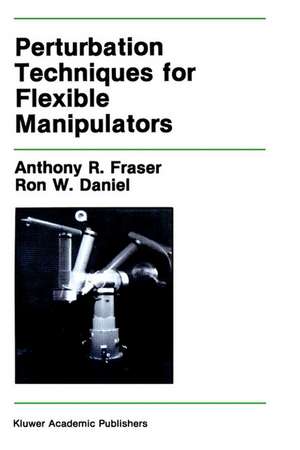
Perturbation Techniques for Flexible Manipulators
Autor Anthony R Fraser, Ron W Danielen Limba Engleză Hardback – 30 iun 1991
Preț: 980.86 lei
Preț vechi: 1196.18 lei
-18%
Puncte Express: 1471
Carte tipărită la comandă
Livrare economică 26 noiembrie-10 decembrie
Livrare prin curier în România Termenul estimat este afișat lângă disponibilitate.
Transport gratuit pentru acest produs Plată online sau ramburs, în funcție de opțiunile comenzii.
Retur gratuit în 14 zile Comandă securizată și suport în română.
Specificații
ISBN-13: 9780792391623
ISBN-10: 0792391624
Pagini: 275
Ilustrații: XVII, 275 p.
Dimensiuni: 160 x 241 x 21 mm
Greutate: 0.62 kg
Ediția:1991 edition
Editura: Springer Us
Locul publicării:New York, NY, United States
ISBN-10: 0792391624
Pagini: 275
Ilustrații: XVII, 275 p.
Dimensiuni: 160 x 241 x 21 mm
Greutate: 0.62 kg
Ediția:1991 edition
Editura: Springer Us
Locul publicării:New York, NY, United States
V-ar putea interesa
-
 Arduino Robot BonanzaGordon McComb-38%Preț: 210.57 lei339.85 lei
 -
 Robotics: A Very Short IntroductionAlan Winfield-20%Preț: 57.12 lei71.12 lei
 -
 The Technological SingularityMurray Shanahan-21%Preț: 97.48 lei122.92 lei
 -
 Optimal ControlFrank L Lewis-9%Preț: 992.25 lei1090.39 lei
 -
 Practical Field RoboticsSturges-8%Preț: 636.53 lei691.87 lei
 -
 Human-Robot Interaction in Social RoboticsTakayuki Kanda-18%Preț: 1611.04 lei1964.69 lei
 -
 Parallel Robots: Mechanics and ControlHamid D. Taghirad-20%Preț: 1784.20 lei2230.26 lei
 -
 Process Control: Problems, Techniques and ApplicationsSamuel P. Werther-27%Preț: 1165.46 lei1585.77 lei
 -
 Passivity-Based Control and Estimation in Networked RoboticsTakeshi Hatanaka-18%Preț: 988.22 lei1205.15 lei
 -
 Social Robots from a Human PerspectiveJane Vincent-15%Preț: 634.07 lei745.96 lei
 -
 Distributed Consensus with Visual Perception in Multi-Robot SystemsEduardo Montijano-15%Preț: 662.81 lei779.78 lei
 -
 Progress in Automation, Robotics and Measuring TechniquesRoman Szewczyk-20%Preț: 638.82 lei798.52 lei
 -
 Computational Linguistics and Talking RobotsRoland Hausser-20%Preț: 673.83 lei842.28 lei
 -
 MechatronicsRyszard Jablo¿ski-18%Preț: 1848.57 lei2254.35 lei
 -
 Active Sensor Planning for Multiview Vision TasksShengyong Chen-18%Preț: 917.56 lei1118.97 lei
 -
 Zukunft der Arbeit in Industrie 4.0Alfons BotthofPreț: 339.37 lei
Public țintă
ResearchCuprins
1 Introduction.- 1.1 Objectives.- 1.2 Book outline.- 2 Present trends in the dynamics and control of flexible manipulators.- 2.1 Introduction.- 2.2 Space Structures.- 2.3 Dynamics of flexible manipulators.- 2.4 Control of flexible manipulators.- 2.5 Conclusions.- 3 Dynamic model of a single-link flexible manipulator.- 3.1 Introduction.- 3.2 Analytic model of a single-link arm.- 3.3 Dynamic model based on natural modes.- 3.4 Dynamic models based on assumed modes.- 3.5 Models for control design.- 3.6 Conclusions.- 4 An experimental single-link flexible arm.- 4.1 Introduction.- 4.2 Experimental apparatus.- 4.3 Experimental identification of the system model.- 4.4 Verification of the arm model.- 4.5 Conclusions.- 5 Control design for the single-link arm.- 5.1 Introduction.- 5.2 Digital control design.- 5.3 Experimental flexible arm control.- 5.4 Conclusions.- 6 Multi-link flexible arm dynamics.- 6.1 Introduction.- 6.2 Dynamic model of a planar two-link flexible arm.- 6.3 Linearisation of the dynamic model.- 6.4 Properties of the linearised model.- 6.5 Variation of the linearised model with loading and configuration.- 6.6 Gravitational effects.- 6.7 Control of multi-link manipulators.- 6.8 Conclusions.- 7 A perturbation approach to changing dynamics.- 7.1 Introduction.- 7.2 Canonical perturbation theory.- 7.3 Extension of canonical perturbation theory to flexible systems.- 7.4 Perturbation analysis based on orthogonality of modes.- 7.5 Assumed modes formulation.- 7.6 Conclusions.- 8 Extended perturbation techniques.- 8.1 Introduction.- 8.2 Extended perturbation analysis.- 8.3 Discrete-time perturbation analysis.- 8.4 Corrective control design.- 8.5 Explicit control correction.- 8.6 Direct update of controller gains.- 8.7 Investigation of corrective control on the two-link arm model.- 8.8 A general perturbation-based control scheme.- 8.9 Conclusions.- 9 Looking to the future - high performance control.- 9.1 Introduction.- 9.2 Controller Design.- 9.3 The Provision of Feedforward.- 9.4 Feedback control.- A Symbols and Nomenclature.- B Experimental determination of arm parameters.- C Modal model of the single-link arm.- D Mass and stiffness terms for the two-link arm.- E Derivation of the assumed modes perturbation analysis.- F Transformation from a state-space to an input/output model.