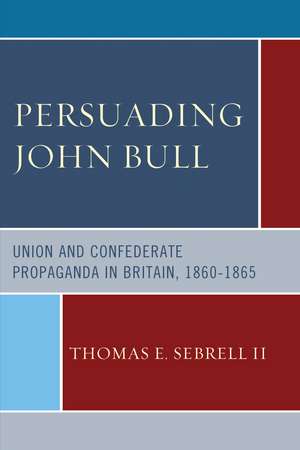
Persuading John Bull: Union and Confederate Propaganda in Britain, 1860–65
Autor Thomas E. Sebrell IIen Limba Engleză Paperback – 23 mai 2016
Persuading John Bull provides scholars and general readers alike a far greater understanding of the largely unknown Northern newspaper's motivations and campaigns during the war, as well as an in-depth analysis of The Index which builds greatly on present historiographical discussions of the Southern journal. It also offers new insights into Britain's roles in the conflict, Anglo-American relations, and mid-Victorian British political and social history.
The book is not restricted to discussing the two propaganda machines as its focus-they are used to approach a greater analysis of British public opinion during the American Civil War-both journals were strongly associated with numerous key figures, societies (British and American), and events occurring on both sides of the Atlantic pertaining to the conflict. Although propaganda is only one source from which to tap, the effectiveness of the two lobbyist journals either directly or indirectly impacted other factors influencing Britain's ultimate decision to remain neutral.
This book reveals a fresh new cast of Union supporters in London, in addition to more Confederate sympathizers throughout Britain not previously discussed by scholars. The roles of these new figures, how and why they endorsed the Northern or Southern war effort, is analyzed in detail throughout the chapters, adding greatly to existing historiography.
Preț: 322.16 lei
Preț vechi: 378.07 lei
-15%
Puncte Express: 483
Carte tipărită la comandă
Livrare economică 14-28 noiembrie
Livrare prin curier în România Termenul estimat este afișat lângă disponibilitate.
Transport gratuit de la 400.00 lei Plată online sau ramburs, în funcție de opțiunile comenzii.
Retur gratuit în 14 zile Comandă securizată și suport în română.
Specificații
ISBN-13: 9781498501392
ISBN-10: 1498501397
Pagini: 260
Dimensiuni: 150 x 227 x 18 mm
Greutate: 0.36 kg
Editura: Bloomsbury Publishing
Colecția Lexington Books
Locul publicării:New York, United States
ISBN-10: 1498501397
Pagini: 260
Dimensiuni: 150 x 227 x 18 mm
Greutate: 0.36 kg
Editura: Bloomsbury Publishing
Colecția Lexington Books
Locul publicării:New York, United States
Cuprins
Abbreviations Used in the Source Citations
An Introduction 1860-61: The Origins of The London American & of the War The Blockade and its Early Controversies in Britain Henry Hotze Arrives in London Summer of 1862: A Move Towards Possible Intervention Knight's Propaganda Movement Collapses 1863: Anglo-Confederate Surges and Discrepancies Naval Controversies 1864: The Confederates Make Last Ditch Efforts in Britain 1865: A Conclusive Ending Appendixes
Bibliography
An Introduction 1860-61: The Origins of The London American & of the War The Blockade and its Early Controversies in Britain Henry Hotze Arrives in London Summer of 1862: A Move Towards Possible Intervention Knight's Propaganda Movement Collapses 1863: Anglo-Confederate Surges and Discrepancies Naval Controversies 1864: The Confederates Make Last Ditch Efforts in Britain 1865: A Conclusive Ending Appendixes
Bibliography
Recenzii
During the Civil War, Britain faced a conundrum: a major sector of the British economy was dependent on cotton from the Southern states, but the British deplored slavery. Official recognition of the Confederacy by Great Britain would have provided valuable backing against the Union. There was no clear response available to Parliament, according to Sebrell. In London, pro-Union and pro-Confederate newspapers edited by Americans avidly-and sometimes clumsily-circulated propaganda, seeking public support. John Adams Knight ran the pro-Union London American; Henry Hotze created and ran The Index, which promoted the Confederacy and was largely funded by that government. Sebrell compares the efforts, circulation, and readership of these publications. Hotze's warnings that the US had designs on Canada were undermined by his ham-fisted attempts to justify slavery, and while Parliament debated the issue, the Union began to construct ironclad ships superior to Britain's, creating a further deterrent to British recognition of the Confederate States. The British could no longer afford the possibility of war with the US. This well-researched book addresses an aspect of the Civil War generally overlooked. Summing Up: Recommended. Lower-division undergraduates through faculty; general readers.
[H]is research is sound and the conclusions he draws . . . are persuasive.
[This book] affords a degree of fresh insight by focusing on the efforts of two periodicals that were especially vested in the outcome of the conflict - the London American, a pro-Union newspaper, and The Index. . . .Persuading John Bull represents the most comprehensive study of Union and Confederate propaganda to emerge in recent years and readers will find in it much of interest. . . .Historians of Anglo-American relations and of the global connections of the Civil War more generally will undoubtedly find this book a welcome addition to the burgeoning literature on British public opinion . . . it will also serve to increase awareness of the Index and the London American as valuable historical resources and inspire further interrogation of the many themes that arise in their coverage of the conflict.
Persuading John Bull offers a detailed, clear, and thoughtful examination of an intriguing episode in northern and southern propaganda efforts in Britain. Particularly in its coverage of The London American and The Index, it enriches our understanding of Anglo-American relations, broadly construed, during the Civil War. The author has original insights to share even when covering ground familiar to specialists.
This book furthers our understanding of the transatlantic nature of the American Civil War. Dr. Sebrell offers a thorough examination of the sources that explain the moves made by 'the blue and the grey' in Great Britain during the conflict.
[H]is research is sound and the conclusions he draws . . . are persuasive.
[This book] affords a degree of fresh insight by focusing on the efforts of two periodicals that were especially vested in the outcome of the conflict - the London American, a pro-Union newspaper, and The Index. . . .Persuading John Bull represents the most comprehensive study of Union and Confederate propaganda to emerge in recent years and readers will find in it much of interest. . . .Historians of Anglo-American relations and of the global connections of the Civil War more generally will undoubtedly find this book a welcome addition to the burgeoning literature on British public opinion . . . it will also serve to increase awareness of the Index and the London American as valuable historical resources and inspire further interrogation of the many themes that arise in their coverage of the conflict.
Persuading John Bull offers a detailed, clear, and thoughtful examination of an intriguing episode in northern and southern propaganda efforts in Britain. Particularly in its coverage of The London American and The Index, it enriches our understanding of Anglo-American relations, broadly construed, during the Civil War. The author has original insights to share even when covering ground familiar to specialists.
This book furthers our understanding of the transatlantic nature of the American Civil War. Dr. Sebrell offers a thorough examination of the sources that explain the moves made by 'the blue and the grey' in Great Britain during the conflict.