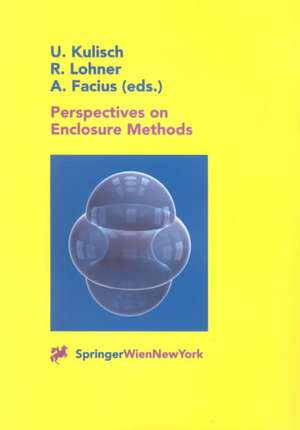
Perspectives on Enclosure Methods
Editat de Ulrich Kulisch, Rudolf Lohner, Axel Faciusen Limba Engleză Paperback – 18 iun 2001
Preț: 380.46 lei
Puncte Express: 571
Carte tipărită la comandă
Livrare economică 28 noiembrie-12 decembrie
Livrare prin curier în România Termenul estimat este afișat lângă disponibilitate.
Transport gratuit de la 400.00 lei Plată online sau ramburs, în funcție de opțiunile comenzii.
Retur gratuit în 14 zile Comandă securizată și suport în română.
Specificații
ISBN-13: 9783211835906
ISBN-10: 3211835903
Pagini: 368
Ilustrații: XII, 345 p.
Dimensiuni: 170 x 244 x 19 mm
Greutate: 0.59 kg
Ediția:Softcover reprint of the original 1st ed. 2001
Editura: SPRINGER VIENNA
Colecția Springer
Locul publicării:Vienna, Austria
ISBN-10: 3211835903
Pagini: 368
Ilustrații: XII, 345 p.
Dimensiuni: 170 x 244 x 19 mm
Greutate: 0.59 kg
Ediția:Softcover reprint of the original 1st ed. 2001
Editura: SPRINGER VIENNA
Colecția Springer
Locul publicării:Vienna, Austria
V-ar putea interesa
-
 Guide to AnalysisMary Hart-31%Preț: 473.18 lei689.17 lei
 -
 An Introduction to Numerical AnalysisEndre Süli-19%Preț: 535.85 lei661.55 lei
 -
 Spline FunctionsLarry Schumaker-11%Preț: 601.48 lei675.81 lei
 -
 Implicit Functions and Solution MappingsAsen L. Dontchev-15%Preț: 622.04 lei731.81 lei
 -
 Mathematical Cardiac ElectrophysiologyPiero Colli Franzone-15%Preț: 676.20 lei795.53 lei
 -
 Geometric Numerical IntegrationErnst Hairer-18%Preț: 1448.72 lei1766.73 lei
 -
 Preț: 458.42 lei
 -
 Elements of Scientific ComputingAslak TveitoPreț: 402.42 lei
 -
 Numerical Techniques for Global Atmospheric ModelsPeter H. Lauritzen-15%Preț: 709.66 lei834.89 lei
 -
 The Concept of Stability in Numerical MathematicsWolfgang HackbuschPreț: 403.03 lei
 -
 Tensor Spaces and Numerical Tensor CalculusWolfgang Hackbusch-24%Preț: 759.08 lei998.80 lei
 -
 ASYMPTOTIC METHODS FOR INTEGRALSTemme Nico M-18%Preț: 1297.75 lei1582.62 lei
 -
 Introduction to Computational Mathematics (2nd Edition)UK" University of Cambridge, UK <p> "University of Cambridge, UK" <p> "University of Cambridge, UK" University of Cambridge, UK <p> "University of Cambridge, UK" <p> "University of Cambridge, UK" University of Cambridge, UK) Yang, Xin-She (<p> "University of CambridgePreț: 459.63 lei
Public țintă
ResearchCuprins
Proving Conjectures by Use of Interval Arithmetic.- 1 Computer Assisted Proofs in Analysis.- 2 The Kepler Conjecture.- 3 The Double Bubble Conjecture.- 4 The Dirac-Schwinger Conjecture.- 5 ‘Chaos conjectures’.- References.- Advanced Arithmetic for the Digital Computer Interval Arithmetic Revisited.- 1 Introduction and Historical Remarks.- 2 Interval Arithmetic, a Powerful Calculus to Deal with Inequalities.- 3 Interval Arithmetic as Executable Set Operations.- 4 Enclosing the Range of Function Values.- 5 The Interval Newton Method.- 6 Extended Interval Arithmetic.- 7 The Extended Interval Newton Method.- 8 Differentiation Arithmetic, Enclosures of Derivatives.- 9 Interval Arithmetic on the Computer.- 10 Hardware Support for Interval Arithmetic.- References.- Highly Accurate Verified Error Bounds for Krylov Type Linear System Solvers.- 1 Introduction.- 2 Iterative Solvers and Finite Precision.- 3 Krylov Subspace Methods.- 4 Improved Arithmetic.- 5 Verified Error Bounds.- 6 Computational Results.- References.- Elements of Scientific Computing.- 1 Hardware Requirements.- 2 Software Requirements.- 3 Modelling Requirements.- 4 Conclusion.- References.- Biography.- The Mainstreaming of Interval Arithmetic.- 1 Introduction.- 2 Moore’s Law and Precision.- 3 Interval Physics.- 4 Summary.- References.- Bounds for Eigenvalues with the Use of Finite Elements.- 1 Introduction.- 2 Setting for the Problem.- 3 Calculation of Bounds.- 4 Verified Computation.- 5 Application: the Membrane Problem.- 6 Numerical Examples.- References.- Algorithmic Differencing.- 1 Algorithmic Representation of Functions.- 2 Transformation of Algorithms.- 3 Finite Precision Calculations.- 4 First Order Difference Operators.- 5 Differences of Inverse Functions.- 6 Higher Order Divided Differences.-References.- A Comparison of Techniques for Evaluating Centered Forms.- 1 Introduction.- 2 Methods for Computing Slope Vectors.- 3 A Numerical Example.- 4 Summary and Recommendations.- References.- On the Limit of the Total Step Method in Interval Analysis.- 1 Introduction.- 2 Notations.- 3 Results.- References.- How Fast can Moore’ Interval Integration Method Really be?.- 1 Introduction.- 2 Moore’s Algorithm.- 3 Estimation of the Integration Error.- 4 Conclusions.- References.- Numerical Verification and Validation of Kinematics and Dynamical Models for Flexible Robots in Complex Environments.- 1 Introduction.- 2 Error Propagation Control and Reliable Numerical Algorithms in MOBILE.- 3 Verified Calculation of the Solution of Discrete-Time Algebraic Riccati Equation.- 4 Accurate Distance Calculation Algorithms.- 5 Accurate Robot Reliability Estimation.- 6 Further Work.- 7 Acknowledgement.- References.- On the Ubiquity of the Wrapping Effect in the Computation of Error Bounds.- 1 Introduction or What is the Wrapping Effect?.- 2 Where does the Wrapping Effect appear?.- 3 How can we Reduce the Wrapping Effect?.- 4 Conclusion.- References.- A New Perspective on the Wrapping Effect in Interval Methods for Initial Value Problems for Ordinary Differential Equations.- 1 Introduction.- 2 Preliminaries.- 3 How the Wrapping Effect Arises in Interval Methods for IVPs for ODEs: A Traditional Explanation.- 4 The Wrapping Effect as a Source of Instability in Interval Methods for IVPs for ODEs.- 5 The Parallelepiped and Lohner’s QR-Factorization Methods.- 6 Why the Parallelepiped Method Often Fails.- 7 When Does the Parallelepiped Method Work Well.- 8 How the QR Method Improves Stability.- 9 Conclusions.- A Lemmas.- References.- A Guaranteed Bound of the Optimal Constant in theError Estimates for Linear Triangular Elements.- 1 Introduction.- 2 Strategy.- 3 The Method to Calculate a Rigorous Solution.- 4 Checking the Condition.- 5 Some Computational Techniques for Efficient Enclosure Methods.- 6 Numerical Results.- References.- Nonsmooth Global Optimization.- 1 Introduction.- 2 Preliminaries.- 3 A Pruning Technique for Global Optimizationx.- 4 Multidimensional Pruning Techniques for Global Optimization.- References.
Caracteristici
Introduction to a most advanced research field in scientific computing Interesting applications Latest research results