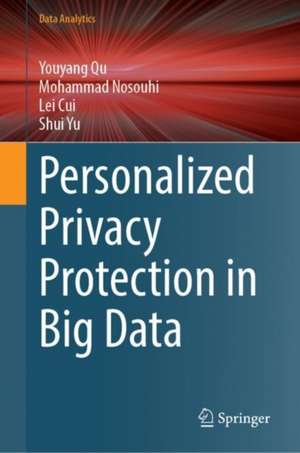
Personalized Privacy Protection in Big Data: Data Analytics
Autor Youyang Qu, Mohammad Reza Nosouhi, Lei Cui, Shui Yuen Limba Engleză Hardback – 25 iul 2021
This book presents the data privacy protection which has been extensively applied in our current era of big data. However, research into big data privacy is still in its infancy. Given the fact that existing protection methods can result in low data utility and unbalanced trade-offs, personalized privacy protection has become a rapidly expanding research topic.
In this book, the authors explore emerging threats and existing privacy protection methods, and discuss in detail both the advantages and disadvantages of personalized privacy protection. Traditional methods, such as differential privacy and cryptography, are discussed using a comparative and intersectional approach, and are contrasted with emerging methods like federated learning and generative adversarial nets.
The advances discussed cover various applications, e.g. cyber-physical systems, social networks, and location-based services. Given its scope, the book is of interest to scientists, policy-makers, researchers, and postgraduates alike.



Preț: 430.81 lei
Preț vechi: 538.52 lei
-20%
Puncte Express: 646
Carte tipărită la comandă
Livrare economică 26 noiembrie-10 decembrie
Livrare prin curier în România Termenul estimat este afișat lângă disponibilitate.
Transport gratuit pentru acest produs Plată online sau ramburs, în funcție de opțiunile comenzii.
Retur gratuit în 14 zile Comandă securizată și suport în română.
Specificații
ISBN-13: 9789811637490
ISBN-10: 9811637490
Pagini: 152
Ilustrații: XI, 139 p. 36 illus., 34 illus. in color.
Dimensiuni: 160 x 241 x 14 mm
Greutate: 0.35 kg
Ediția:1st ed. 2021
Editura: Springer
Colecția Data Analytics
Seria Data Analytics
Locul publicării:Singapore, Singapore
ISBN-10: 9811637490
Pagini: 152
Ilustrații: XI, 139 p. 36 illus., 34 illus. in color.
Dimensiuni: 160 x 241 x 14 mm
Greutate: 0.35 kg
Ediția:1st ed. 2021
Editura: Springer
Colecția Data Analytics
Seria Data Analytics
Locul publicării:Singapore, Singapore
V-ar putea interesa
-
 Blown to BitsHal Abelson-20%Preț: 119.10 lei148.87 lei
 -
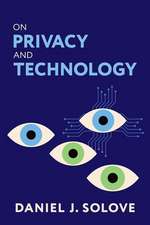 On Privacy and TechnologyDaniel J. Solove-16%Preț: 132.32 lei157.19 lei
 -
 Standardizing Personal Data ProtectionIrene Kamara-32%Preț: 647.91 lei959.58 lei
 -
 Differential PrivacySimson L. Garfinkel-20%Preț: 87.45 lei109.31 lei
 -
 -41%Preț: 84.12 lei143.20 lei
 -
 -39%Preț: 394.79 lei646.62 lei
 -
 Controlling Privacy and the Use of Data Assets SetUlf Mattsson-20%Preț: 685.25 lei856.56 lei
 -
 Preț: 416.62 lei
 -
 Privacy Preservation of Genomic and Medical DataAmit Kumar Tyagi-20%Preț: 1496.11 lei1870.14 lei
 -
 -19%Preț: 99.37 lei122.26 leiRecomandat
 -
 -29%Preț: 385.77 lei543.12 lei
 -
 Privacy-Preserving Machine LearningJ Morris Chang-20%Preț: 331.00 lei413.75 lei
 -
 Data PrivacyNishant Bhajaria-20%Preț: 293.86 lei367.32 lei
 -
 Advances in AI for Cloud, Edge, and Mobile Computing ApplicationsShrikaant Kulkarni-20%Preț: 1296.62 lei1620.78 lei
 -
 Combating Security Challenges in the Age of Big DataZubair Md. Fadlullah-20%Preț: 1077.32 lei1346.65 lei
 -
 Privacy and Identity ManagementFelix Bieker-20%Preț: 438.53 lei548.16 lei
 -
 Data Privacy GamesLei Xu-20%Preț: 669.16 lei836.45 lei
 -
 -18%Preț: 918.30 lei1119.88 lei
Cuprins
Chapter 1: Introduction.- Chapter 2: Current Methods of Privacy Protection.- Chapter 3: Privacy Attacks.- Chapter 4: Personalize Privacy Defense.- Chapter 5: Future Directions.- Chapter6: Summary and Outlook.
Notă biografică
Dr. Youyang Qu received his Ph.D. degree in Information Technology at School of Information Technology, Deakin University, in 2019, and he is currently serving as Research Fellow in Deakin University. His research interests focus on dealing with security and customizable privacy issues in blockchain, social networks, machine learning, and IoT. He has over 30 publications on top journals and magazines such as IEEE IOTJ, IEEE TII, and IEEE Wireless Communication. He has served as TPC Member for IEEE flagship conferences including IEEE ICC and IEEE Globecom. He is also Publicity Chair of SPDE 2020. Dr. Longxiang Gao received a Ph.D. in Computer Science from Deakin University, Australia. He is currently Senior Lecturer at the School of Information Technology, Deakin University. Before joining Deakin University, he was Post-doctoral Research Fellow at IBM Research and Development Australia. His research interests include data processing, mobile social networks, fog computing, and network security. He has over 80 publications, including patents, monographs, book chapters, and journal and conference papers. Some of his publications have been published in the top venues, such as IEEE TMC, IEEE IoT, IEEE TDSC, and IEEE TVT. He received the 2012 Chinese Government Award for Outstanding Students Abroad (Ranked No.1 in Victoria and Tasmania consular districts). Dr. Gao is Senior Member of IEEE and is active in IEEE Communication Society. He has served as TPC Co-Chair, Publicity Co-Chair, Organization Chair, and TPC Member for many international conferences. Professor Shui Yu is currently Full Professor of School of Computer Science, University of Technology Sydney, Australia. Dr. Yu's research interest includes security and privacy, networking, big data, and mathematical modelling. He has published two monographs and edited two books, more than 200 technical papers, including top journals and top conferences, such as IEEE TPDS, TC,TIFS, TMC, TKDE, TETC, ToN, and INFOCOM. Dr. Yu initiated the research field of networking for big data in 2013. Dr. Yu actively serves his research communities in various roles. He is currently serving the editorial boards of IEEE Communications Surveys and Tutorials, IEEE Communications Magazine, IEEE Internet of Things Journal, IEEE Communications Letters, IEEE Access, and IEEE Transactions on Computational Social Systems. He has served many international conferences as Member of organizing committee, such as Publication Chair for IEEE Globecom 2015, IEEE INFOCOM 2016 and 2017, TPC Chair for IEEE BigDataService 2015, and General Chair for ACSW 2017. Dr Yu is Final Voting Member for a few NSF China programs in 2017. He is Senior Member of IEEE, Member of AAAS and ACM, Vice Chair of Technical Committee on Big Data of IEEE Communication Society, and Distinguished Lecturer of IEEE Communication Society. Professor Yong Xiang received the Ph.D. degree in electrical and electronic engineering from the University of Melbourne, Australia. He is currently Professor and Director of the Artificial Intelligence and Image Processing Research Cluster with the School of Information Technology, Deakin University, Australia. His research interests include information security and privacy, multimedia (speech/image/video) processing, wireless sensor networks, massive MIMO, and bio-medical signal processing. He has authored more than 110 refereed journal and conference papers in these areas. He is Associate Editor of the IEEE SIGNAL PROCESSING LETTERS and the IEEE ACCESS. He has served as Program Chair, TPC Chair, Symposium Chair, and Session Chair for a number of international conferences.
Textul de pe ultima copertă
This book presents the data privacy protection which has been extensively applied in our current era of big data. However, research into big data privacy is still in its infancy. Given the fact that existing protection methods can result in low data utility and unbalanced trade-offs, personalized privacy protection has become a rapidly expanding research topic.
In this book, the authors explore emerging threats and existing privacy protection methods, and discuss in detail both the advantages and disadvantages of personalized privacy protection. Traditional methods, such as differential privacy and cryptography, are discussed using a comparative and intersectional approach, and are contrasted with emerging methods like federated learning and generative adversarial nets.
The advances discussed cover various applications, e.g. cyber-physical systems, social networks, and location-based services. Given its scope, the bookis of interest to scientists, policy-makers, researchers, and postgraduates alike.
Caracteristici
Enriches readers’ understanding of the foundations of and recent advances in personalized privacy protection Summarizes the latest studies on personalized privacy protection and covers a broad range of applications Discusses both the advantages and disadvantages of existing personalized privacy protection techniques and highlights numerous potential research opportunities