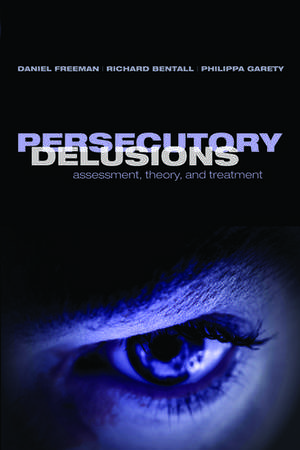
Persecutory Delusions: Assessment, Theory, and Treatment
Editat de Daniel Freeman, Richard Bentall, Philippa Garetyen Limba Engleză Paperback – 17 iul 2008
Preț: 757.39 lei
Preț vechi: 983.87 lei
-23%
Puncte Express: 1136
Carte tipărită la comandă
Livrare economică 04-15 decembrie
Livrare prin curier în România Termenul estimat este afișat lângă disponibilitate.
Transport gratuit pentru acest produs Plată online sau ramburs, în funcție de opțiunile comenzii.
Retur gratuit în 14 zile Comandă securizată și suport în română.
Specificații
ISBN-13: 9780199206315
ISBN-10: 0199206317
Pagini: 450
Ilustrații: 20 black & white line figures
Dimensiuni: 156 x 234 x 26 mm
Greutate: 0.7 kg
Ediția:1
Editura: OUP OXFORD
Colecția OUP Oxford
Locul publicării:Oxford, United Kingdom
ISBN-10: 0199206317
Pagini: 450
Ilustrații: 20 black & white line figures
Dimensiuni: 156 x 234 x 26 mm
Greutate: 0.7 kg
Ediția:1
Editura: OUP OXFORD
Colecția OUP Oxford
Locul publicării:Oxford, United Kingdom
V-ar putea interesa
-
 ParanoiaDaniel FreemanPreț: 78.99 lei
 -
 Surviving Schizophrenia, 7th EditionE. Fuller TorreyPreț: 80.39 lei
 -
 Madness ExplainedRichard P BentallPreț: 123.75 lei
 -
 Schizophrenia: A Very Short IntroductionChris Frith-22%Preț: 59.75 lei76.67 lei
 -
 When Everyone Knows That Everyone Knows...Steven PinkerPreț: 137.96 lei
 -
 Massachusetts General Hospital Handbook of General Hospital PsychiatryTheodore A. Stern-26%Preț: 518.94 lei704.55 lei
 -
 Working With Serious Mental Illness: A Manual for Clinical PracticeCatherine Gamble-31%Preț: 241.97 lei349.57 lei
 -
 -27%Preț: 68.28 lei93.06 lei
 -
 Preț: 256.01 lei
 -
 -5%Preț: 346.41 lei364.64 lei
 -
 -31%Preț: 259.19 lei374.11 lei
 -
 Schizophrenia: Cognitive Theory, Research, and TherapyAaron T. Beck-5%Preț: 385.99 lei406.30 lei
 -
 -5%Preț: 493.18 lei519.14 lei
 -
 On the BrinkPenelope CamplingPreț: 79.99 lei
 -
 Preț: 157.41 lei
 -
 -20%Preț: 107.86 lei135.45 lei
 -
 The Divided Mind: Uncovering psychiatry's dark past and reimagining its futureProfessor Edward Bullmore-28%Preț: 105.56 lei146.82 lei
 -
 SchizophreniaRomeo Vitelli-43%Preț: 225.01 lei395.72 lei
Recenzii
'Persecutory Delusions is an outstanding book that provides a unique update on the assessment, biological and psychological processes, and treatment of this important clinical phenomenon. Freeman, Bentall, and Garety, all seasoned clinicians who have also made valuable contributions to theories of delusions, have assembled world experts on this topic for the first time in this welcomed volume. The state-of-the-art summary of research, theory, and clinical practice related to persecutory delusions make this book a critical resource for anyone seeking to understand or treat psychosis.'
' Delusions have long been known to psychiatry - but have largely been considered a subset of 'psychosis'. However, over the last decade a range of scientists, psychologists, phenomenologists, pharmacologists, and imagers have been studying delusions in their own right, and social epidemiologists and geneticists have been looking for their causes in clinical populations and wider society. This book is the first to pull together these different perspectives under one cover. For scientists and practitioners who study and treat psychosis this is a remarkable resource. This will be a "go to" reference book for developing a comprehensive understanding of delusions.'
' Delusions have long been known to psychiatry - but have largely been considered a subset of 'psychosis'. However, over the last decade a range of scientists, psychologists, phenomenologists, pharmacologists, and imagers have been studying delusions in their own right, and social epidemiologists and geneticists have been looking for their causes in clinical populations and wider society. This book is the first to pull together these different perspectives under one cover. For scientists and practitioners who study and treat psychosis this is a remarkable resource. This will be a "go to" reference book for developing a comprehensive understanding of delusions.'
Notă biografică
Daniel Freeman is a Wellcome Trust Fellow at the Institute of Psychiatry, King's College London, and a consultant clinical psychologist in the South London and Maudsley NHS Trust. He publishes prolifically in the leading international journals, makes regular keynote addresses at international conferences, and is an Associate Editor of the British Journal of Clinical Psychology. He studied natural sciences at Cambridge University, specialising in experimental psychology, and has completed doctorates in psychology and clinical psychology at the Institute of Psychiatry, King's College London. He is the lead author of Overcoming Paranoid and Suspicious Thoughts, the first self-help book for people affected by suspicious thoughts, and has recently written a popular science book on paranoia, Paranoia: The 21st Century FearRichard Bentall attended the University College of North Wales, Bangor as an undergraduate (1975-9) before taking a Ph.D. in experimental psychology at the same institution (awarded 1983). Moved to the University of Liverpool to obtain a qualification in clinical psychology (1984) before later achieving a part-time MA in philosophy applied to health care from University of Wales, Swansea (1989). Returned to Liverpool to work as a lecturer (1986) after a brief stint working for the National Health Service as a forensic clinical psychologist (1984-1986). Was appointed professor at Liverpool (1994) before moving to the University of Manchester (1999) and then returning to the University of Bangor (2007). Research interests include psychological processes involved in psychotic symptoms (e.g. hallucinations and delusions) and the psychological treatment of severe mental illness.Philippa Garety studied Philosophy and Psychology (Natural Sciences) at Cambridge University in the 1970s, then undertook clinical psychology training at the Institute of Psychiatry, London, followed by a PhD. Since then she has combined clinical practice in the NHS with research. Her main focus of research has been the investigation of cognitive processes in psychosis, particularly reasoning and affective processes in delusions, together with the development of psychological treatments, such as Cognitive Behavioural Therapy (CBT). She is interested in translating the findings of theoretical and empirical research into improvements in treatments and service provision. Her current post is as Professor of Clinical Psychology at the Institute of Psychiatry, King's College, London and Head of Psychology for the South London and Maudsley NHS Foundation Trust.