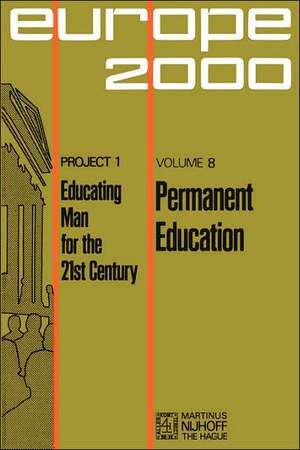
Permanent Education: Plan Europe 2000, Project 1: Educating Man for the 21st Century, cartea 8
Autor B. Schwartzen Limba Engleză Paperback – 30 noi 1974
Preț: 614.60 lei
Preț vechi: 723.05 lei
-15%
Puncte Express: 922
Carte tipărită la comandă
Livrare economică 01-15 decembrie
Livrare prin curier în România Termenul estimat este afișat lângă disponibilitate.
Transport gratuit pentru acest produs Plată online sau ramburs, în funcție de opțiunile comenzii.
Retur gratuit în 14 zile Comandă securizată și suport în română.
Specificații
ISBN-13: 9789024716487
ISBN-10: 9024716489
Pagini: 272
Ilustrații: 269 p.
Dimensiuni: 155 x 235 x 14 mm
Greutate: 0.39 kg
Ediția:1974
Editura: SPRINGER NETHERLANDS
Colecția Springer
Seria Plan Europe 2000, Project 1: Educating Man for the 21st Century
Locul publicării:Dordrecht, Netherlands
ISBN-10: 9024716489
Pagini: 272
Ilustrații: 269 p.
Dimensiuni: 155 x 235 x 14 mm
Greutate: 0.39 kg
Ediția:1974
Editura: SPRINGER NETHERLANDS
Colecția Springer
Seria Plan Europe 2000, Project 1: Educating Man for the 21st Century
Locul publicării:Dordrecht, Netherlands
V-ar putea interesa
-
 Schaum's Easy Outline of GermanElke Gschossmann-HendershotPreț: 69.55 lei
 -
 New Breakthrough ItalianGiovanni CarsanigaPreț: 202.97 lei
 -
 Mira 1 Pupil BookANNELI MCLACHLANPreț: 301.20 lei
 -
 Catalyst 3 Red Student BookCarol ChapmanPreț: 286.59 lei
 -
 -8%Preț: 611.77 lei664.97 lei
 -
 New Proficiency Gold Course BookJacky NewbrookPreț: 308.87 lei
 -
 Career Skills: Opening Doors into the Job MarketDavid LittlefordPreț: 212.03 lei
 -
 -31%Preț: 48.03 lei69.52 lei
Public țintă
ResearchCuprins
I. System of Values Underlying This Project.- What Type of Society?.- For What Kind of Man?.- II. Main Trends and Margins of Choice.- Central Hypotheses.- Concentration of Means of Production.- Concentration of Decision-Making.- Increasing Division of Labour.- Increasing Leisure Time.- Increasing Consumption of Goods and Services.- Proliferation of Information.- Increasing Demand for Education.- A Plan for Education is Always a Political Plan.- III. The Political and the Educational.- Education: Product and Motive Force.- Under What Circumstances Can Social Conditions be a Cultural Factor?.- To What Extent Can the Educational System Correct Cultural Inequalities?.- The Proposal We are Backing: Permanent Education.- IV. Guiding Principles of Our Plan.- Continuity in Space and Time — Structural Incidences.- Developing and Using Human Faculties to the Full — Definition of This Principle — Structural incidences.- V. General Structures.- Pre-School Education.- The Basic School.- Post-School Education.- VI. General Education and Specialization.- What is General Education?.- Curricula Only Have Meaning When Related to Objectives.- Definition of General Education — Our Aims.- General Education and Common Curriculum.- General Education and Special Options.- VII. Assisted Independent Learning, Auto-Assessment and Autonomy.- Introductory remarks.- How Modern Technology is Likely to Affect the Fundamentals of Teaching Methods.- Methods of Self-Education.- Self-Assessment.- Assisting Independent Learners.- By Way of Conclusion: Pluralism.- VIII. Creativity and Socialization.- Education for Personal Development.- Development of Creativity.- Development of Man as a Social Being.- IX. The Educational and Cultural District.- Purposes and Size of the District.- The DistrictAdministration Knows, Informs and Guides the Consumers.- The District Offers Courses Matched to Demand.- The District Recruits, Manages and Trains Its Teaching Staff.- The District Organizes, Manages and Distributes Aids and Equipment.- The District as a Public Concern.- X. Functions of Central Administration.- Definition and Implementation of an Educational Policy.- Predicting demand and planning. Programmes and curricula. Evaluation of methods. Legislation.- Organizing Public Information and Participation.- Implementation of a Policy for Teacher Training and Utilization.- Implementation of a Policy for the Development of Educational Technology.- Implementation of a Policy for Educational Research and Innovation.- Conclusion.- The Problem of Costs.- Initial Steps — the Transition Period.- Annexes.- I — Educational credit.- II — System of capitalizable units.- III — An example of a primary school in Great Britain.- V — An adult education scheme in the Lorraine Iron Ore Mining District.- VI — Implications of open-plan schools.- VII — The use of a medium (film) as an aid in self-instruction.- VIII — The Handen (Sweden) public library.- The Author.