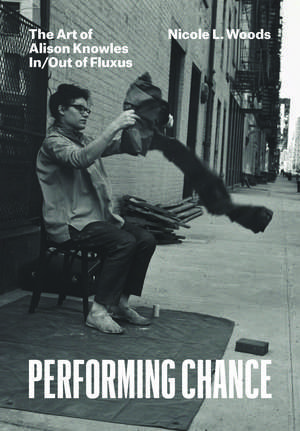
Performing Chance: The Art of Alison Knowles In/Out of Fluxus
Autor Nicole L. Woodsen Limba Engleză Hardback – 24 feb 2026
Alison Knowles stands out as the sole female artist among the founders of Fluxus, yet she has remained an enigmatic, underrecognized figure in the history of art. Performing Chance fills a gap in the record, bringing to light Knowles’s transformative body of work as it evolved from abstract painting in the late 1950s, to silkscreens, print media, and performance in the early 1960s, to groundbreaking works in digital poetry, acoustical art, and large-scale installations in the late 1960s-70s.
Through her access to previously unpublished archival materials and direct interviews with the artist, Nicole L. Woods provides close readings of pivotal works, disclosing the ways Knowles instituted formal tactics that moved beyond modernist painting, championed principles of indeterminacy and chance, and fostered sociopolitical consciousness. Situating Knowles’s innovations in various media within the distinct cultural contexts of Wiesbaden, London, Paris, New York City, and Los Angeles, Performing Chance brings this key artist back to her rightful place as a leader of the postwar avant-garde and provides a nuanced history of the role of women artists in Fluxus and beyond.
Preț: 331.30 lei
Precomandă
Puncte Express: 497
Preț estimativ în valută:
58.61€ • 69.11$ • 50.91£
58.61€ • 69.11$ • 50.91£
Carte nepublicată încă
Doresc să fiu notificat când acest titlu va fi disponibil:
Se trimite...
Specificații
ISBN-13: 9780226654942
ISBN-10: 022665494X
Pagini: 280
Ilustrații: 8 color plates, 95 halftones
Dimensiuni: 178 x 254 x 30 mm
Greutate: 0.85 kg
Editura: University of Chicago Press
Colecția University of Chicago Press
ISBN-10: 022665494X
Pagini: 280
Ilustrații: 8 color plates, 95 halftones
Dimensiuni: 178 x 254 x 30 mm
Greutate: 0.85 kg
Editura: University of Chicago Press
Colecția University of Chicago Press
V-ar putea interesa
-
 Fluxus Forms: Scores, Multiples, and the Eternal NetworkNatilee HarrenPreț: 401.93 lei
 -
 Sonic Flux: Sound, Art, and MetaphysicsChristoph CoxPreț: 216.63 lei
 -
 Fluxus Administration: George Maciunas and the Art of PaperworkColby ChamberlainPreț: 298.53 lei
 -
 Preț: 322.08 lei
 -
 Unspeakable ActsNancy PrincenthalPreț: 184.46 lei
 -
 Women in AbstractionKarolina Lewandowska-17%Preț: 351.66 lei423.59 lei
 -
 Performance ArtRoselee Goldberg-23%Preț: 143.09 lei186.75 lei
 -
 Yoko OnoLaurie Anderson-22%Preț: 250.13 lei321.26 lei
 -
 Yoko Ono: One Woman Show, 1960-1971Klaus Biesenbach-20%Preț: 233.66 lei290.43 lei
 -
 -31%Preț: 98.11 lei142.08 lei
 -
 Preț: 287.89 lei
 -
 FirespitterJayne CortezPreț: 168.50 lei
 -
 Preț: 184.17 lei
 -
 An Anecdoted Topography of ChanceDaniel Spoerri-29%Preț: 109.48 lei153.49 lei
 -
 Reframing Women PrintmakersPl HendersonPreț: 150.28 lei
 -
 Sex Is No EmergencyDorothy Max PriorPreț: 138.52 lei
 -
 Allen Jones MovesMark HudsonPreț: 345.70 lei
 -
 Pissing WomenSophy Rickett-20%Preț: 77.59 lei96.53 lei
 -
 Senga Nengudi: Populated AirMatilde Guidelli-Guidi-21%Preț: 236.19 lei299.33 leiNou
 -
 Begin Suddenly in SplendourRose English-21%Preț: 258.33 lei328.57 lei
Notă biografică
Nicole L. Woods is a Los Angeles–based art historian and critic. She is distinguished visiting professor of modern and contemporary art at Loyola Marymount University, Los Angeles.
Cuprins
Introduction
1 From Painting to Performance
2 Toward a Feminist Fluxus Score
3 The Provisional
4 Novel Environments
5 Object/Poem
Epilogue
Acknowledgments
Notes
Index
1 From Painting to Performance
2 Toward a Feminist Fluxus Score
3 The Provisional
4 Novel Environments
5 Object/Poem
Epilogue
Acknowledgments
Notes
Index
Recenzii
“Performing Chance unfurls the radical innovations of Alison Knowles, a pioneering force within Fluxus whose groundbreaking practice benefits from Woods’s sustained attention. Drawing from unprecedented access to Knowles’s archive and extensive interviews, Woods theorizes the artist’s ‘dialectics of chance’—a proto-feminist methodology that fundamentally reshaped understandings of chance operations, domestic labor, and the boundaries between art and life. From the artist’s influential textual propositions and food events to immersive environments and visionary experiments with computer-generated poetry, this richly detailed study positions Knowles at the forefront of key developments in contemporary art practice.”
“Meticulously researched and elegantly argued, Performing Chance is a timely and incisive contribution to contemporary art history. Woods restores Alison Knowles to the center of Fluxus and Intermedia, revealing how her nuanced performances transformed the vocabularies associated with feminine domesticity—houses, food, beauty products—into critical works of durational art. This vital study redefines Knowles not as a peripheral collaborator but as a formative force in the history of experimental media.”
“The first sustained account of Alison Knowles’s idiosyncratic, transformative oeuvre between 1958 and 1975, this book makes a case for feminist art history as a method of careful attention, one that permits both art and the individuals who make it to exceed the categories that would otherwise constrain them. Woods rigorously assembles a rich trove of archival material but never loses sight of the fact that Knowles is an artist of provisional, quotidian, and inconstant forms—a model of art historical precision without preciousness and formal insight against fixity.”