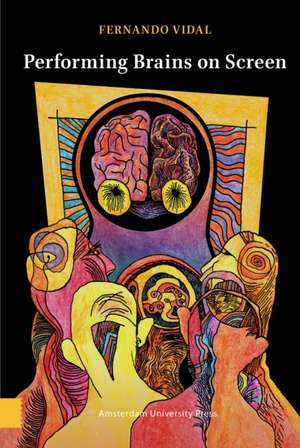
Performing Brains on Screen
Autor Fernando Vidalen Limba Engleză Hardback – 21 apr 2022
| Toate formatele și edițiile | Preț | Express |
|---|---|---|
| Paperback (1) | 301.33 lei 3-5 săpt. | |
| Taylor & Francis – dec 2025 | 301.33 lei 3-5 săpt. | |
| Hardback (1) | 757.22 lei 3-5 săpt. | +0.00 lei 7-13 zile |
| Taylor & Francis – 21 apr 2022 | 757.22 lei 3-5 săpt. | +0.00 lei 7-13 zile |
Preț: 757.22 lei
Preț vechi: 1071.41 lei
-29%
134.01€ • 156.62$ • 116.35£
Carte disponibilă
Livrare economică 30 ianuarie-13 februarie
Livrare express 16-22 ianuarie pentru 1010.44 lei
Specificații
ISBN-10: 9462989141
Pagini: 258
Dimensiuni: 156 x 234 x 20 mm
Greutate: 0.54 kg
Ediția:1
Editura: Taylor & Francis
Colecția Routledge
Locul publicării:Oxford, United Kingdom
V-ar putea interesa
-
 The Moral Authority of NatureLorraine DastonPreț: 317.97 lei
 -
 Preț: 317.15 lei
 -
 Readings of the Vessantara JatakaSteven CollinsPreț: 247.20 lei
 -
 Piaget before PiagetFernando Vidal-5%Preț: 667.02 lei702.13 lei
 -
 The Gothic Visionary PerspectiveBarbara Nolan-23%Preț: 733.92 lei953.15 lei
 -
 -23%Preț: 1013.49 lei1316.22 lei
 -
 The Theory of the ArtsFrancis Edward Sparshott-23%Preț: 1767.45 lei2295.39 lei
 -
 Being Brains – Making the Cerebral SubjectFernando VidalPreț: 234.50 lei
 -
 Endangerment, Biodiversity and CultureFernando Vidal-17%Preț: 348.48 lei418.88 lei
 -
 Film, Art, New Media: Museum Without Walls?: Museum Without Walls?Angela Dalle Vacche-15%Preț: 615.66 lei724.31 lei
 -
 Preț: 75.48 lei
 -
 Preț: 76.06 lei
 -
 Preț: 76.06 lei
 -
 Preț: 75.48 lei
 -
 Preț: 69.60 lei
 -
 Preț: 75.86 lei
 -
 Preț: 75.48 lei
 -
 Preț: 69.60 lei
 -
 Preț: 75.48 lei
 -
 Preț: 69.60 lei
 -
 Preț: 76.06 lei
 -
 Preț: 75.48 lei
 -
 Preț: 76.59 lei
 -
 NeuroculturesFrancisco Ortega-5%Preț: 615.64 lei648.04 lei
 -
 Der Königsweg der MusikWolfgang ZeitlerPreț: 140.57 lei
Public țintă
AcademicNotă biografică
Cuprins
Descriere
Performing Brains on Screen deals with film enactments and representations of the belief that human beings are essentially their brains, a belief that embodies one of the most influential modern ways of understanding the human. Films have performed brains in two chief ways: by turning physical brains into protagonists, as in the “brain movies” of the 1950, which show terrestrial or extra-terrestrial disembodied brains carrying out their evil intentions; or by giving brains that remain unseen inside someone’s head an explicitly major role, as in brain transplantation films or their successors since the 1980s, in which brain contents are transferred and manipulated by means of information technology. Through an analysis of filmic genres and particular movies, Performing Brains on Screen documents this neglected filmic universe, and demonstrates how the cinema has functioned as a cultural space where a core notion of the contemporary world has been rehearsed and problematized.