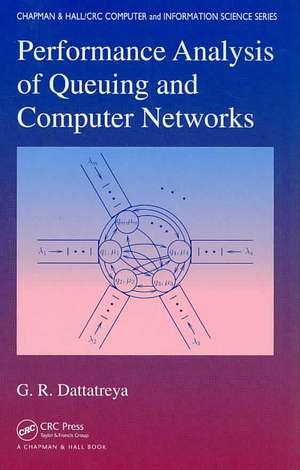
Performance Analysis of Queuing and Computer Networks: Chapman & Hall/CRC Computer and Information Science Series
Autor G.R. Dattatreyaen Limba Engleză Hardback – 9 iun 2008
| Toate formatele și edițiile | Preț | Express |
|---|---|---|
| Paperback (1) | 480.49 lei 6-8 săpt. | |
| CRC Press – 19 sep 2019 | 480.49 lei 6-8 săpt. | |
| Hardback (1) | 1188.88 lei 6-8 săpt. | |
| CRC Press – 9 iun 2008 | 1188.88 lei 6-8 săpt. |
Din seria Chapman & Hall/CRC Computer and Information Science Series
- 20%
 Preț: 1580.02 lei
 - 20%
 Preț: 346.63 lei
 - 20%
 Preț: 364.73 lei
 - 18%
 Preț: 857.62 lei
 - 20%
 Preț: 348.34 lei
 - 20%
 Preț: 539.75 lei
 - 18%
 Preț: 968.23 lei
 - 20%
 Preț: 563.72 lei
 - 20%
 Preț: 594.49 lei
 - 18%
 Preț: 1123.68 lei
 - 20%
 Preț: 386.61 lei
 - 20%
 Preț: 424.04 lei
 - 20%
 Preț: 363.61 lei
 - 18%
 Preț: 773.04 lei
 - 20%
 Preț: 480.49 lei
 - 20%
 Preț: 526.96 lei
 - 20%
 Preț: 565.58 lei
 - 32%
 Preț: 292.57 lei
 - 20%
 Preț: 478.08 lei
 - 20%
 Preț: 1022.71 lei
 - 34%
 Preț: 1303.56 lei
 - 33%
 Preț: 285.30 lei
 - 34%
 Preț: 1253.96 lei
 - 31%
 Preț: 303.00 lei
 - 34%
 Preț: 1264.42 lei
 - 34%
 Preț: 615.11 lei
 - 34%
 Preț: 1256.86 lei
 - 32%
 Preț: 509.73 lei
 - 35%
 Preț: 949.89 lei
 - 35%
 Preț: 893.47 lei
Preț: 1188.88 lei
Preț vechi: 1486.09 lei
-20%
Puncte Express: 1783
Preț estimativ în valută:
210.48€ • 245.08$ • 182.84£
210.48€ • 245.08$ • 182.84£
Carte tipărită la comandă
Livrare economică 23 februarie-09 martie
Preluare comenzi: 021 569.72.76
Specificații
ISBN-13: 9781584889861
ISBN-10: 1584889861
Pagini: 472
Ilustrații: 80 b/w images and 6 tables
Dimensiuni: 156 x 234 x 30 mm
Greutate: 1.03 kg
Ediția:1
Editura: CRC Press
Colecția Chapman and Hall/CRC
Seria Chapman & Hall/CRC Computer and Information Science Series
ISBN-10: 1584889861
Pagini: 472
Ilustrații: 80 b/w images and 6 tables
Dimensiuni: 156 x 234 x 30 mm
Greutate: 1.03 kg
Ediția:1
Editura: CRC Press
Colecția Chapman and Hall/CRC
Seria Chapman & Hall/CRC Computer and Information Science Series
Public țintă
Computer scientists, electrical engineers, practitioners in network companies, and undergraduate and graduate students in computer science, electrical engineering, and computer engineering.Cuprins
Introduction.Characterization of Data Traffic.The M/M/1/∞ Queue.State-Dependent Markovian Queues.The M/G/1 Queue.Discrete Time Queues. Continuous Time Queuing Networks.The G/M/1 Queue. Queues with Bursty, MMPP, and Self-Similar Traffic.Analysis of Fluid Flow Models. Appendix. Index.
Descriere
With examples and exercises, this text develops simple models and analyticalmethods from first principles to evaluate performance metrics of various configurations of computer systems and networks. It includes simple, analytically tractable models, such as optimization of saturated CSMA/CD and CSMA/CA LANs; presents models for complex systems as analyzable modifications and/or interconnections of simple models; and contains a wide variety of queuing models, including bursty, MMPP, approximate self-similar traffic, and fluid flow. The author also discusses timing and synchronization in the analysis of discrete time (slotted) networks.