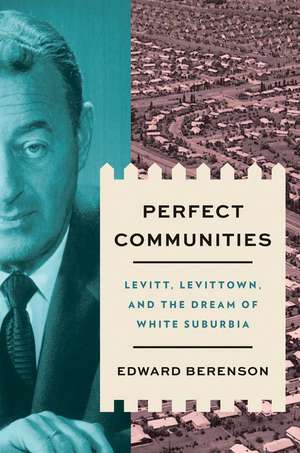
Perfect Communities: Levitt, Levittown, and the Dream of White Suburbia
Autor Edward Berensonen Limba Engleză Hardback – 22 apr 2025
Ne-a atras atenția modul în care Perfect Communities reușește să demistifice figura lui William J. Levitt, oferind o perspectivă mult mai critică și nuanțată decât volumele de istorie locală precum Levittown de Margaret Lundrigan Ferrer. Putem afirma că lucrarea lui Edward Berenson nu este doar o biografie, ci o analiză socio-economică a modului în care „Visul American” a fost proiectat pe baze de excluziune rasială. Autorul explorează cum producția de masă a caselor unifamiliale din anii '40, menită să rezolve criza locuințelor pentru veterani, a creat de fapt fundamentele inegalității de avere care persistă și astăzi în Statele Unite.
Merită menționat că Berenson aplică aici aceeași rigoare în analiza mecanismelor puterii și a carismei pe care am observat-o în lucrarea sa anterioară, Constructing Charisma. Dacă în Heroes of Empire – Five Charismatic Men and the Conquest of Africa autorul investiga fețele imperialismului, în Perfect Communities el disecă imperialismul domestic al suburbiei albe. Stilul narativ este precis, documentând transformarea casei dintr-un simbol al stabilității într-o marfă, proces care a dus la o expansiune urbană necontrolată.
Spre deosebire de Expanding the American Dream de Barbara M. Kelly, care se concentrează pe evoluția caselor ca artefacte culturale, Berenson pune accent pe deciziile politice și juridice ale lui Levitt. Este o alternativă necesară la istoriile pur tehnice despre construcții, evidențiind „partea întunecată” a eficienței industriale. Cartea oferă un portret tragic al unui om care a revoluționat modul de viață american, dar care a murit ruinat, victimă a propriului stil de viață extravagant și a investițiilor imprudente.
Preț: 207.85 lei
Carte disponibilă
Livrare economică 10-24 noiembrie
Livrare express 27-31 octombrie pentru 60.54 lei
Specificații
ISBN-10: 0300259549
Pagini: 424
Ilustrații: 41 b-w illus.
Dimensiuni: 156 x 235 x 33 mm
Greutate: 0.79 kg
Editura: Yale University Press
Colecția Yale University Press
De ce să citești această carte
Această carte este esențială pentru cei interesați de urbanism, istorie socială și mecanismele segregării. Cititorul va înțelege cum planificarea urbană postbelică a modelat nu doar peisajul geografic, ci și structura socială actuală. Este o recomandare solidă pentru studenții la istorie sau sociologie, oferind o lecție despre consecințele pe termen lung ale politicilor locative discriminatorii și despre fragilitatea succesului industrial.
Despre autor
Edward Berenson este profesor de istorie și director al Institutului de Studii Franceze de la Universitatea din New York. Cu o carieră dedicată cercetării mișcărilor politice și a figurilor carismatice, Berenson a publicat lucrări de referință precum Populist Religion and Left-Wing Politics in France și The Trial of Madame Caillaux. Expertiza sa în istoria culturală și politică îi permite să abordeze subiectul suburbiei americane dintr-o perspectivă academică riguroasă, integrând biografia individuală în contextul marilor transformări sociale ale secolului XX.
Descriere scurtă
Two material artifacts defined the middle-class American lifestyle in the mid-twentieth century: the automobile, which brought gas stations, highways, commercial strips, and sprawl; and the single-family suburban home, the repository of many families’ long-term wealth. While the man who did the most to make the automobile a mass commodity—Henry Ford—is well known, few know the story of the man who did the same for the suburban house.
Edward Berenson describes the remarkable career of William Levitt, who did more than anyone else to create the modern suburb. In response to an unprecedented housing shortage as veterans returned home from World War II, his Levittown developments provided inexpensive mass-produced housing that was wildly popular—prospective buyers would camp out in line for two days for the chance to put down a deposit on a Levitt house. He was a celebrity, a life-changing hero to tens of thousands, and the pitchman of a renewed American Dream. But Levitt also shared Ford’s dark side. He refused to allow Black people to buy or rent in his developments and doggedly defended this practice against legal challenges. Leading the way for other developers who emulated his actions, he helped ensure that suburbs nationwide remained white enclaves. These legacies are still with us. Levitt made a major contribution to the stubborn wealth disparity between white families and Black families, and his solution to the housing crisis of the 1940s—the detached house and surrounding yard—is a primary cause of the housing crisis today.
As a person, Levitt was a strangely guileless and tragic figure. He accumulated vast wealth but, after losing control of his building company, surrendered it all through foolish investments and a lavish lifestyle that included a Long Island mansion and a two-hundred-foot yacht. Just weeks before his death, as a charity patient in a hospital to which he had once given millions, he was still imagining his great comeback.
Recenzii
“[An] outstanding book.”—Stephen Whitfield, Jewish Book Council
“The sun barely set on the Levitt family’s global real estate empire, from Long Island and the East Coast to far flung outposts in Puerto Rico and France. Perfect Communities is a compelling history of how Levittowns remade suburbia and attempted to remake the world.”—Thomas J. Sugrue, author of The Origins of the Urban Crisis
“More than 10,000 independent suburbs surround the major cities of the United States. Some are widely known, but Levittown is the most famous of them all. The effort had obvious shortcomings, but the Levittown homes were affordable, and they turned dreams into realities for families that were desperate for space. With clarity and precision, Perfect Communities tells a remarkable story of how our modern nation came to be.”—Kenneth T. Jackson, Barzun Professor Emeritus of History, Columbia University
“Perfect Communities provides an insightful analysis of the rise and fall of William Levitt and his Levittown developments. It makes an important contribution to the scholarship of housing, suburbanization, racial segregation, and Levittowns’ role in these dynamics of metropolitan development.”—Gregory D. Squires, editor of The Fight for Fair Housing: Causes, Consequences, and Future Implications of the Federal Fair Housing Act