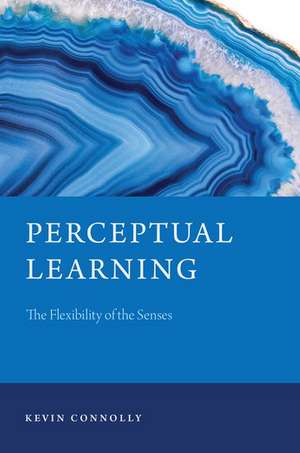
Perceptual Learning: The Flexibility of the Senses: Philosophy of Mind Series
Autor Kevin Connollyen Limba Engleză Hardback – 21 mar 2019
Din seria Philosophy of Mind Series
- 22%
 Preț: 522.39 lei
- 17%
 Preț: 213.76 lei
- 28%
 Preț: 404.42 lei
- 6%
 Preț: 379.39 lei
- 31%
 Preț: 663.94 lei
- 12%
 Preț: 298.08 lei
- 22%
 Preț: 531.14 lei
- 28%
 Preț: 451.38 lei
- 11%
 Preț: 338.83 lei
- 31%
 Preț: 773.12 lei
- 11%
 Preț: 332.37 lei
- 28%
 Preț: 537.95 lei
- 17%
 Preț: 145.41 lei
- 13%
 Preț: 272.06 lei
- 13%
 Preț: 250.13 lei
- 31%
 Preț: 694.63 lei
- 12%
 Preț: 254.53 lei
- 11%
 Preț: 384.90 lei
- 31%
 Preț: 662.60 lei
- 31%
 Preț: 574.88 lei
- 13%
 Preț: 292.95 lei
- 11%
 Preț: 381.74 lei
- 31%
 Preț: 660.14 lei
- 11%
 Preț: 352.66 lei
- 12%
 Preț: 343.10 lei
- 31%
 Preț: 726.96 lei
- 18%
 Preț: 263.07 lei
- 28%
 Preț: 430.49 lei
- 34%
 Preț: 664.38 lei
- 19%
 Preț: 356.59 lei
- 34%
 Preț: 667.02 lei
- 31%
 Preț: 775.65 lei
- 21%
 Preț: 656.13 lei
- 31%
 Preț: 661.46 lei
- 31%
 Preț: 589.47 lei
- 20%
 Preț: 277.07 lei
- 29%
 Preț: 714.65 lei
- 34%
 Preț: 599.73 lei
- 35%
 Preț: 583.67 lei
- 31%
 Preț: 641.41 lei
Preț: 549.96 lei
Preț vechi: 764.95 lei
-28%
Puncte Express: 825
Carte tipărită la comandă
Livrare economică 03-08 decembrie
Livrare prin curier în România Termenul estimat este afișat lângă disponibilitate.
Transport gratuit pentru acest produs Plată online sau ramburs, în funcție de opțiunile comenzii.
Retur gratuit în 14 zile Comandă securizată și suport în română.
Specificații
ISBN-13: 9780190662899
ISBN-10: 0190662891
Pagini: 272
Dimensiuni: 213 x 142 x 25 mm
Greutate: 0.45 kg
Editura: Oxford University Press
Colecția OUP USA
Seria Philosophy of Mind Series
Locul publicării:New York, United States
ISBN-10: 0190662891
Pagini: 272
Dimensiuni: 213 x 142 x 25 mm
Greutate: 0.45 kg
Editura: Oxford University Press
Colecția OUP USA
Seria Philosophy of Mind Series
Locul publicării:New York, United States
Notă biografică
Kevin Connolly is a cognitive scientist and philosopher who works on learning. His research focuses especially on perception-based learning, as found in experts from wine tasters to radiologists to bird watchers. He is currently an Assistant Professor of Psychology at Minerva Schools at KGI-a new university founded on the principles of the science of learning-where he plays a central role in curriculum design for the School of Social Sciences. Prior to Minerva he was an Andrew W. Mellon Postdoctoral Fellow at the University of Pennsylvania.
Cuprins
- PREFACE
- PART 1. THE NATURE OF PERCEPTUAL LEARNING
- I. HOW TO UNDERSTAND PERCEPTUAL LEARNING
- 1.1 Introduction
- 1.2 What Is Perceptual Learning?
- 1.3 A Taxonomy of Perceptual Learning Cases
- 1.4 The Offloading View of Perceptual Learning
- 1.5 Looking Ahead
- II. IS PERCEPTUAL LEARNING GENUINELY PERCEPTUAL?
- 2.1 Introduction
- 2.2 Skepticism about Perceptual Learning as Genuinely Perceptual
- 2.3 Introspective Evidence that Perceptual Learning Is Genuinely Perceptual
- 2.4 Neuroscientific Evidence that Perceptual Learning Is Genuinely Perceptual
- 2.5 Behavioral Evidence that Perceptual Learning Is Genuinely Perceptual
- 2.6 Conclusion
- PART 2. THE SCOPE OF PERCEPTUAL LEARNING
- III. LEARNED ATTENTION AND THE CONTENTS OF PERCEPTION
- 3.1 Introduction
- 3.2 The Phenomenal Contrast Argument
- 3.3 The Attentional Reply to the Phenomenal Contrast Argument
- 3.4 The Blind Flailing Model of Perceptual Learning
- 3.5 A New Attentional Reply to the Phenomenal Contrast Argument
- 3.6 Learned Attention and the Offloading View
- IV. LEARNED ATTENTION II: SENSORY SUBSTITUTION
- 4.1 Introduction
- 4.2 Attentional Weighting in Distal Attribution
- 4.3 Latent Inhibition as a Kind of Learned Attention
- 4.4 Applying Principles of Attentional Training to Sensory Substitution
- 4.5 Perceptual Learning and Perceptual Hacking
- 4.6 An Empirical Test for Determining the Nature of SSD Experience
- 4.7 Conclusion
- V. "CHUNKING" THE WORLD THROUGH MULTISENSORY PERCEPTION
- 5.1 Introduction
- 5.2 The Kind of Conscious Awareness We Have in Multisensory Perception
- 5.3 Unitization as a Perceptual Learning Mechanism
- 5.4 Applying Unitization to Multisensory Cases
- 5.5 Objections and Replies
- 5.6 Unitization and the Offloading View
- 5.7 Conclusion
- VI. LEARNING TO DIFFERENTIATE PROPERTIES: SPEECH PERCEPTION
- 6.1 Introduction
- 6.2 The Phenomenal Contrast Argument for Hearing Meanings
- 6.3 The Argument from Homophones
- 6.4 The Role of Differentiation in Speech Perception
- 6.5 Why Perceptual Learning Does Not Support the View that We Hear Meanings
- 6.6 The Offloading View and Speech Perception
- 6.7 Conclusion
- VII. LEARNING TO DIFFERENTIATE OBJECTS: THE CASE OF MEMORY COLOR
- 7.1 Introduction
- 7.2 Memory Color and Cognitive Penetration
- 7.3 A Brief Survey of Memory Color Studies
- 7.4 Why Memory Color Is Not a Mechanism for Color Constancy
- 7.5 Applying Differentiation to Memory Color
- 7.6 Memory Color and the Offloading View
- 7.7 Conclusion
- CONCLUSION: PERCEPTUAL LEARNING BEYOND PHILOSOPHY OF MIND
- ACKNOWLEDGEMENTS
- REFERENCES