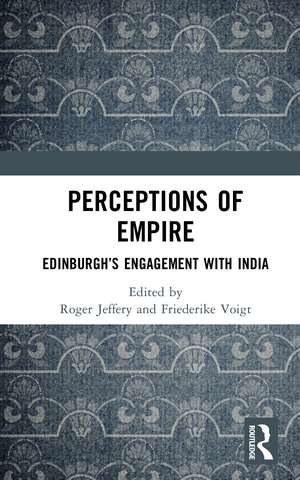
Perceptions of Empire: Edinburgh’s Engagement with India
Editat de Roger Jeffery, Friederike Voigten Limba Engleză Hardback – 14 ian 2027
- Explores Edinburgh's historical connections with India and South Asia.
- Examines colonialism, cultural exchange, and diaspora.
- Highlights contributions of South Asians in Edinburgh during the 1960s–80s.
- Discusses key figures such as William Robertson and Alexander Duff.
- Provides insights into missionary work and student politics.
Preț: 1127.23 lei
Preț vechi: 1485.35 lei
-24% Precomandă
Puncte Express: 1691
Carte nepublicată încă
Livrare prin curier în România Precomanda se expediază când titlul devine disponibil.
Transport gratuit pentru acest produs Plată online sau ramburs, în funcție de opțiunile comenzii.
Retur gratuit în 14 zile Comandă securizată și suport în română.
Doresc să fiu notificat când acest titlu va fi disponibil:
Se trimite...
Specificații
ISBN-13: 9781041456520
ISBN-10: 1041456522
Pagini: 308
Ilustrații: 40
Dimensiuni: 138 x 216 mm
Ediția:1
Editura: Taylor & Francis
Colecția Routledge
Locul publicării:Oxford, United Kingdom
ISBN-10: 1041456522
Pagini: 308
Ilustrații: 40
Dimensiuni: 138 x 216 mm
Ediția:1
Editura: Taylor & Francis
Colecția Routledge
Locul publicării:Oxford, United Kingdom
Public țintă
Academic, General, Postgraduate, and Undergraduate AdvancedNotă biografică
Roger Jeffery is Professor Emeritus of Sociology at the University of Edinburgh, Scotland. He specializes in South Asian studies, with a focus on health, education, and social change in India. Professor Jeffery has conducted extensive fieldwork in India and has published widely on topics such as caste, gender, and development. His work bridges sociology and anthropology, offering nuanced insights into the complexities of Indian society. He has contributed to numerous edited volumes and journals, establishing himself as a leading scholar in the field of South Asian studies.
Friederike Voigt is Curator of South Asian and Himalayan collections at National Museums Scotland, Edinburgh, Scotland. She holds expertise in material culture, colonial history, and the cultural heritage of South Asia. Her research focuses on the intersection of art, history, and anthropology, particularly in the context of colonial encounters and their legacies. Friederike has curated several exhibitions and contributed to academic publications that explore the rich cultural heritage of South Asia and its global connections.
Friederike Voigt is Curator of South Asian and Himalayan collections at National Museums Scotland, Edinburgh, Scotland. She holds expertise in material culture, colonial history, and the cultural heritage of South Asia. Her research focuses on the intersection of art, history, and anthropology, particularly in the context of colonial encounters and their legacies. Friederike has curated several exhibitions and contributed to academic publications that explore the rich cultural heritage of South Asia and its global connections.
Cuprins
1. Edinburgh’s Indian heritage (by Roger Jeffery) 2. William Robertson: A ‘moderate’ view of India 3. John Borthwick Gilchrist: Advice to Hindustani language students 4. Maria Dundas’ residence in India 5. James Mill: Hindus, ‘the most enslaved portion of the human race’ 6. Margaret Tytler: Skilled work and the division of labour in Bihar (by Friederike Voigt) 7. George Paterson: Edinburgh, phrenology and the Hindus 8. Sir Walter Scott and India 9. Margaret Bayne Wilson: Missionary letters from India 10. Alexander Duff: Mission and mutiny 11. John Heiton: Edinburgh’s caste of India-returned, 1859 12. William Wilson Hunter and England’s Work in India 13. Prafulla Chandra Ray: Nationalist chemist 14. William Burn Murdoch: Sketching in India, 1905–06 15. Student politics and racism in Edinburgh, 1900–30 16. Victor Kiernan: A Marxist historian in Edinburgh 17. South Asians in Edinburgh, 1960s–80s 18. Afterword References Index
Descriere
This book explores Edinburgh's deep historical connections with India and South Asia, spanning the 18th to 20th centuries. Through the lives of key figures such as William Robertson, Maria Dundas, and Alexander Duff, it examines themes of colonialism, cultural exchange, missionary work, and the South Asian diaspora.